Outline
- What is the real business risk behind a “non-renewal” email, and how do you model it as a single point of failure?
- Which commercial leasing dynamics in Singapore create renewal uncertainty that SMEs often underestimate?
- What lease-protection terms should you push for if you want renewal risk to be manageable (without over-lawyering it)?
- How do you build a renewal-risk dashboard that tells you what to do at T-12, T-9, and T-6 months?
- How should you gate capex, staffing, and marketing so you don’t invest into uncertainty?
- What financial controls keep you solvent if you get a short extension or forced move?
- How do you reduce landlord dependency with diversification and digital revenue buffers—without distracting the team?
- When renewal risk spikes, what crisis-communications plan protects brand and cashflow without burning bridges?
- What should your management action plan look like for 2027 readiness—starting this quarter?
- Conclusion
- Want a renewal-risk plan you can actually run monthly?
- FAQs
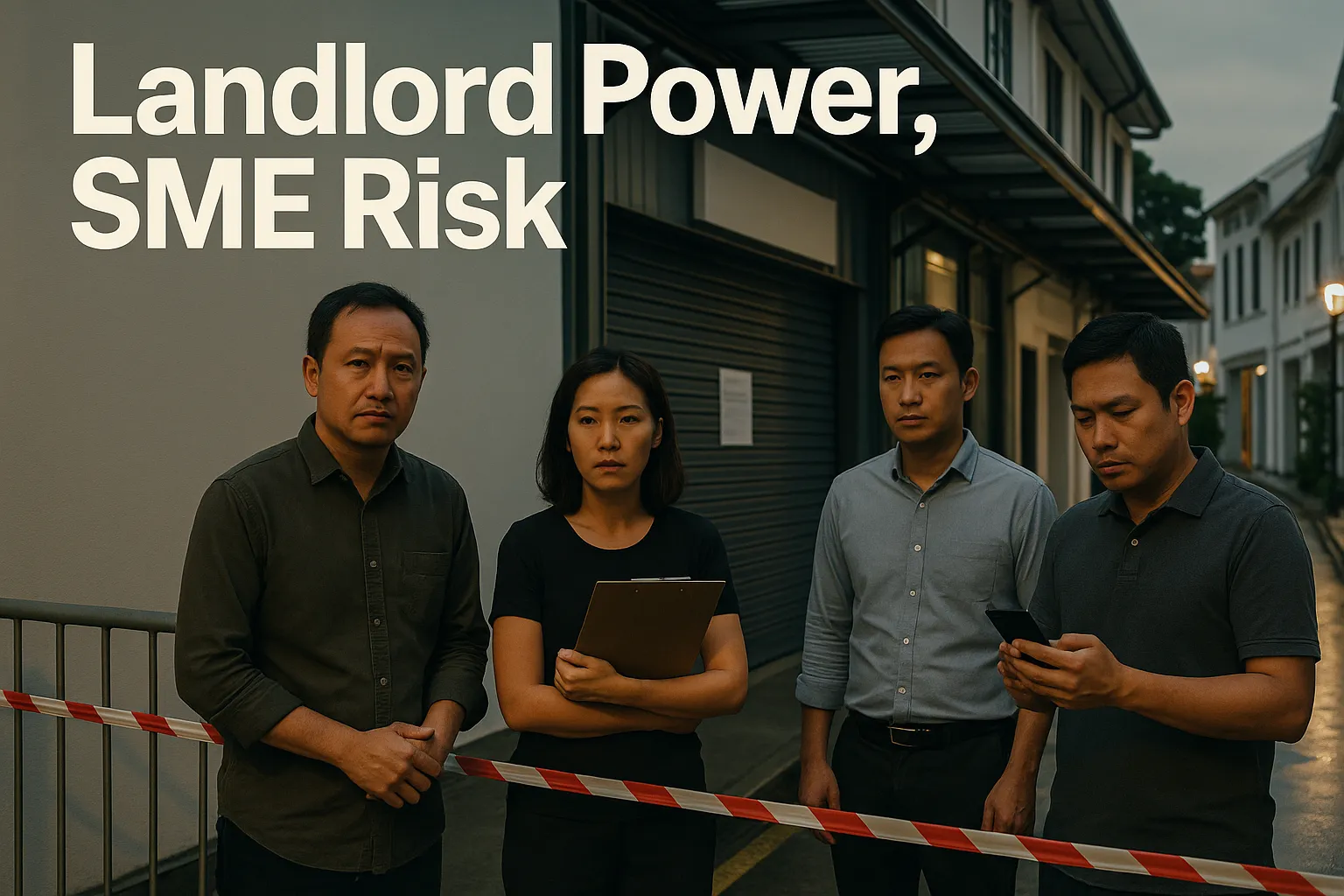
The Punggol East container-park lease saga is a timely reminder that for many location-dependent Singapore brands, “renewal” is not an admin task—it’s a single decision by a landlord that can reset your entire operating plan. For founders running Singapore SME leases in F&B, lifestyle, sports and concept retail, short extensions, redevelopment risk, master-tenant structures and opaque renewal decisions can turn a profitable outlet into a stranded asset overnight: staff rosters, fit-out payback, marketing calendars, even supplier commitments stop making sense. The practical problem isn’t only negotiating harder—it’s building controls so renewal risk is detected early, decisions are gated, and cashflow survives a forced move. This guide turns the episode into an implementation playbook: lease levers to ask for, early-warning triggers to monitor, capex and hiring gates to enforce, revenue buffers to build, and a crisis-communications plan that protects brand and liquidity when renewal risk spikes.
What is the real business risk behind a “non-renewal” email, and how do you model it as a single point of failure?
Treat landlord renewal discretion as an enterprise risk, not a one-off negotiation.
The single-point-of-failure model (location-dependent SMEs)
If one outlet (or one landlord) contributes an outsized share of revenue, your business can fail not because demand drops—but because permission to trade disappears.
Use a simple dependency score:
- Revenue concentration: % of total revenue and gross profit from the site
- Brand concentration: how much your brand identity is tied to the site (tourist footfall, “destination” effect)
- Asset lock-in: how much value is trapped in the fit-out, signage, specialised equipment, and layout
- Operational stickiness: staff who live nearby, training investment, local partnerships
- Timeline risk: time needed to secure and open a replacement location vs notice period
A common trap in Singapore: a concept looks “diversified” because it has multiple revenue streams, but is still landlord-dependent because the flagship site drives marketing reach, influencer content, and bulk of first-time customer acquisition.
Translate the risk into management questions
Once you quantify dependency, the questions become operational:
- If we get 6 months’ notice, can we relocate without cash crunch?
- If we get 1 year extension, do we invest more, or freeze and harvest cash?
- If renewal is uncertain until late, what decisions must be pre-approved with gates?
Output you want: a clear internal stance such as:
- “This site is Tier 1 critical. We plan on the assumption that renewal is uncertain unless confirmed by T-9 months.”
- “We will not approve capex with payback longer than remaining lease term minus a safety buffer.”
Which commercial leasing dynamics in Singapore create renewal uncertainty that SMEs often underestimate?
You don’t need to turn into a lawyer to plan for how Singapore commercial leasing tends to work.
Patterns that increase renewal uncertainty
- Short renewal cycles: even strong tenants can be offered short extensions that don’t match investment horizons.
- Redevelopment / repositioning risk: landlords may redesign tenant mix, change the concept, or re-tender.
- Master-tenant scenarios: your “landlord” may be a master tenant managing the site under its own constraints; renewal decisions can be opaque and timeline-sensitive.
- Tender / re-bid processes: some sites move to periodic tenders; operational continuity is not guaranteed.
- Footfall and concept risk: container-park and experiential formats are especially vulnerable—if the overall concept changes, individual tenants lose negotiating leverage.
What founders often misread
- “We’re performing well, so renewal is likely.” Performance helps, but isn’t a control.
- “They’ll tell us early.” Without a contractual timeline, early notice is goodwill, not obligation.
- “We can move quickly if needed.” In Singapore, the time from site search to opening can be long once you include renovation lead times, landlord approvals, and operational readiness.
The objective is not to predict landlord decisions. It’s to design your business so late decisions don’t destroy your cashflow and brand.
What lease-protection terms should you push for if you want renewal risk to be manageable (without over-lawyering it)?
Lease clauses don’t eliminate risk, but they can reduce ambiguity and buy time—two things operators need to protect cashflow.
Below are commercial levers to discuss early. The exact drafting belongs with your legal counsel; the management job is knowing what to ask for and what you’re trading away.
1) Renewal process and timeline (make the decision date real)
Aim for clarity on:
- When renewal discussions start (e.g., landlord to respond by a certain date)
- Notice periods for non-renewal
- Information requirements (what performance data or proposals are needed)
Why it matters: it turns renewal from a surprise into a scheduled decision you can plan around.
2) Option-to-renew mechanics (reduce discretion where possible)
Where you have leverage, explore:
- An option to renew exercisable by the tenant
- A clear method for setting rent on renewal (even if it references market rent with a process)
Even when a full option isn’t realistic, you can sometimes negotiate a first right to negotiate with defined timelines.
3) Notice periods and “extension while negotiating”
Operationally, the killer is late notice. Consider:
- A longer non-renewal notice period
- A short rolling extension (e.g., month-to-month) at defined rent while both parties finalise documentation
This helps avoid a cliff-edge where you must decide on capex/hiring without certainty.
4) Assignment and subletting flexibility (your exit and pivot valve)
Ask what flexibility exists to:
- Assign the lease if you sell the outlet
- Sublet part of the space
- Add or change concepts within a permitted use range
This is less about “getting out” and more about preserving options if the site economics change.
5) Fit-out, reinstatement, and amortisation realities
These terms determine how expensive leaving becomes.
- Reinstatement scope: what exactly must be removed and restored?
- Make-good standards: clarity reduces last-minute disputes and surprise costs
- Fit-out amortisation thinking: if the lease term is short, your capex must be treated as higher risk; negotiate on what you can control (scope, approvals, salvage)
6) Relocation rights (if the landlord reconfigures the site)
If the landlord may redevelop or reshuffle, discuss:
- Whether the landlord can relocate you
- Who pays for relocation, downtime, and fit-out impact
- Whether you can terminate instead
7) Signage and trading environment commitments (where feasible)
Not all landlords will agree, but it’s legitimate to discuss:
- Signage visibility and wayfinding
- Access, operating hours, event calendars
- Temporary works that materially reduce footfall and what relief applies
Negotiation reality check: trade-offs you should pre-decide
Every additional protection usually costs something (rent, term, deposit, restrictions). Decide internally:
- Which protections are must-have vs nice-to-have
- What you’re willing to trade (e.g., higher base rent vs longer certainty)
This prevents founders from conceding the wrong thing under time pressure.
How do you build a renewal-risk dashboard that tells you what to do at T-12, T-9, and T-6 months?
The most practical control is a dashboard that forces earlier decisions than your emotions would.
Build a simple dashboard (owner: Ops + Finance)
Track these fields for each outlet:
- Lease end date, break clauses, notice periods
- Renewal milestones (contractual or expected)
- Fit-out book value (management estimate) and remaining payback
- Reinstatement exposure (low/med/high with notes)
- Staff dependency (headcount, key roles, distance-to-work sensitivity)
- Revenue and gross margin by outlet
- Local competition changes and footfall signals
- Landlord relationship map (who decides, who influences)
Keep it visible: monthly leadership meeting, not buried in a folder.
Define trigger dates and required outputs
T-12 months (strategy lock)
- Output: “Renew / Relocate / Reduce exposure” plan for the outlet
- Actions:
- Request renewal discussion timeline in writing
- Update reinstatement and move-cost estimate
- Freeze any capex without CFO/owner sign-off
T-9 months (decision pressure test)
- Output: A “go/no-go” package for capex, hiring, and marketing for the remaining term
- Actions:
- Identify 3–5 alternative sites (even if imperfect)
- Start landlord stakeholder mapping (who signs, who manages)
- Build a transition budget and confirm cash buffer availability
T-6 months (execution readiness)
- Output: Launch-ready relocation plan OR confirmed renewal terms
- Actions:
- If renewal unclear: activate relocation pipeline (site visits, preliminary layouts, vendor quotes)
- Prepare customer comms draft and operational migration checklist
- Confirm supplier contract flexibility and lead times
Document trail as a control (not paperwork)
Keep a renewal folder containing:
- Key emails and meeting notes
- Proposed terms exchanged
- Performance decks you provided
- Any commitments or statements made
Why this matters: it reduces “he-said-she-said”, helps your advisors move faster, and keeps leadership aligned.
How should you gate capex, staffing, and marketing so you don’t invest into uncertainty?
This is where many SMEs lose money: they keep operating as if renewal is certain, then discover they’ve funded improvements the next tenant benefits from.
Capex gates (fit-out, equipment, upgrades)
Use three rules:
- Payback rule: Don’t approve capex with payback longer than the remaining committed term minus a safety buffer (many operators use 3–6 months as a buffer, depending on lead times).
- Portability rule: Prefer assets you can move—equipment, modular fixtures, reusable signage.
- Split funding rule: If an upgrade benefits the landlord or the site more than your brand (e.g., structural improvements), require either a longer term, contribution, or rent adjustment—otherwise treat as a red flag.
Implementation tip: maintain a “capex classification” list:
- Portable (moveable)
- Semi-portable (partial salvage)
- Sunk (cannot salvage)
Approve sunk capex only under high renewal certainty.
Staffing gates (hiring, training, retention spend)
Renewal uncertainty is not a reason to under-invest in service quality—but it is a reason to adjust commitments.
- Convert part of the workforce plan into flex capacity (cross-trained part-timers, redeployable roles).
- Identify critical staff you must retain and build a redeployment plan if relocation happens.
- Avoid expanding headcount purely to support a marketing spike if the outlet may close before the spike pays back.
Marketing gates (campaign calendars and partnerships)
Marketing is often booked 2–6 months ahead. Controls to adopt:
- Campaign approval windows: any campaign extending beyond T-6 months requires a renewal-confidence check.
- Contract clauses with partners: reschedule rights, location-change provisions.
- Asset strategy: invest in brand assets and content that transfer across locations, not only site-specific builds.
The objective is not to stop investing. It’s to stop making irreversible commitments without matching certainty.

What financial controls keep you solvent if you get a short extension or forced move?
Renewal risk becomes a cashflow problem long before it becomes a PR problem.
1) Fit-out amortisation planning (management view)
Even if your accounting treatment differs, for decision-making you need a practical payback view:
- Estimate total fit-out and opening costs (including pre-opening payroll, marketing, deposits)
- Divide by expected gross profit contribution to compute a “months to recover”
- Recalculate whenever renewal term shortens
If you’re offered a one-year extension, your question is: “Can we recover incremental investment within that year while maintaining optionality?”
2) Break-even under shortened terms
Create a “short-term break-even” scenario:
- What cost base can you reduce in 30–60 days if closure becomes likely?
- Which costs are fixed (rent, minimum utilities, core staff) vs variable?
- What minimum revenue keeps the outlet cash-positive while you plan the next step?
This helps you avoid pouring good money after bad when the rational move is to harvest cash and prepare.
3) Cash buffer sizing linked to real exit costs
A useful buffer model is:
- Reinstatement and make-good estimate (with a contingency)
- Move-out and storage costs
- New site deposits and initial fit-out tranche (if relocating)
- Working capital gap during downtime (payroll, supplier settlements)
Founders often budget for the new fit-out but forget the double-cost period: paying out the old obligations while starting the new site.
4) “Exit budget” as a standing line item
Treat exit costs like an inevitable future cost, not a surprise:
- Maintain a rolling estimate per outlet
- Update quarterly
- Include it in pricing and margin discussions
This isn’t pessimism—it’s realism for businesses where landlord decisions can accelerate timelines.
How do you reduce landlord dependency with diversification and digital revenue buffers—without distracting the team?
Diversification is a control only if it is designed, resourced, and measured. Otherwise it becomes a side project.
Diversification that actually reduces risk
1) Location portfolio design (small steps first)
- Avoid having one outlet contribute an extreme share of revenue.
- When opening a second or third site, prioritise different landlord exposure and different footfall drivers (e.g., office crowd vs residential vs destination).
- Consider “satellite” formats: smaller footprints, kiosks, pop-ups that test demand with lower fit-out risk.
2) Contract-light channels that travel with you Digital and off-site revenue won’t replace a great location overnight, but it can stabilise cashflow during disruption:
- Online bookings and pre-paid packages (where suitable)
- Memberships (class-based sports concepts, lifestyle services)
- Corporate packages and private events
- Delivery or catering if operationally consistent with your brand
The control is the transferability: revenue streams that survive a location change.
Implementation discipline: treat buffers like products
Assign an owner and targets:
- One channel owner (not “everyone”)
- A monthly KPI (e.g., % revenue from transferable channels)
- A simple operating rhythm: test, measure, refine
Common failure: launching e-commerce or memberships without operational capacity, leading to refunds, service issues, and brand damage.
If you use tools/automation (CRM, booking systems, marketing automation), plan for:
- Data hygiene (customer records, consent management)
- Integration with POS/booking
- Staff training and adoption
- Security and access controls
The goal is not digital transformation for its own sake. It’s continuity: customers can still find you, book you, and pay you even if the physical address changes.
When renewal risk spikes, what crisis-communications plan protects brand and cashflow without burning bridges?
Public narrative can influence outcomes, but it also carries risks: landlord relationships, customer expectations, and staff morale.
Build a comms plan before you need it
Have a ready kit:
- A one-page holding statement (neutral, factual)
- A customer FAQ draft (where are you operating, what happens to bookings/packages)
- A staff briefing note (what we know, what we don’t, what changes now)
- A partner/supplier note (continuity, payment terms, operational changes)
Principles for communication under uncertainty
- Separate facts from hopes: don’t promise renewal or relocation dates you can’t control.
- Protect cashflow: prioritise messages that reduce cancellations and refund spikes.
- Keep optionality: avoid statements that corner the landlord publicly unless you’ve decided the relationship is no longer strategic.
- One spokesperson: reduce inconsistency; log inbound media/customer queries.
Decision framework: private escalation vs public pressure
Go public only after you’ve assessed:
- Your legal and contractual constraints (with counsel where appropriate)
- The probability of a negotiated outcome
- The reputational upside vs long-term landlord ecosystem cost
In Singapore’s tight commercial ecosystem, burning bridges can affect future sites. That doesn’t mean you stay silent; it means you choose a controlled approach.
Operational comms that many teams forget
- Update Google/Apple listings, booking pages, delivery platforms quickly if address changes.
- Make sure frontline staff have a script for customer questions.
- If you sell packages/memberships, prepare a continuity offer (transfer to new site, extend validity) to reduce refund demand.
Well-managed comms is a cashflow control: it reduces panic-driven cancellations and keeps staff focused.
What should your management action plan look like for 2027 readiness—starting this quarter?
Renewal risk engineering works when it is scheduled and owned, not improvised.
Step 1: Classify every outlet by renewal risk (2 weeks)
Owner: CEO/COO + Finance
- Tier outlets by revenue concentration and asset lock-in
- Identify which leases have the highest “cliff risk” in the next 12–24 months
Deliverable: a one-page portfolio risk map.
Step 2: Install the renewal-risk dashboard and trigger calendar (30 days)
Owner: Ops
- Centralise lease dates, notice periods, and key contacts
- Create T-12/T-9/T-6 tasks in a shared system
- Set monthly review cadence
Deliverable: live dashboard reviewed at leadership meetings.
Step 3: Put decision gates into your approval workflows (30–60 days)
Owner: Finance
- Capex request form updated to include: remaining lease term, payback months, portability class
- Hiring plans include: redeployability and closure scenario
- Marketing plans include: campaign horizon vs lease certainty
Deliverable: approvals can’t proceed without lease-risk fields completed.
Step 4: Build the exit budget and buffer policy (60–90 days)
Owner: Finance
- Reinstatement/move-cost estimates refreshed
- Buffer target agreed (linked to outlet tier)
- Identify funding sources (operating cash, revolving facility, owner injections—whatever fits your business)
Deliverable: quarterly updated “exit exposure” report.
Step 5: Create the continuity channels roadmap (next 2 quarters)
Owner: Commercial lead
- Pick 1–2 transferable revenue buffers to prioritise
- Set KPIs and assign owners
- Implement tools with training, data discipline, and clear operating playbooks
Deliverable: measurable share of revenue that is not address-dependent.
Where Paul Hype Page & Co. fits (without turning this into a legal exercise)
For many SMEs, the failure point isn’t knowing the risk—it’s executing the controls across finance, ops, payroll implications during transitions, and cashflow planning. Paul Hype Page & Co. often supports clients by:
- building lease-risk dashboards and decision gates into monthly management routines
- stress-testing outlet economics under shortened terms and move scenarios
- helping teams organise the documentation trail and stakeholder map so renewals run as a managed project, not a scramble
This sits alongside (not instead of) your legal counsel for clause drafting and disputes.
Conclusion
If your concept is tied to a physical site, landlord renewal discretion is not background noise—it’s a runway variable. The practical response in Singapore isn’t simply “negotiate harder”; it’s to engineer the risk down with controls: lease levers that force earlier clarity, a renewal-risk dashboard with T-12/T-9/T-6 triggers, approval gates that stop irreversible capex and hiring into uncertainty, and financial buffers that reflect real exit costs. At the same time, build revenue channels and a comms kit that travel with you so a location change doesn’t become a brand collapse. Start this quarter: classify outlet dependency, calendar the trigger dates, and make renewal readiness a standing item in management meetings—before the next short extension forces decisions on someone else’s timeline.
FAQs
Focus on a clear renewal process and timeline, non-renewal notice periods, interim extensions while negotiating, assignment/subletting flexibility, clarity on reinstatement scope, and (where relevant) relocation rights.
Prepare a holding statement, customer FAQ for bookings/packages, staff briefing note, and partner/supplier note; stick to verified facts, protect cashflow by reducing cancellations/refunds, and keep one spokesperson while you maintain negotiation optionality.
It’s a single point of failure: revenue stops while you still face exit costs (reinstatement, deposits, downtime), and you may lose staff, customers, and marketing momentum before a replacement site is ready.
Avoid sunk capex with payback beyond the remaining committed term minus a buffer, prioritise portable assets, require extra sign-off for long-horizon marketing, and design staffing with redeployable roles and a retention plan for critical staff.
Start at T-12 months with a clear “renew / relocate / reduce exposure” plan, tighten capex approvals, and request the landlord’s renewal timeline in writing, then pressure-test decisions again at T-9 and T-6 months.
Share This Story, Choose Your Platform!
Related Business Articles