Outline
- What actually breaks first in a deposit-driven renovation business—profit, cash, or trust?
- How do ‘new deposits funding old jobs’ patterns form—and why is it a hidden insolvency risk?
- What does ‘ringfencing project cash’ mean in practice for a Singapore renovation SME?
- How should milestone billing be designed so collections match real delivery (not sales optimism)?
- What are the early-warning indicators of overtrading in Singapore project SMEs?
- How do you implement capacity discipline before accepting the next contract?
- How should payroll and CPF be governed so cash stress doesn’t become an enforcement event?
- What crisis communication controls protect customer trust when timelines slip?
- How do you run a cash-stabilisation plan without creating more unfinished sites?
- What internal controls and systems upgrades give the fastest risk reduction (without heavy ERP spend)?
- Conclusion
- Need help implementing deposit and project cash controls?
- FAQs
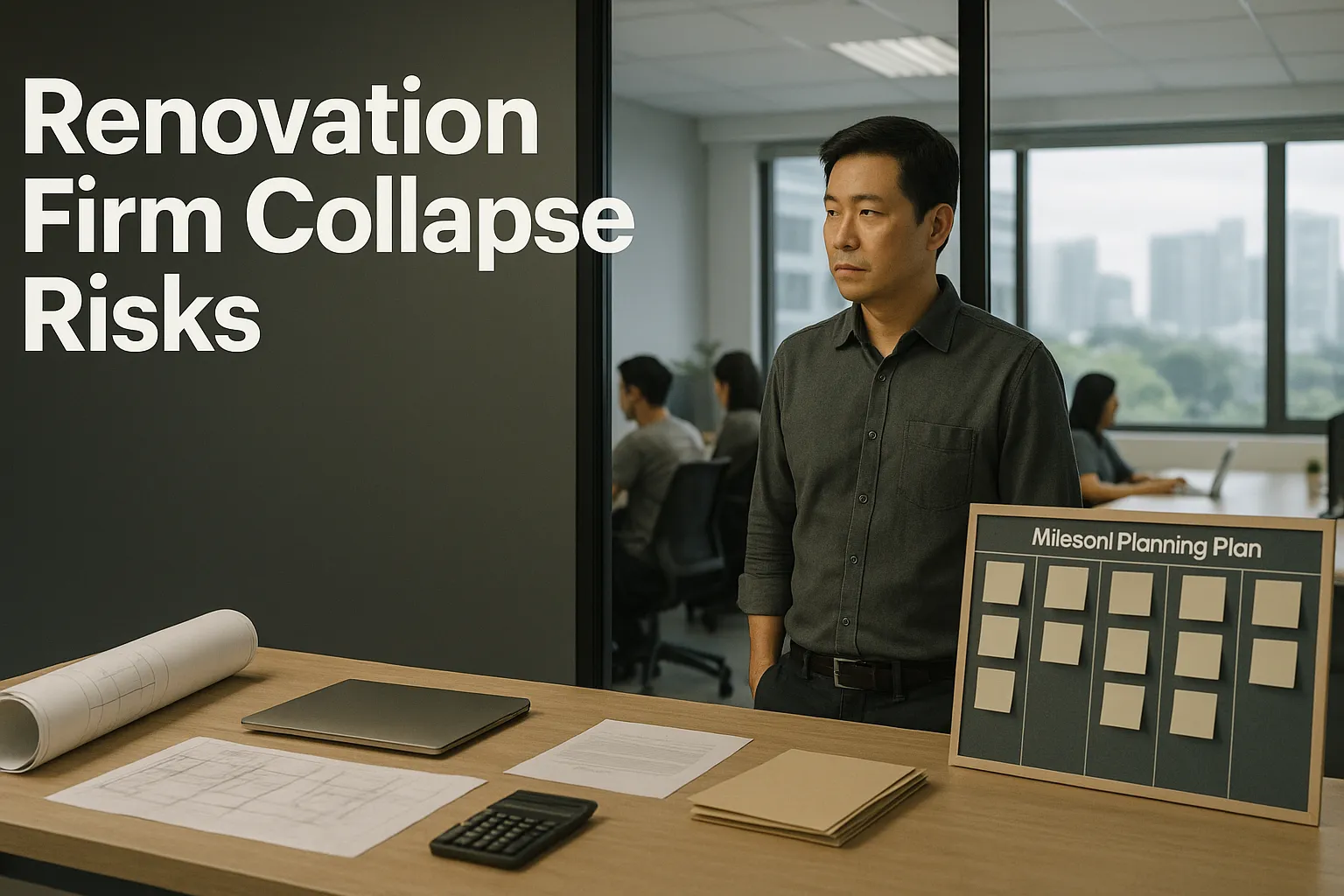
The Axion Design saga (as reported publicly, and still subject to ongoing clarification in the market) is a useful case study for founders thinking about Singapore renovation business risk—not because every situation is the same, but because the underlying pattern is common: customer deposits arrive early, costs and rework arrive later, and “new deposits funding old jobs” quietly becomes the operating model. When timelines slip, cash tightens fast, complaints go public, subcontractors and suppliers squeeze, and payroll/CPF becomes a governance flashpoint—not just an ops issue. This guide gives founders a control-and-communication playbook: how to ringfence customer deposits and project cash flow, design milestone billing that matches delivery and procurement lead times, spot overtrading early, and run credible customer communications when schedules change.
What actually breaks first in a deposit-driven renovation business—profit, cash, or trust?
Most founders think collapse starts with “not enough sales” or “cost overruns”. In deposit-driven project SMEs, the first break is usually cash integrity—and the second break is trust.
The typical failure chain (what it looks like on the ground)
- Jobs are sold with attractive upfront deposits (and optimistic timelines).
- Procurement and subcontractor payments hit earlier than expected (or in larger chunks).
- Variations and delays grow (client indecision, condo restrictions, manpower constraints, defective works, supplier lead times).
- Cash for Project A is used to keep Project B moving, because “we’ll catch up when the next deposit comes in.”
- Backlog grows but cash shrinks (you look busy, but you’re under-water).
- Small delays become a reputation event (WhatsApp screenshots, social posts, review sites).
- Refund requests and cancellations spike exactly when you least can pay.
- Payroll and CPF get squeezed—and that escalates the situation from commercial stress to governance and enforcement exposure.
Why this is hard to see early
- P&L can still look “okay” because revenue is booked, but cash is being consumed by WIP (work-in-progress).
- A busy pipeline creates a false sense of safety.
- Founders often personally smooth issues (“I’ll manage it”) until the volume exceeds any one person’s ability to control.
A practical takeaway: in project businesses, your early-warning system cannot be revenue. It has to be project cash position + capacity realism + customer communications discipline.
How do ‘new deposits funding old jobs’ patterns form—and why is it a hidden insolvency risk?
No founder sets out to run a deposit carousel. It forms because deposits are the easiest cash to collect, and project costs are lumpy.
The mechanics of the trap
- You collect a 30–40% deposit.
- You commit to materials, labour, and subcontractors.
- A few projects run late and consume more resources.
- The cash gap is bridged using the next project’s deposit.
At that point, your business may still be trading, but it is vulnerable to any of these shocks:
- slower sales month
- higher refund pressure
- supplier tightens credit
- manpower shortfall
- project disputes slow collections
The commercial reality founders need to accept
If your operating model depends on future deposits to complete existing obligations, you have:
- mispriced jobs, mis-timed billing, or over-accepted work (often all three).
This is why the Axion Design-type situation resonates: regardless of the specifics of any one company, the market has seen repeated cases where deposit timing masks delivery capacity—until it doesn’t.
Control objective
Your goal isn’t “never use deposits.” The goal is to ensure deposits are allocated, tracked, and governed so that:
- each project remains solvent on its own timeline
- the business can survive a sales dip without failing existing customers
- refunds (when justified) can be processed without breaking payroll governance
That requires ringfencing mechanics and intake discipline, not just “watch cash flow more closely.”
What does ‘ringfencing project cash’ mean in practice for a Singapore renovation SME?
Ringfencing is a set of rules and workflows that prevent project funds from being casually diverted. You can implement it without creating a separate legal entity (and without turning the business into a bureaucracy).
Ringfencing has three layers
1) Accounting ringfence (minimum viable)
- Set up job/project codes for every contract.
- Track, per project: invoiced amounts, received amounts, committed costs (POs), paid costs, and expected remaining costs.
- Produce a project cash position weekly: cash received minus cash paid minus committed costs.
2) Operational ringfence (the control that changes behaviour) Implement approval gates:
- No procurement above a threshold unless the project cash position remains positive after the commitment.
- No new project start unless resourcing and timeline capacity are confirmed (see overtrading indicators below).
- No refunds/discounts above a threshold without a documented decision (why, amount, funding source, and customer comms plan).
3) Banking ringfence (stronger, not always necessary) Some firms operationalise ringfencing by using:
- a dedicated collections account, or
- separate accounts by project category, or
- a “client deposits” holding account with internal release rules.
You don’t need to over-engineer banking structures, but you do need visible separation so the team stops treating deposits as general working capital.
A simple “release rule” founders can actually run
- Deposits received go into a tracked pool.
- Funds are released to operating cash only when:
- the matching milestone is achieved, and
- committed costs and payroll runway remain covered, and
- the project cash position remains non-negative.
This creates the discipline that prevents one delayed site from consuming the next customer’s deposit.
Ownership: who runs ringfencing?
- Ops owns milestone confirmation.
- Finance owns project cash position reporting.
- Founder/GM owns exceptions and intake freezes.
If one person owns everything, ringfencing fails under stress.
How should milestone billing be designed so collections match real delivery (not sales optimism)?
Milestone schedules fail when they are built for closing deals rather than funding delivery.
The billing design principle
Your billing milestones should mirror:
- procurement lead times and payment terms
- subcontractor stage payments
- on-site sequencing and inspection points
- variation risk points
A practical milestone template (adapt it to your work type)
- Deposit (contract signing): covers design effort + initial mobilisation costs. Keep it defensible.
- Pre-procurement milestone: triggered by finalised specifications/measurements and approved material list.
- Materials order milestone: timed before supplier payments are due.
- Site start milestone: tied to confirmed access date and approved schedule.
- Mid-point milestone: based on measurable site progress, not a calendar date.
- Handover milestone: practical completion.
- Retention / defects liability milestone: small final amount after rectification window.
Variation orders: the cash leak most SMEs ignore
When timelines slip, variations become both more frequent and more contentious.
Controls for variations:
- No variation work starts without a signed variation order (even if it’s a simple one-page acknowledgement).
- Variation orders must state:
- scope change
- price change
- timeline impact
- payment timing
- Track variations as their own line items per project code.
Collections workflows that reduce disputes
- Issue milestone invoices with:
- progress photos
- a simple checklist of completed items
- the next-week plan and access requirements
- Keep a single “source of truth” for schedule changes (avoid multiple WhatsApp versions).
This isn’t about being rigid; it’s about avoiding the scenario where work is done, cash is not collected, and the business funds delivery out of the next customer’s deposit.
What are the early-warning indicators of overtrading in Singapore project SMEs?
Overtrading isn’t “too many projects.” It’s too many commitments for your cash and capacity.
A founder-ready overtrading dashboard (weekly)
You want a 30-minute review that answers: are we selling ourselves into a cash crunch?
Track these indicators:
1) Backlog quality (not just backlog size)
- % of backlog with unclear start dates
- % of backlog with unfinalised specs
- number of projects with client-driven indecision flagged
Poor quality backlog converts into delays, disputes, and unpaid variations.
2) WIP vs cash reality
- total WIP cost incurred but not yet billed/collected
- projects with negative project cash position (received < paid + committed)
- average days between milestone completion and payment receipt
3) Timeline slippage compounding costs
- number of projects slipping > 2 weeks
- rework hours per project
- number of return trips (each trip is cost and schedule disruption)
4) “Refund and cancellation pressure” as a cash stress signal
- count and value of refund requests this month
- cancellations pre-site start
- complaints escalation rate (e.g., from PM to founder to public)
5) Subcontractor and supplier arrears
- overdue subcontractor payments
- suppliers moving you to COD (cash on delivery)
- loss of credit terms or reduced limits
These are not just vendor issues; they are a measurable signal of cash fragility.
Thresholds that should trigger action (examples)
- more than a small number of projects with negative project cash position
- repeated payroll “timing fixes” (paying late, splitting payments)
- supplier COD requests increasing
- weekly schedule slippage trend worsening
The right response is not “sell harder.” It’s to pause intake, reset milestones, and stabilise delivery.

How do you implement capacity discipline before accepting the next contract?
Capacity discipline is the most commercially difficult control because it limits short-term sales. But it protects the firm from the public collapse dynamic: more sales creating more failures.
Step 1: Define your true capacity unit
Stop thinking in “projects.” Define capacity in something measurable:
- site-days per crew per month
- PM active jobs limit (e.g., one PM can actively manage X sites)
- designer throughput (number of concurrent selection/procurement cycles)
Step 2: Create job acceptance criteria (a “gating checklist”)
Before signing:
- Is scope sufficiently defined to price and schedule?
- Are procurement lead times compatible with promised timeline?
- Do you have crew/subcon availability for the critical path dates?
- Are payment milestones aligned to your cash outflows?
- Does the client understand decision deadlines (materials, colours, hacking windows)?
If any answer is “no,” you either:
- adjust timeline,
- adjust milestone schedule,
- narrow scope,
- or decline the job.
Step 3: Introduce an intake throttle
A simple rule founders can enforce:
- only accept new jobs up to a capped value/volume per month unless delivery KPIs are green.
Delivery KPIs to link to intake:
- on-time milestone rate
- rework rate
- number of stalled sites
- negative project cash count
Step 4: Protect your best clients and projects first
When stretched, SMEs often treat every client the same. Instead:
- prioritise projects closest to completion (fastest trust recovery)
- avoid starting new sites when existing sites are stalled
- concentrate subcontractors to finish, not to spread thin
Capacity discipline is not anti-growth. It is controlled growth—and it reduces the chance that a temporary cash squeeze becomes a public trust crisis.
How should payroll and CPF be governed so cash stress doesn’t become an enforcement event?
In Singapore, payroll and CPF are not “optional” or “later” items. When these slip, the business moves from operational stress into governance risk, with potential attention from authorities such as MOM and CPF Board depending on the situation.
Treat payroll/CPF as protected payments
A practical control is to create a protected runway:
- maintain a rolling forecast of payroll cash needs (at least 8–12 weeks)
- ringfence cash for salary payments and CPF contributions as a first call
- require founder approval for any use of funds that would reduce payroll runway below a set threshold
Why this matters commercially (not just compliance)
- Late payroll damages retention exactly when you need stability.
- Subcontractors and employees talk; word spreads quickly in the industry.
- Customer confidence collapses when staff turnover causes site abandonment.
Minimum governance controls
- A monthly checklist signed off by finance and a director:
- salaries paid on time
- CPF submission and payment scheduled and executed
- payroll records reconciled to bank payments
- If cash is tight, escalate early:
- don’t wait until after missed payments to “explain”
- prioritise a restructuring plan that protects payroll continuity
If you’re already behind
This article is not legal advice, but from a practical governance perspective:
- stop taking actions that deepen the hole (e.g., starting new sites you cannot fund)
- get professional help early to plan cash triage and communications
Paul Hype Page & Co. often supports SMEs here not only on payroll processing, but on building the governance workflow—so payroll and CPF are managed as a board-level control, not an afterthought.
What crisis communication controls protect customer trust when timelines slip?
Renovation disputes become reputational crises when customers feel surprised, ignored, or misled. Your operational reality may be complex, but your communication must stay simple and consistent.
The communication objective
Maintain credibility by:
- acknowledging impact
- explaining the plan (without blaming customers)
- giving specific next steps and dates
- documenting agreements
A practical “3-trigger” crisis comms system
Trigger a formal comms protocol when any of these happen:
- Schedule slippage exceeds a threshold (e.g., > 10 working days beyond plan).
- A key subcontractor or supplier fails, creating a material timeline risk.
- Refund/cancellation requests spike, indicating confidence loss.
What the protocol includes
1) Single source of truth
- one project schedule version controlled by PM/ops
- changes logged with reason and customer acknowledgement
2) Weekly customer updates (even if progress is limited) A short format:
- what was completed this week
- what is blocked and why
- what will be done next week
- what you need from the customer (decisions, access)
3) Escalation ladder
- PM resolves within 48 hours
- ops lead reviews within 72 hours
- founder intervention only for defined cases (refunds, major scope disputes, high-risk clients)
What to avoid (because it inflames distrust)
- overpromising new dates without capacity proof
- “going quiet” when the site is messy
- shifting blame to the client or subcontractor in writing
- negotiating different terms in multiple chat threads
A disciplined comms system reduces public complaint risk because customers can see governance in action—even when things aren’t perfect.
How do you run a cash-stabilisation plan without creating more unfinished sites?
When you’re already under stress, the worst move is to keep starting projects to bring in deposits. It increases unfinished sites and multiplies complaints.
A stabilisation sequence founders can execute
Step 1: Freeze intake (temporarily) based on delivery capacity
- stop accepting new start dates you can’t honour
- keep sales conversations, but defer commitments until the schedule is credible
Step 2: Segment your live projects into three buckets
- Near completion: finish fast; this releases retention and rebuilds trust.
- Mid-stage but cash-positive: maintain momentum; protect cash discipline.
- Cash-negative or high-dispute: assign senior oversight; restructure the plan.
Step 3: Build a 13-week cash forecast that is project-aware Not just “company-level cash.” Include:
- milestone collections expected (with probability)
- committed supplier/subcon payments
- payroll/CPF runway
- refund risk scenarios
Step 4: Renegotiate from a position of structure With suppliers/subcons:
- propose revised payment schedules tied to project milestones
- concentrate work to complete fewer sites rather than spreading resources thin
With customers:
- propose revised schedules with visible weekly plan
- where appropriate, restructure milestone timing to match delivery (document it)
A key control: no “silent scope drift”
Under stress, teams try to please customers by doing extra work “to keep them happy.” That creates unpriced labour and materials—exactly when cash must be defended.
Stabilisation is about reducing uncertainty and finishing work—not about winning arguments.
What internal controls and systems upgrades give the fastest risk reduction (without heavy ERP spend)?
Many SMEs assume they need a big system to fix this. You usually don’t. You need consistent data and enforced workflows.
The minimum viable control stack
1) Project ledger with job costing
- every invoice, receipt, PO, and supplier bill tagged to a project code
- weekly project cash position report
2) Approval gates embedded into daily work
- PO approval tied to project cash position
- refund approval with documented funding source
- variation order sign-off before work starts
3) A schedule discipline tool This can be a well-managed project board, not necessarily enterprise software:
- master schedule view across all sites
- capacity view by crew/PM
- blocked-items list with owners and deadlines
Common implementation failure: reporting without consequences
If the dashboard says “project cash negative” but teams can still order materials and promise dates, controls are cosmetic.
Assign explicit decision rights:
- Finance can block procurement when project cash rules are breached.
- Ops can block sales from committing start dates without confirmed capacity.
- Founder resolves exceptions within a defined SLA (so the business doesn’t stall).
Data quality and adoption (the human part)
- Train PMs and designers on why coding costs correctly matters.
- Make it easy: drop-down project codes, standard templates.
- Audit a sample of projects monthly for miscoded costs and missing variation orders.
These changes are low-glamour, but they directly reduce the risk of deposit misuse and uncontrolled overtrading.
Conclusion
A renovation firm rarely collapses because founders don’t care; it collapses because deposit timing, project reality, and capacity decisions drift apart—until cash and trust break at the same time. For Singapore project-based SMEs preparing for 2027, the practical playbook is: ringfence project monies with clear release rules, design milestone billing around real procurement and site sequencing, watch overtrading indicators weekly (not monthly), and enforce capacity gates before signing the next contract. Protect payroll and CPF governance as non-negotiables, and run a structured customer communication protocol when timelines slip. If you need help turning these controls into working routines—project ledgers, cash forecasting, approval gates, and payroll/CPF governance—Paul Hype Page & Co. can support as an implementation partner so the controls are operated consistently, not just documented.
FAQs
Common signs include projects with negative cash positions, rising WIP not yet billed/collected, worsening schedule slippage, increasing refund pressure, and suppliers tightening to COD or chasing arrears.
It means tracking deposits by project and using simple release rules and approval gates so funds aren’t casually diverted to other jobs, while still keeping day-to-day operations workable.
Use one version-controlled schedule, send consistent weekly updates with blockers and next steps, and follow a clear escalation ladder so customers aren’t surprised or left chasing multiple chat threads.
Because missed or delayed salary payments and CPF contributions quickly shift the situation from operational strain to governance risk, damaging retention and escalating enforcement exposure.
Build milestones around procurement lead times, subcontractor stage payments, and measurable site progress, and require signed variation orders before extra work starts.
Share This Story, Choose Your Platform!
Related Business Articles