大纲
- What are ACRA obligations at a glance (what to maintain, prepare, hold/dispense with, file, and update)?
- How should directors assign ownership so compliance doesn’t depend on one person’s memory?
- What does “maintaining proper accounting records” mean in practice, and how do you operationalise it?
- How do you prepare financial statements efficiently without turning it into a technical accounting project?
- Do you need to hold an AGM, and how do you plan for ‘hold’ versus ‘dispense with’ pathways?
- How do you file the Singapore company annual return on time without last-minute surprises?
- What statutory information updates should you treat as ‘event-driven’ tasks during the year?
- What does a director-friendly annual compliance workflow look like from start to finish?
- Where do teams most commonly fail, and what controls prevent repeat offences (late filings, outdated records, missing evidence)?
- How can an external advisor support implementation without replacing management ownership?
- 结论
- Want to turn this into a working annual compliance plan?
- 常见问题
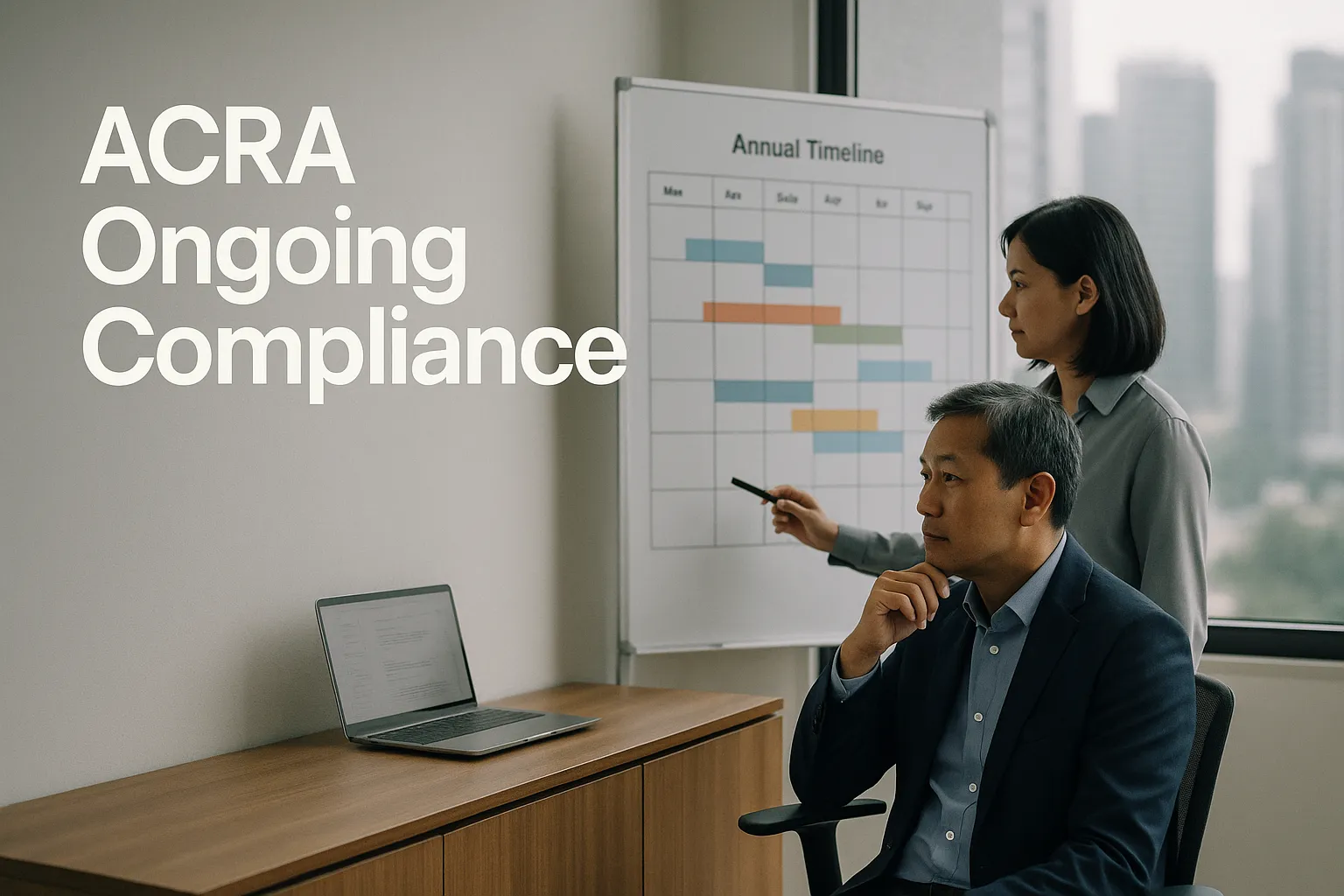
For most directors, “ACRA ongoing compliance requirements” become a problem only when something slips: the annual return is filed late, financial statements are not ready for sign-off, or statutory information is outdated after a change in officers or shareholding. The cost is rarely just a late fee—delays can disrupt banking, fundraising, tenders, and even internal decision-making because no one trusts the numbers or the records. The practical challenge is turning ACRA’s obligations into a repeatable operating rhythm with clear owners, inputs, and checkpoints. This guide translates the core duties—maintaining records and registers, preparing financial statements, managing AGM requirements (and exemptions), filing the annual return, and keeping statutory particulars updated—into a director-friendly annual workflow you can run year after year.
What are ACRA obligations at a glance (what to maintain, prepare, hold/dispense with, file, and update)?
Think of ACRA compliance as five moving parts that must connect cleanly each financial year. If you design them as a workflow, the year-end becomes a controlled close rather than a scramble.
1) Maintain (always-on obligations)
- Accounting records that correctly explain transactions and support financial statements.
- Statutory registers and company records (for example, registers relating to members/shareholdings and officers) kept current.
- Supporting documents (contracts, invoices, board minutes/resolutions, bank statements) organised so your finance team and corporate secretary can evidence changes and decisions.
2) Prepare (year-end deliverables)
- Financial statements suitable for director review and approval (where required), supported by a disciplined year-end close.
- Directors’ review pack: key movements, major contracts, related party items, and explanations for material variances.
3) Hold or dispense with (AGM pathway)
- Some companies must hold an AGM.
- Some may be able to dispense with holding an AGM or use alternative processes, depending on eligibility and proper documentation.
4) File (external submission)
- Annual return filing with ACRA, based on the company’s financial year end and applicable requirements.
5) Update (event-driven obligations)
- Keep ACRA-recorded particulars updated when changes happen (for example, officers, registered office, share capital or shareholding-related particulars, where applicable).
Practical takeaway: treat this as one system. Accounting records drive financial statements; financial statements and governance steps feed annual return filing; statutory updates must be captured as they occur so the year-end filing isn’t derailed by missing or inconsistent records.
Note: exact filing timelines and eligibility criteria can change. Confirm requirements and deadlines against ACRA’s latest official guidance before relying on any exemption or workflow timing.
How should directors assign ownership so compliance doesn’t depend on one person’s memory?
Most breakdowns happen at handoffs: finance closes the books but no one coordinates approvals; the corporate secretary expects documents that aren’t prepared; directors assume someone else updated ACRA after an appointment or resignation.
A workable ownership model separates accountability (director-level) 从 execution (CFO/finance and corporate secretarial).
Use a simple RACI for the annual cycle
- Board / Directors (Accountable):
- Ensure accounting records are kept.
- Review and approve financial statements where required.
- Approve key governance actions (AGM/dispensation route, declarations/resolutions).
- Ensure annual return is filed.
- CFO / Finance Lead (Responsible for finance inputs):
- Maintain accounting records and schedules.
- Run the year-end close timetable.
- Produce a financial statement-ready trial balance and supporting packs.
- Corporate Secretary (Responsible for statutory and filing workflow):
- Maintain statutory registers/records and track changes.
- Prepare meeting/resolution documentation.
- Manage annual return preparation and filing steps (with directors’ confirmation where required).
- Operations / HR (Consulted, event-driven):
- Trigger updates when officers change, addresses change, or new hires/terminations affect authorised signatories or internal approval matrices.
- External accountant/auditor (if engaged) (Consulted/Responsible for specific deliverables):
- Support accounts preparation and/or audit, depending on scope.
Build the “single source of truth”
Create one shared compliance workspace (secure folder or governance tool) containing:
- Company particulars and current officer list
- Latest registers and key resolutions
- Financial year-end close timetable
- Prior-year filing and approval evidence
- A running “changes log” (appointments, resignations, share issuances/transfers, address changes)
Management control point
Schedule a quarterly 30-minute compliance huddle (director + finance + corporate secretary). Agenda:
- Changes since last meeting (officers/shareholding/address)
- Accounting close status and issues
- Upcoming year-end milestones and approvals
- Risks to annual return filing (missing documents, delayed sign-off)
This keeps compliance operational and prevents “year-end surprises” from becoming late filings.
What does “maintaining proper accounting records” mean in practice, and how do you operationalise it?
“Accounting records” is often misunderstood as “we have accounting software.” In practice, directors need to ensure the company can show a complete, consistent trail from transaction → entry → support → bank movement → financial statements.
What good looks like (director-level expectations)
You should be able to answer “yes” to these questions without heroic effort:
- Can we produce bank reconciliations for all bank accounts up to a recent month-end?
- Do we maintain AR and AP listings that tie to the ledger?
- Are revenue recognition and cut-off practices consistent (especially around year-end)?
- Do we have documentation for material or unusual transactions (new loans, shareholder funding, asset purchases, disposals)?
- Are related party transactions identified and supported (common issue in founder-led SMEs)?
Turn record-keeping into a monthly discipline
A practical monthly close checklist (lightweight but consistent):
- Reconcile bank accounts
- Post and review all sales and purchases for the month
- Review receivables/payables ageing (follow-up actions)
- Track founder/director expenses separately with clear business purpose
- Maintain fixed asset register (if relevant) and depreciation basis
- Review payroll postings (even if payroll compliance is handled separately)
- Save supporting documents in a consistent folder structure
Document discipline that prevents year-end delays
Common year-end blockers are not “accounting problems”; they are missing paperwork problems.
Set a rule: no support, no posting (or post to a suspense account pending documents).
Suggested folder structure:
- 01 Sales (invoices, contracts, credit notes)
- 02 Purchases (supplier invoices, agreements)
- 03 Banking (statements, facility letters)
- 04 Payroll summaries (high-level, for accounting tie-out)
- 05 Corporate (board approvals, key contracts)
- 06 Tax (keep separate; not the main workflow here)
Retention mindset
Directors should plan for retention as a capability, not a one-off archive:
- Keep records in a way that is retrievable if a director changes, staff turnover happens, or an auditor/accountant requests evidence.
- Control access and versioning. One “master” folder beats five personal drives.
Practical outcome: when accounting records are kept properly all year, the financial statements preparation becomes a controlled compilation exercise—not a forensic reconstruction.
How do you prepare financial statements efficiently without turning it into a technical accounting project?
Financial statements are where the accounting workflow meets director responsibility. The goal is not to memorise standards; it is to run a close process that produces reliable numbers and a clean sign-off path.
Start earlier than the due date (work backwards from approvals)
Instead of asking “when is it due,” ask:
- When do directors need a review pack?
- When will the corporate secretary need finalised figures to prepare the annual return?
- If an audit is required, when does the auditor need the PBC (provided-by-client) pack?
A practical rule for many SMEs: begin year-end preparation weeks before financial year end (confirm your actual filing timeline with ACRA), focusing on cleaning up the ledger and gathering missing documents.
Build a year-end close timetable (minimum viable)
Phase 1: Pre-close (before year end)
- Clear suspense and uncoded items
- Confirm major contracts and commitments
- Review director/shareholder balances and funding arrangements
- Ensure fixed asset list is updated
Phase 2: Close (immediately after year end)
- Final bank recs
- Cut-off checks (sales and purchases around year-end)
- Inventory checks (if applicable)
- Accruals and prepayments review
Phase 3: Financial statements readiness
- Draft statements prepared
- Variance explanations prepared (current year vs prior year)
- Directors’ review meeting scheduled
The director review pack (what directors should ask for)
To make sign-off practical and defensible, ask management for a short pack:
- Trial balance and management accounts
- Key movements (revenue, gross margin, major expenses)
- Significant transactions and non-recurring items
- Related party transactions summary
- Cash position and major liabilities
- Any uncertainties (disputes, contingent items) flagged early
Keep sign-off clean: minutes and evidence
Even when the business is small, governance evidence matters. Make sure:
- The board meeting or written resolution approving the statements is documented.
- Directors have enough time to review—avoid “approve tonight, file tomorrow.”
Common execution traps (and how to avoid them)
- Founder reimbursements mixed with business expenses: set a policy and separate accounts.
- Loan/convertible instruments not documented: keep facility letters and board approvals in the corporate folder.
- Revenue cut-off chaos: define a cut-off rule (delivery/acceptance) and apply consistently.
Financial statement preparation runs smoothly when you treat it as an operations project: timetable, owners, inputs, review checkpoints, and a disciplined document trail.
Do you need to hold an AGM, and how do you plan for ‘hold’ versus ‘dispense with’ pathways?
AGM requirements are often where directors lose time because they plan late or assume an exemption applies without checking. The workable approach is to decide the AGM pathway early, then run the documentation flow accordingly.
Step 1: Classify your AGM pathway early
Treat this as a governance decision with two tracks:
Track A — “Must hold an AGM” (plan and schedule):
- If the company does not meet conditions to dispense with an AGM (or shareholders want an AGM), plan the meeting.
- Build in time for financial statements finalisation, notice/document circulation, and Q&A.
Track B — “May dispense with an AGM” (confirm eligibility and document properly):
- Some companies may be able to dispense with holding an AGM, subject to eligibility and proper member/shareholder processes.
- This is not “do nothing.” You still need a controlled workflow: confirm eligibility, circulate financial statements as required, obtain written resolutions/acknowledgements where applicable, and retain evidence.
Because eligibility and procedural details can change, verify your position against ACRA’s current guidance before relying on any dispensation or exemption.
Step 2: Build the internal document flow
Regardless of track, you need a repeatable document set:
- Final (or near-final) financial statements
- Directors’ resolution/board minutes on approval
- Shareholder communications (notice or circulation, depending on the route)
- Evidence of shareholder decisions (meeting minutes or written resolutions)
Step 3: Use a “go/no-go” checkpoint
Set a checkpoint date (for example, shortly after year end):
- Are accounts on track?
- Is audit (if applicable) on track?
- Are there shareholder sensitivities that make an AGM advisable even if dispensable?
- Are there changes in shareholders/officers that must be updated before you circulate documents?
实际案例
A company with two shareholders often assumes “we don’t need an AGM.” The better process:
- Corporate secretary confirms the company’s eligibility to dispense (based on current ACRA rules).
- Finance commits to a financial statement finalisation date.
- Directors approve the statements.
- Shareholders receive the statements and sign the necessary documentation.
- Annual return preparation proceeds without last-minute governance gaps.
The key is not which track you choose; it’s making the choice early and running it consistently with evidence.

How do you file the Singapore company annual return on time without last-minute surprises?
Singapore company annual return filing is rarely late because someone forgot the date. It’s late because an upstream dependency didn’t land: accounts not approved, AGM/dispensation steps incomplete, or statutory particulars unclear.
Treat annual return filing as the final step in a chain
Annual return readiness depends on:
- Accounting records complete
- Financial statements prepared and approved (as required)
- AGM held or correctly dispensed with (as applicable)
- Statutory information current (officers, registered office, etc.)
If any one of these is not clean, filing becomes a scramble.
A practical filing workflow (with ownership)
Step 1 — Kick-off (Corporate Secretary + Finance, shortly after year end)
- Confirm financial year end recorded correctly
- Confirm filing pathway (AGM vs dispensation)
- Confirm who will provide financial figures and when
Step 2 — Data freeze and validation (Finance lead)
- Lock the period in accounting software (or control changes)
- Provide final figures and supporting schedules
- Confirm bank balances, share capital movements (if any), and officer changes reflected in internal records
Step 3 — Governance evidence (Directors + Corporate Secretary)
- Board approval documentation completed
- AGM minutes or written resolutions filed in the corporate records
Step 4 — Pre-filing check (Corporate Secretary)
- Cross-check statutory registers vs information to be filed
- Confirm no pending changes (appointments/resignations/address changes) that would make the filing inconsistent
Step 5 — File and archive (Corporate Secretary)
- File the annual return
- Save the filing acknowledgement and a copy of filed information
- Update the compliance calendar for next year
Controls that prevent recurring late filings
- Maintain a rolling compliance calendar with milestone dates (not just due dates): “accounts draft,” “director review,” “AGM/dispensation decision,” “filing prep,” “file by.”
- Use a two-person review for filings: preparer + reviewer (director or senior staff) to catch mismatches.
- Hold a post-mortem: if filing was stressful, document why (missing invoices? delayed approvals?) and fix the upstream cause.
Important: avoid quoting or relying on static deadlines in internal SOPs. Instead, keep a link to ACRA’s current guidance and confirm timelines each year, especially if your financial year end changes or your company’s status changes.
What statutory information updates should you treat as ‘event-driven’ tasks during the year?
Many directors treat statutory updates as “something we’ll do at year end.” That approach creates risk because changes can stack up, documents go missing, and filings become inconsistent.
Build an event-driven update trigger list
Whenever any of these happen, your internal process should trigger a corporate secretarial action and records update:
- Appointment/resignation/changes of directors, 公司秘书, or key officers
- Change in registered office address
- Changes in shareholding 或 share capital (issuances, transfers, share splits/consolidations where relevant)
- Changes in company name or other core particulars (where applicable)
Create a “change request” intake
A simple internal form (email template is enough) sent to the corporate secretary whenever a change occurs:
- What changed?
- Effective date?
- Supporting documents attached?
- Who approved it (board/shareholders) and where is the resolution?
Link statutory updates to operational realities
These changes often sit inside operational decisions:
- Bringing in an investor → share issuances/updates
- Changing signatories with the bank → often linked to director changes
- Moving office → address update plus letterhead/invoice updates
If you treat updates as part of the operating workflow, you reduce “outdated records” offences and avoid downstream friction with banks, auditors, and counterparties doing due diligence.
Control point: monthly “company particulars” check
Add a lightweight monthly check to the finance/ops routine:
- Are the current directors and secretary list correct?
- Is the registered office address still correct?
- Were there any share transfers or issuances?
This takes minutes and prevents year-end surprises.
What does a director-friendly annual compliance workflow look like from start to finish?
Below is an implementation roadmap you can adapt to your financial year end. It focuses on sequencing and handoffs, not static deadlines (confirm timing against ACRA’s current guidance).
Step-by-step annual workflow (operational roadmap)
Stage 0 — Set the system (once, then maintain) Owner: Director sponsor + Corporate Secretary + Finance lead
- Create a compliance calendar with milestones
- Set the document repository structure
- Define internal approval thresholds (what needs board approval)
- Assign named owners and backups
Deliverable: one-page “Compliance Operating Plan” stored in the corporate folder.
Stage 1 — Run monthly close all year (ongoing) Owner: Finance lead
- 每月银行对账
- Maintain AR/AP and key schedules
- Track director/shareholder balances and related party items
- Keep contract and invoice support complete
Control: monthly close sign-off (even informal) and exception log.
Stage 2 — Pre-year-end readiness (weeks before year end) Owner: Finance lead; Directors informed
- Clear suspense items
- Confirm treatment of major transactions
- Check fixed asset/inventory records
- Identify any missing documents early
Control: “Year-end readiness meeting” (30 minutes) with finance + corporate secretary.
Stage 3 — Year-end close (immediately after year end) Owner: Finance lead
- Final postings and cut-off
- Final reconciliations
- Prepare draft numbers and variance notes
Dependencies: complete paperwork and clear sign-off authority on estimates.
Stage 4 — Financial statements and approvals Owner: Finance lead prepares; Directors approve; Corporate Secretary documents
- Draft financial statements prepared
- Directors review pack delivered
- Approval meeting or written resolution completed
Control: directors’ questions logged and answered before approval.
Stage 5 — AGM decision and execution (or dispensation) Owner: Directors + Corporate Secretary
- Confirm “hold vs dispense with” pathway
- Execute meeting or written processes
- Archive evidence in corporate records
Control: eligibility checked against current ACRA guidance before dispensing.
Stage 6 — Annual return preparation and filing Owner: Corporate Secretary; Directors verify
- Validate filed information against registers
- Confirm approvals completed
- File annual return
- Save acknowledgement and update next year’s calendar
Control: preparer-reviewer check and consistency check across registers, resolutions, and financial figures.
What to measure (so the process improves each year)
- Days to close the books after year end
- Number of unresolved suspense items at year end
- Time from draft statements to director approval
- Whether annual return filing was completed without escalations
- Number of post-filing corrections needed (aim for zero)
This turns compliance from an annual fire drill into a managed operating rhythm.
Where do teams most commonly fail, and what controls prevent repeat offences (late filings, outdated records, missing evidence)?
Most non-compliance events are operational failures, not knowledge failures. The fixes are simple controls applied consistently.
Failure 1: Late annual return because accounts aren’t ready
Root causes
- Weak monthly close discipline
- Missing invoices/contracts
- No timetable for director review and approvals
Controls
- Monthly reconciliations and suspense-clearing
- Year-end close timetable agreed in advance
- Director review meeting booked early (calendar control)
Failure 2: AGM/dispensation confusion
Root causes
- Assuming exemption without confirming eligibility
- Missing shareholder documentation
- Financial statements not circulated on time
Controls
- Early “AGM pathway” decision checkpoint
- Corporate secretary maintains a standard documentation pack
- Eligibility verified against ACRA’s latest guidance each year
Failure 3: Outdated statutory information
Root causes
- Changes managed informally (WhatsApp approvals, no resolutions)
- No trigger to notify the corporate secretary
- Records stored across personal drives
Controls
- Change request intake form + required attachments
- Single corporate repository with version control
- Quarterly compliance huddle to reconcile what changed
Failure 4: Directors sign without understanding key movements
Root causes
- No director pack
- No explanation of major variances or unusual transactions
Controls
- A standard directors’ review pack (short, consistent)
- A log of director questions and management responses
Failure 5: Key-person risk (only one person knows the process)
Root causes
- Corporate secretarial and finance tasks not documented
- No backup owner
Controls
- Written SOP for annual workflow
- Named backup for each step
- Annual “dry run” (review last year’s file set and confirm it is complete)
If you implement only two controls, prioritise: (1) a disciplined monthly close, and (2) an early governance decision on AGM vs dispensation. Those two reduce most late filing scenarios.
How can an external advisor support implementation without replacing management ownership?
Many companies don’t need more reminders of obligations—they need a smoother workflow and better handoffs between directors, finance, and corporate secretarial execution.
A practical way firms like Paul Hype Page & Co. can support (without taking ownership away from directors) is by:
- Helping you design the annual compliance operating plan (owners, milestones, document list)
- Stress-testing your year-end readiness (what’s missing, what will delay approvals)
- Coordinating the finance-to-secretarial handoff so figures, approvals, and records align
- Building a repeatable close and filing checklist tailored to how your team actually works
The value is operational: fewer last-minute escalations, cleaner records, and a process that still works when staff change or the business grows.
结论
ACRA compliance is easiest to manage when you stop treating it as a once-a-year filing task and run it as an annual workflow with clear owners, inputs, and checkpoints. Keep accounting records “financial statement-ready” through a monthly close discipline, start year-end preparation early, decide your AGM pathway (hold vs dispense with) based on verified eligibility, and treat statutory updates as event-driven tasks—not year-end clean-up. If you document the handoffs between finance, directors, and the corporate secretary, the annual return becomes the final step in a controlled sequence rather than a deadline-driven scramble. Before you finalise your internal calendar each year, confirm timelines and detailed requirements against ACRA’s latest official guidance so your workflow stays current.
常见问题
Treat the annual return as the last step in a chain: clean books, approved financial statements, completed AGM/dispensation documentation, and up-to-date statutory information—then run a pre-filing consistency check before submission and archive the acknowledgement.
Directors remain accountable, while finance runs the monthly and year-end close and provides statement-ready numbers, and the corporate secretary maintains registers, prepares resolutions/minutes, manages the AGM/dispensation documentation flow, and coordinates annual return filing.
Treat changes like director/secretary appointments or resignations, registered office address changes, and shareholding or share capital-related movements as event-driven tasks with a simple internal change request sent to the corporate secretary with supporting documents and approvals attached.
It means a consistent transaction-to-support trail with regular bank reconciliations, AR/AP listings that tie to the ledger, clear cut-off practices, and organised source documents so year-end statements don’t become a reconstruction exercise.
They generally fall into five moving parts: maintain accounting records and statutory registers, prepare financial statements, decide and document the AGM pathway (hold or dispense with if eligible), file the annual return, and update ACRA-recorded particulars when changes happen.
分享这个故事,选择您的平台!
相关文章