



指南
Many Singapore SMEs adopt AI through scattered tools that are hard to measure and even harder to substantiate when incentives are reviewed. This guide shows founders and CFOs how to scope AI into a governed programme with baselines, KPIs, cost coding, vendor deliverables, and an audit-ready documentation pack.
Even if your Singapore company is dormant, has “No Business Done”, or is making a loss, IRAS may still require ECI and/or an annual corporate income tax return for the relevant YA. This guide gives a practical yes/no workflow to check myTax Portal and IRAS notices, confirm whether a waiver or simplified dormant filing applies, and document your decision each year.

Singapore withholding tax can apply to specific IRAS-listed income types paid to non-residents, and the payer is responsible for classifying, filing, and paying IRAS on time. This guide gives finance teams a practical end-to-end workflow to screen invoices, confirm source and treaty position, apply the right rate, and document decisions for mixed or unclear payments.
Singapore withholding tax is triggered by specific IRAS income types and by when amounts are paid or credited to a non-resident, not simply because a vendor is overseas. This guide shows finance teams how to classify payments, confirm non-resident status, apply treaty evidence where relevant, file the right IRAS form, pay by the statutory deadline, and retain an audit-ready evidence pack.
GST registration in Singapore is self-assessed, so growing businesses need a repeatable way to monitor taxable turnover across channels and avoid crossing the S$1 million threshold without realising. This guide shows a practical workflow for running the retrospective and prospective tests, documenting “reasonable expectation” decisions, and setting triggers so registration is handled on time.
Singapore companies must plan for two linked timelines: ECI is generally due within 3 months of financial year-end, and the annual corporate income tax return is e-filed by 30 November of the relevant Year of Assessment. This guide shows how to run both as one workflow with internal cut-offs, clear ownership, a tax-ready close pack, and early checks for waiver and form type so filing doesn’t become a November scramble.
Corporate Income Tax filing is a fixed annual deliverable that drives your close timetable and myTax Portal authorisations, and missing it can create avoidable disruption. This guide shows how to map your FYE to the correct YA, choose the right IRAS form (C-S (Lite), C-S or C), confirm whether any waiver applies, and e-File with a clean proof-of-filing trail.
Most Singapore companies should assume corporate income tax filing is an annual requirement unless IRAS has waived filing or instructed otherwise for that Year of Assessment. This guide shows a scenario-based workflow to determine whether you must file, which form applies (C‑S (Lite), C‑S, or C), and how to execute e‑filing on myTax Portal with basic internal controls.
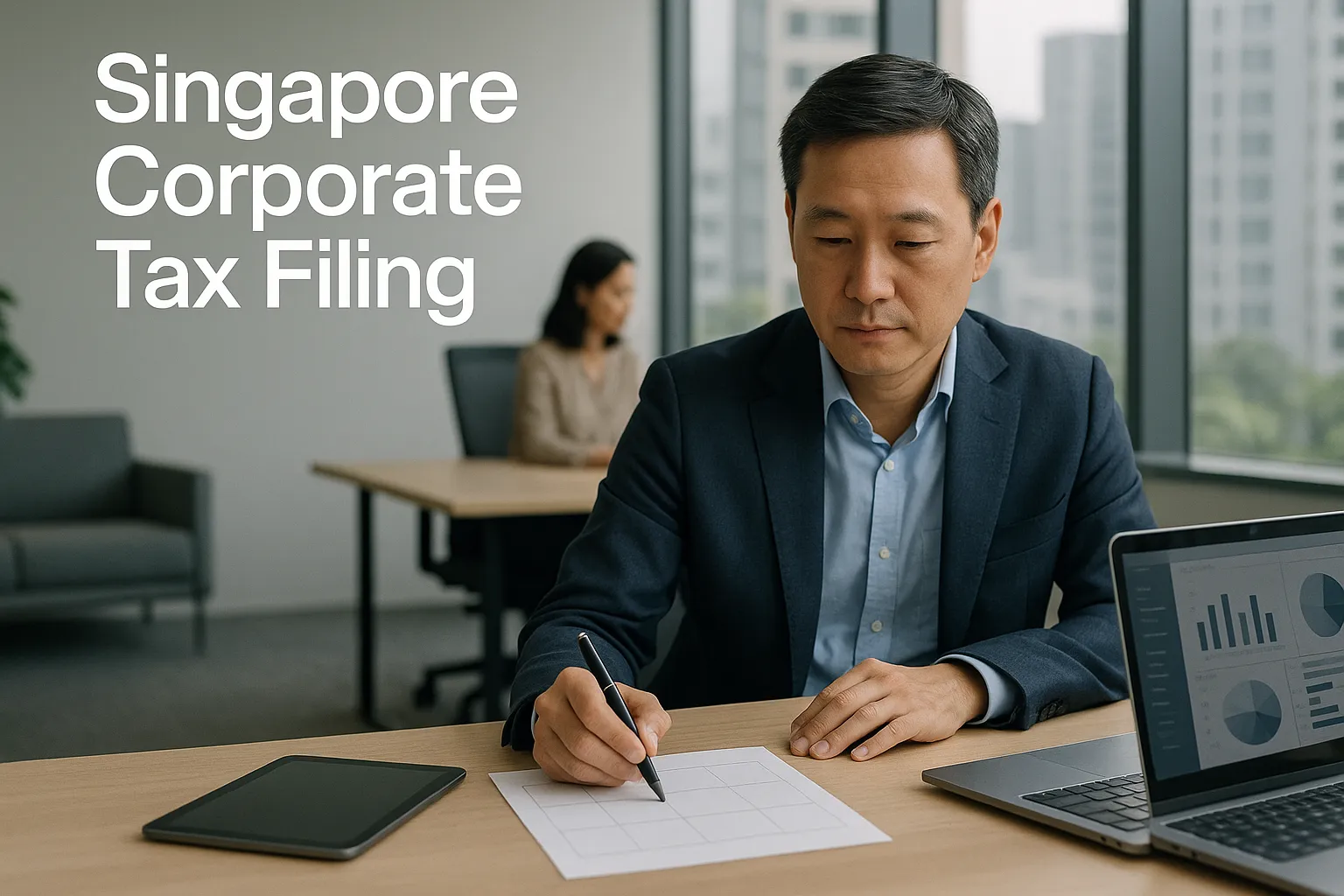
Singapore corporate income tax filing can become messy when ECI timing, Year of Assessment mapping, and IRAS e-filing are handled late or without clear ownership. This guide sets out a predictable, FYE-anchored workflow covering ECI within three months, choosing the right return (Form C-S Lite/C-S/C), documentation controls, and practical steps if you miss a filing.
新加坡税务视频指南

新加坡公司税
新加坡个人所得税