All Resources
July – September 2026 | Singapore Guides
GST registration in Singapore is self-assessed, so growing businesses need a repeatable way to monitor taxable turnover across channels and avoid crossing the S$1 million threshold without realising. This guide shows a practical workflow for running the retrospective and prospective tests, documenting “reasonable expectation” decisions, and setting triggers so registration is handled on time.
Singapore companies must plan for two linked timelines: ECI is generally due within 3 months of financial year-end, and the annual corporate income tax return is e-filed by 30 November of the relevant Year of Assessment. This guide shows how to run both as one workflow with internal cut-offs, clear ownership, a tax-ready close pack, and early checks for waiver and form type so filing doesn’t become a November scramble.
Corporate Income Tax filing is a fixed annual deliverable that drives your close timetable and myTax Portal authorisations, and missing it can create avoidable disruption. This guide shows how to map your FYE to the correct YA, choose the right IRAS form (C-S (Lite), C-S or C), confirm whether any waiver applies, and e-File with a clean proof-of-filing trail.
Singapore-incorporated companies generally need statutory financial statements prepared under an applicable Singapore financial reporting framework, not simply a last-minute conversion of group IFRS packs. This guide explains what counts as statutory accounts, how to choose between SFRS, SFRS for Small Entities, and SFRS(I), and the controls directors and finance teams use to avoid ACRA-facing rework and audit delays.
Most Singapore companies should assume corporate income tax filing is an annual requirement unless IRAS has waived filing or instructed otherwise for that Year of Assessment. This guide shows a scenario-based workflow to determine whether you must file, which form applies (C‑S (Lite), C‑S, or C), and how to execute e‑filing on myTax Portal with basic internal controls.
Singapore corporate income tax filing can become messy when ECI timing, Year of Assessment mapping, and IRAS e-filing are handled late or without clear ownership. This guide sets out a predictable, FYE-anchored workflow covering ECI within three months, choosing the right return (Form C-S Lite/C-S/C), documentation controls, and practical steps if you miss a filing.
Choosing a Singapore company structure affects control, fundraising options, and how stakeholders participate as shareholders or members. This guide compares private limited by shares, public limited by shares, and public limited by guarantee, with a practical decision framework and prompts to cross-check definitions on ACRA before filing.
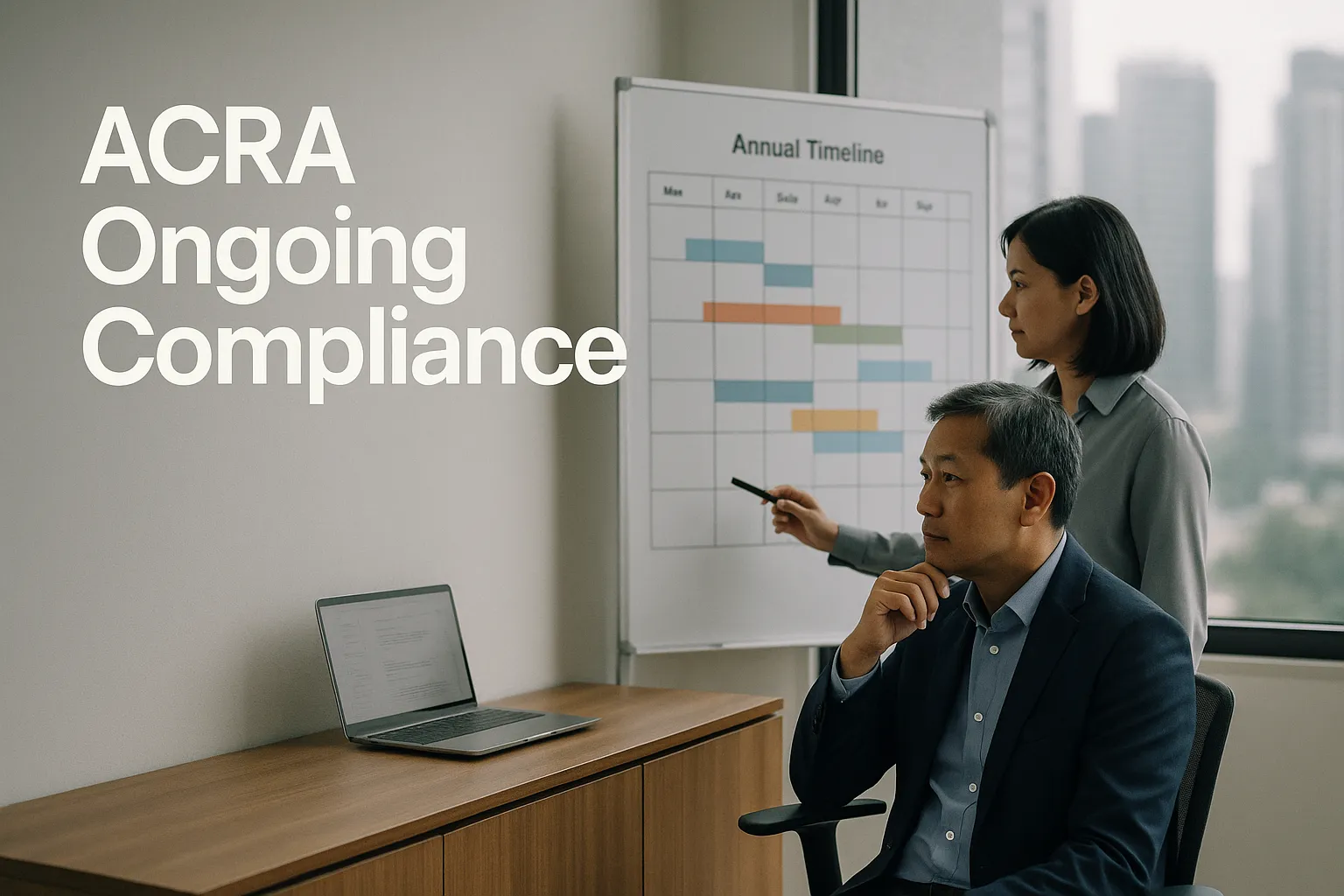
ACRA compliance often breaks down when year-end tasks depend on memory and handoffs between finance, directors, and the corporate secretary. This guide turns the core obligations—records, financial statements, AGM pathways, annual return filing, and event-driven updates—into a repeatable annual workflow with clear owners and checkpoints.
Work out whether your company is legally audit-required or can rely on audit exemption as a small or dormant company, including the common traps around group structures and changing activity. This guide also explains how the audit decision relates to IRAS filing (Form C-S (Lite), Form C-S, or Form C) and what financial records you should still have ready.
Singapore corporate income tax compliance is easier to manage when you treat it as a yearly workflow rather than a one-off filing task. This guide shows how to run the cycle from financial year-end close through ECI decisions, selecting the right Corporate Income Tax Return (Form C-S/C), e-filing, and NOA payment tracking using IRAS as the source of truth for deadlines.
Many teams run into trouble not because of the IRAS deadline, but because they identify the wrong filing route too late or don’t have the right accounts, computation, and supporting records ready for e‑Filing. This guide shows how to confirm whether you must file, decide between Form C and Form C‑S, and map your internal close and approvals to your financial year-end.
Singapore corporate tax compliance often goes wrong when teams treat everything as a single “annual filing” and mix up ECI, the Corporate Income Tax Return (Form C‑S/C‑S (Lite)/Form C), and ACRA annual returns. This guide breaks the work into two clear workflows with practical owners, inputs, waiver decision points, and a simple calendar you can run each year.
April – June 2026 | Singapore Guides
January – March 2026 | Singapore Guides

MERCOSUR – 新加坡自由贸易协定可能会改善新加坡中小企业在 2026-2027 年扩展到巴西和阿根廷的关税结果,但文档、国际贸易术语和税务结构可能影响利润。了解如何准备您的会计、海关证明、跨境税务计划和银行准备,以确保增长不超过合规。
改进的MAS调查GDP预测可能成为新加坡中小企业的推动力——但前提是您的会计、税务和风险控制能够支持更快的扩展。了解如何将宏观乐观转化为审计准备的账簿、更智能的税务准备和2026–2027年的现金流规划,使用PHP。

新加坡2026年第一季度制造业展望指向温和增长与高度不确定性,这使得分阶段的产能、招聘和合规规划至关重要。本指南将情绪转化为一个涵盖预测、资本支出时机、工资/CPF、审计准备、公司秘书任务和补助文档的90天行动计划。

2025–2026年间,国际和私立学校的扩张正在改变外籍人士的期望——而不一定降低整体学费。了解如何建模学校费用支持,使Offer信函与就业通行证文件对齐,以及实施工资和税务报告控制,以便在2026–2027年保持有效。
2026–2027年CPF政策变更最常会因过时的薪资设置而使中小企业违反合规要求——如OW/AW映射、MediSave分配、年龄段费率和员工分类。本指南展示了如何更新您的薪资和税务结算流程,以防止欠款、罚款和员工争议,同时保持审计准备状态。
US–Asia tariffs in 2025–2026 are pushing founders and finance teams to rethink contracting, inventory ownership, transfer pricing, and documentation—not just landed cost. Singapore company incorporation can still be attractive as a neutral, rules-based regional hub when paired with strong accounting, tax governance, and real operational substance.
MAS消费者价格动态报告是新加坡中小企业可以用来进行压力测试2026年预算、定价和工资的实用基准——超越名义通胀。本指南展示了如何将分类级别的通胀信号转化为可辩护的损益和现金流假设、合同更新以及薪资审查框架。
新加坡2025年的GDP增长了4.8%,但2026年的展望预计将会放缓并更加波动,尤其是对贸易暴露的中小企业。这份指南将宏观变化转化为涵盖会计、现金流、税务、审计准备、薪资和合规的实践性30-60-90天财务计划。
随着更新的COMPASS框架自2026年1月1日起生效,就业准证的批准将愈加依赖于中小企业如何设计角色、基准薪资和提供真实的商业实质。本指南解释了新加坡雇主如何通过提前规划劳动力、薪酬结构和合规性来减少EP风险,从而在提交申请之前做好准备。

在2026年,外国创始人在新加坡设立公司时,必须超越注册本身,关注从第一天起的税务准备和工作准证资格。本文指南解释了如何构建您的新加坡公司,以符合IRAS的期望,支持就业准证的批准,并避免未来成本高昂的重组。