Foreigners Own Over 40% of Registered Companies
Singapore Company Registration is a popular choice among global entrepreneurs due to the nation’s strong business appeal. As a global business hub, Singapore attracts more than 40% of new companies with foreign ownership.
The country’s business-friendly policies, strong legal system, and strategic location make it ideal for international investors. Moreover, its low corporate tax rates and straightforward incorporation process simplify market entry.
In addition, foreign investors benefit from a highly skilled local workforce, making it easier to establish and expand their operations in Singapore.
Related Read: Current SME Trends and Growth Outlook 2024
What Does This Mean for Foreign Entrepreneurs?
In short: Foreigners can register a Singapore private limited company from overseas; it needs at least one locally resident director, a company secretary within 6 months and a local registered address. Paul Hype Page charges S$800 plus the S$315 ACRA fee (S$1,115 total); a company secretary is S$600/yr, a registered address S$300/yr, and a nominee director if you have no resident director. Need one? We can provide one. WhatsApp us. Our S$2,015 local package is only for companies that already have a Singapore-resident director; ask us what it covers for your case.
Since 2008 · ACRA-registered public accounting firm · 30 Petain Road, Singapore 208099
Singapore company registration prices (2026)
| Service | Price |
|---|---|
| Company incorporation | S$800 + S$315 ACRA fee (S$1,115) |
| Local incorporation package | S$2,015 (ask us what it covers for your case) |
| Registered address | S$300 a year |
| Company secretary | S$600 a year |
| Corporate bank account opening support | S$1,500 |
| Accounting (excludes corporate tax filing) | S$1,200 |
| GST registration (if needed) | S$1,200 |
| Nominee director | We can provide a nominee director if you need one |
| Employment Pass | Free eligibility check · contact us for a quote |
| EntrePass | S$3,800 |
| Dependant’s Pass | S$1,360 |
| Branch office registration | S$2,800 |
| Paul Hype Page fees in Singapore dollars. | Government fees are separate. See the full breakdown: Singapore company setup cost for foreigners. |
Paul Hype Page fees in Singapore dollars. Government fees are separate. See the full breakdown: Singapore company setup cost for foreigners.
Registering a company so you can move here on an Employment Pass?
Most foreign founders register the company first, then apply for an Employment Pass through it. We handle both: 96% EP success rate across 1,000+ applications (PHP internal records). If MOM rejects your EP, we appeal for free. You can sign every document remotely. Start with our free EP eligibility check. → Singapore Employment Pass
Related guides
- Before you register, read our guide on How to Register a Foreign Company in Singapore.
- Before you register, read our guide on Registering a Company via ACRA BizFile+.
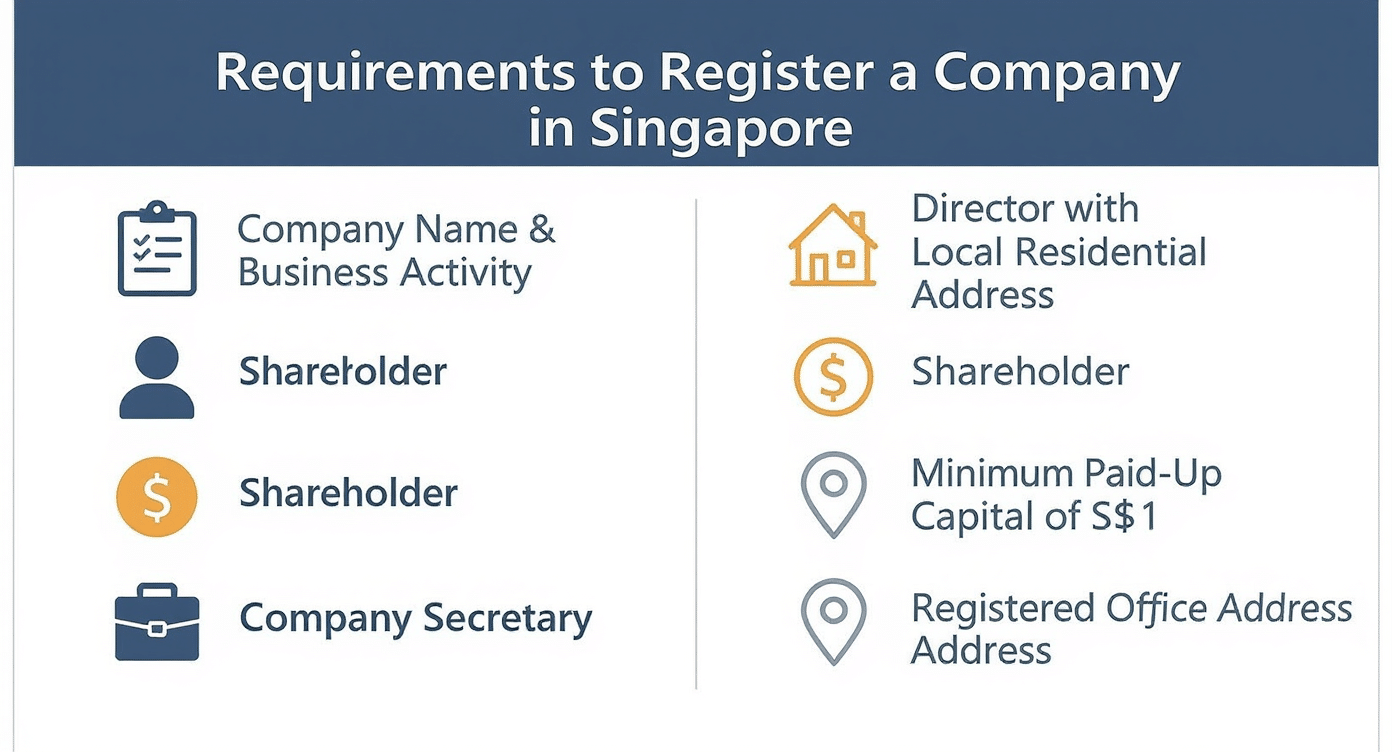
Understanding Singapore Company Registration Requirements
The requirements for registering a company in Singapore are straightforward.
Check Your Company Name Availability Using Our Free Tool!
Please enter the full name you would like to use for your company — for example, ‘Singapore Airlines’ — and click on ‘Search Name’ below.
What is the Process to Register a Company in Singapore?
Here is our step-by-step guide on Singapore company registration, you can check your company name availability here!
Who Can Register a Business in Singapore?
Singapore’s business-friendly policies make it easy for both locals and foreigners to incorporate a company. Citizens and Permanent Residents can register with no additional requirements.
Foreign entrepreneurs must appoint at least one local director but can still retain 100% ownership. Those expanding into Singapore may choose to set up a Subsidiary, Branch Office, or Representative Office—each offering varying levels of independence.
If you don’t have a local director, our Nominee Director Services can help meet regulatory needs while allowing you to maintain full control. This ensures compliance and provides a straightforward path to establish a business in Singapore.
Tax Benefits for Singapore-Registered Companies
Qualifying new companies may receive start-up tax exemption for their first three consecutive years of assessment: 75% on the first S$100,000 of normal chargeable income and 50% on the next S$100,000, subject to IRAS eligibility conditions, including Singapore incorporation, tax residence and shareholding requirements. Investment-holding and property-development companies are excluded. This reduces early-stage tax burdens significantly.
Beyond low tax rates, there’s no capital gains tax. Profits from investments, asset sales, or shares are entirely tax-free.
Singapore also has Double Taxation Agreements with over 80 countries, helping businesses avoid being taxed twice on international income.
Companies registered for GST can claim input tax on expenses, improving cash flow. All these factors make Singapore Company Registration a smart move for sustainable growth
Requirements to Register your Company in Singapore as a Foreigner?
Our Singapore Company Incorporation Services
With extensive expertise in business registration across Singapore, Malaysia, Indonesia, and Hong Kong, we specialize in incorporating private limited companies (Pte Ltd) in Singapore. Our in-depth knowledge of Singapore’s incorporation process and proven success in facilitating seamless registrations make us the trusted partner for businesses. Let us guide you through a smooth and efficient journey, ensuring your company is set up quickly and without hassle.
Common Types of Business Structures in Singapore
-
Private Limited Company (Pte Ltd)
The most common and recommended structure. Ideal for entrepreneurs and SMEs looking for scalability, limited liability, and credibility with banks and investors. -
Limited Partnership (LP)
Suited for business collaborations where one or more partners manage operations and others act as investors without active involvement. -
Limited Liability Partnership (LLP)
A hybrid model offering flexibility in management while protecting partners from personal liability. -
Sole Proprietorship
Best for small, low-risk businesses or freelancers. Easiest to set up but comes with unlimited liability.
Each structure has its pros and cons. It’s important to evaluate them based on your business type, growth plans, and regulatory responsibilities.
What is the timeline to incorporate in Singapore?
The typical timeline for setting up a company in Singapore is 5 to 7 working days. However, this can vary based on how efficiently the company secretary works with shareholders and directors.
A key factor is how quickly each party submits their required documents—proof of identity and residential address—to the secretary for verification.
The faster the documents are provided, the quicker the registration can proceed. Some companies are incorporated within hours, while others take longer due to delays in paperwork.
For shareholders and directors, timely submission is essential. It speeds up the Singapore company registration process and ensures a smooth experience.
Post-Incorporation Compliance in Singapore
After successfully registering your company in Singapore, you must follow through with several important post-incorporation steps. These include setting up a corporate business profile, opening a corporate bank account, securing the required licenses and permits, and fulfilling your annual filing obligations to remain compliant with local regulations.
Opening a Corporate Bank Account in Singapore
Establishing a corporate bank account is one of the first operational steps for any newly incorporated company in Singapore. The process usually involves confirming your business structure, submitting the relevant incorporation documents, providing proof of identity and address, and completing the bank’s application forms.
Singaporean banks may also conduct due diligence checks, particularly for foreign-owned entities, to meet financial compliance standards set by MAS and ACRA.
Obtaining Business Licenses and Permits
Depending on your business activities, specific licenses and permits may be required before you can legally operate in Singapore. For example, businesses in the food and beverage, financial, education, or health sectors must comply with additional licensing regulations.
Failure to obtain these approvals may lead to penalties, exclusion from certain industry associations, or even business suspension. Agencies such as ACRA, MAS, and SFA oversee various sectoral compliance requirements.
International Trademark and IP Protection
Registering your intellectual property, especially your brand trademark, is a vital step in protecting your company’s identity. International trademark registration safeguards your branding and enhances your market presence. This is particularly important if you’re planning to scale into ASEAN or other global markets.
Our 2 Decades of Proven Expertise Will Guide Your Business
With over 20 years of experience across Singapore, Malaysia, Indonesia, and Hong Kong, we’ve successfully incorporated more than 2,000 companies in various jurisdictions.
In Singapore, our high success rate in securing work passes and handling complex regulations reflects our commitment to client success
As trusted advisors, we use strategic networks and market insights to streamline the Singapore company registration process—helping businesses build a strong foundation in a competitive environment.
Frequently Asked Questions
Only if none of your directors is ordinarily resident in Singapore. If you need one, we can provide a nominee director through our ACRA-registered corporate service provider role.
Yes. ACRA accepts a valid Employment Pass holder as meeting the local residency requirement, provided the person is ordinarily resident in Singapore. The pass must be issued for your own company, because MOM treats directorship duties as work. A company must exist before it can apply for your EP, so it usually needs a nominee director at incorporation until your pass is approved. Paul Hype Page is an ACRA-registered public accounting firm and corporate service provider. We can set up that sequence, and for EP clients we also open the corporate bank account, fund the paid-up capital and prepare the financials and projections.
Only with MOM’s approval. Directorship duties count as work, so besides the company that sponsors the pass, an EP holder needs a Letter of Consent (LOC) from MOM for each other company. MOM generally grants it only where the companies share a corporate shareholder and the role relates to the main job. A link through you as an individual shareholder does not qualify, and unrelated companies are assessed with a sector agency. Do not accept a second directorship until the LOC is approved. As an ACRA-registered CSP and accounting firm, we can review your shareholding structure and tell you whether an LOC is realistic.
Often yes, but each bank decides. OCBC advertises fully remote, online account opening for Singapore companies owned by foreigners. DBS handles foreign-owned companies through a relationship manager, and UOB’s online route needs a Singapore citizen or PR to start it. Banks must identify the ultimate owners under MAS rules, so expect document checks and possibly video verification. For EP clients, we open the corporate account. For nominee director clients, we certify the bank trail, source of funds and forecasts, so accounts open faster with fewer questions. As we own our office building, we can also provide a genuine office rental agreement.
No. A registered filing agent such as Paul Hype Page can file the incorporation with ACRA while you are overseas, after verifying your identity documents.
Source: www.acra.gov.sg
The legal minimum is S$1. Banks and MOM may expect more if you plan to open a corporate account or apply for an Employment Pass, so plan genuine working capital for your business needs.
Source: www.acra.gov.sg
Yes. Shareholders can be 100% foreign individuals or companies. Only the director requirement is local: at least one director must be ordinarily resident in Singapore.
Source: www.acra.gov.sg
Only if taxable turnover exceeds S$1 million in the past 12 months or is expected to in the next 12 months; voluntary registration is possible. Paul Hype Page handles GST registration for S$1,200.
Yes. A foreign company can register a Singapore branch, which is not a separate legal entity and needs an authorised representative resident in Singapore. Paul Hype Page registers branches for S$2,800.
S$1,115: our S$800 fee plus the S$315 ACRA fee. You will also need a company secretary (S$600 a year) and a registered address (S$300 a year).
Yes, if you meet MOM’s qualifying salary and pass COMPASS. We offer a free EP eligibility check.
If MOM rejects your EP, we appeal for free.
Yes, it is a mandatory in Singapore. If not, will result in the imposition of penalties, fines, and potential legal repercussions as Companies Laws.
All Singapore companies should have at least one director who is a Singapore Citizen, a Singapore permanent resident, or a valid Employment Pass holder who is ordinarily resident in Singapore, with the pass issued for your own company. Important to take note, a foreign director can be appointed alongside the local director.
The answer is quite straightforward. A private limited company must have a minimum of one shareholder, according to Singapore company laws. Here are more info to read the article.
The benefits include limited liability for shareholders, a separate legal entity status, ease of raising capital, tax incentives, and credibility with clients and investors.
A Private Limited Company (PTE LTD) in Singapore is a separate legal entity from its owners, offering limited liability protection to its shareholders. This means that shareholders are only liable for the company’s debts up to the amount of their investments.
No, S Pass or Work Permit holders in Singapore are not allowed to open company in Singapore. They are prohibited from being shareholders, owning, or managing businesses in the country.
Singapore Company Registration Guides
Supplement your existing knowledge with additional insightful readings that we’ve crafted based on our 20 years of experience.