All Resources
July – September 2026 | Singapore Guides
Core inflation rising to 2.2% in August 2026—driven by services and utilities—can quickly show up in payroll pressure, vendor contracts, energy bills, and weaker contribution margins. This guide shows SMEs how to rebuild 2026–2027 budgets line-by-line, set scenarios and triggers, reprice using contribution margin, and stress-test cashflow with tax-aware forecasting.

As Singapore employers scale past 200 employees, HR needs to operate with clear decision rights, consistent manager practice, reliable data, and defensible documentation—not just add a certificate. This guide sets out an 18–24 month roadmap to build HR governance, HR–payroll–finance controls, and dispute-handling readiness before growth makes fixes expensive.

Singapore electronics exporters riding the AI export boom can become over-dependent on a few customers and markets, creating cash flow, revenue cut-off, tax, and audit risks when disruptions hit. This guide shows how to measure concentration, stress-test exposure, and build proportionate controls across contracts, Incoterms, BOM change control, export screening, credit, FX, and documentation.

A stronger Singapore growth outlook can tempt SMEs to scale too quickly and get squeezed by working capital, payroll commitments, and tax cash outflows when conditions soften. This guide shows how to build base/upside/downside scenarios, set trigger-based spending and hiring gates, run a reforecast and cash rhythm, and plan tax and MRA execution without creating reporting surprises.
A higher-for-longer cost environment can turn small execution gaps into real cash-flow stress for Singapore SMEs. This guide shows how to convert the MAS outlook into a CFO-level plan using a rolling cash forecast, scenario triggers, payroll and working-capital levers, tax cash timing, and financing readiness.
Core inflation at 2.2% changes how Singapore SMEs should think about pricing, wage adjustments, and cashflow, because cost increases hit unevenly and renewals don’t move at the same time. This guide shows how to refresh unit economics, execute segmented repricing, model payroll properly, tighten working capital, and keep accounting and documentation strong (including if using MRA support).
For Singapore cross-border related-party transactions, the key practical issue is knowing what is binding law versus IRAS audit expectation. This guide explains how the Income Tax Act gives IRAS its adjustment and enquiry powers, while the Transfer Pricing Guidelines set out how to support arm’s length outcomes with methods, documentation, and controls.

XBRL filing is an Annual Return execution issue: you need to confirm whether ACRA expects your company’s financial statements to be lodged in full XBRL, a simplified XBRL template, or under an exemption. This guide outlines a practical workflow to choose the right ACRA-prescribed template, map and validate efficiently, and reduce rejection risk before submission.

Multinational finance teams often discover late in the close that a Singapore entity’s IFRS group pack can’t necessarily be used for Singapore statutory financial statements. This guide explains the ASC-issued frameworks expected in Singapore (SFRS(I) or SFRS for Small Entities) and provides a practical roadmap to bridge from IFRS reporting to audit-ready statutory accounts.

ACRA BizFile+ filings can get delayed when the information you enter doesn’t match what ACRA expects in each field. This guide breaks Singapore company registration into clear stages and shows what data to prepare upfront—SSIC codes, shareholding and officers’ particulars, registered office details, and constitution choices—to reduce resubmissions.

Enhanced childcare leave can break SME delivery when teams rely on single points of failure and ad hoc scheduling. This playbook shows how to map critical tasks, redesign roles, cross-train with deliberate redundancy, and set roster and approval rules that protect service levels and retention.

Many AI startups in Singapore can sell locally but struggle to run Southeast Asia with consistent governance, delivery, and enterprise-ready assurance. This playbook explains the operating models, Singapore-anchored control functions, and lightweight workflows and cadence needed to scale across SEA without losing speed or control.
April – June 2026 | Singapore Guides

Singapore private companies generally need an audit unless they qualify for audit exemption under ACRA’s small company regime. This guide gives a practical yes/no pathway covering the 2-out-of-3 test over two consecutive financial years, how group structures change the analysis, and what to do in transition years.

Applied Materials’ expansion signals tighter competition for engineering and technician talent, more demand for high-spec industrial space, and higher procurement expectations across the semiconductor ecosystem. This guide maps which SME vendor categories may see pull-forward demand in 2026–2027 and outlines practical readiness moves in traceability, documentation, delivery reliability, and cashflow discipline.
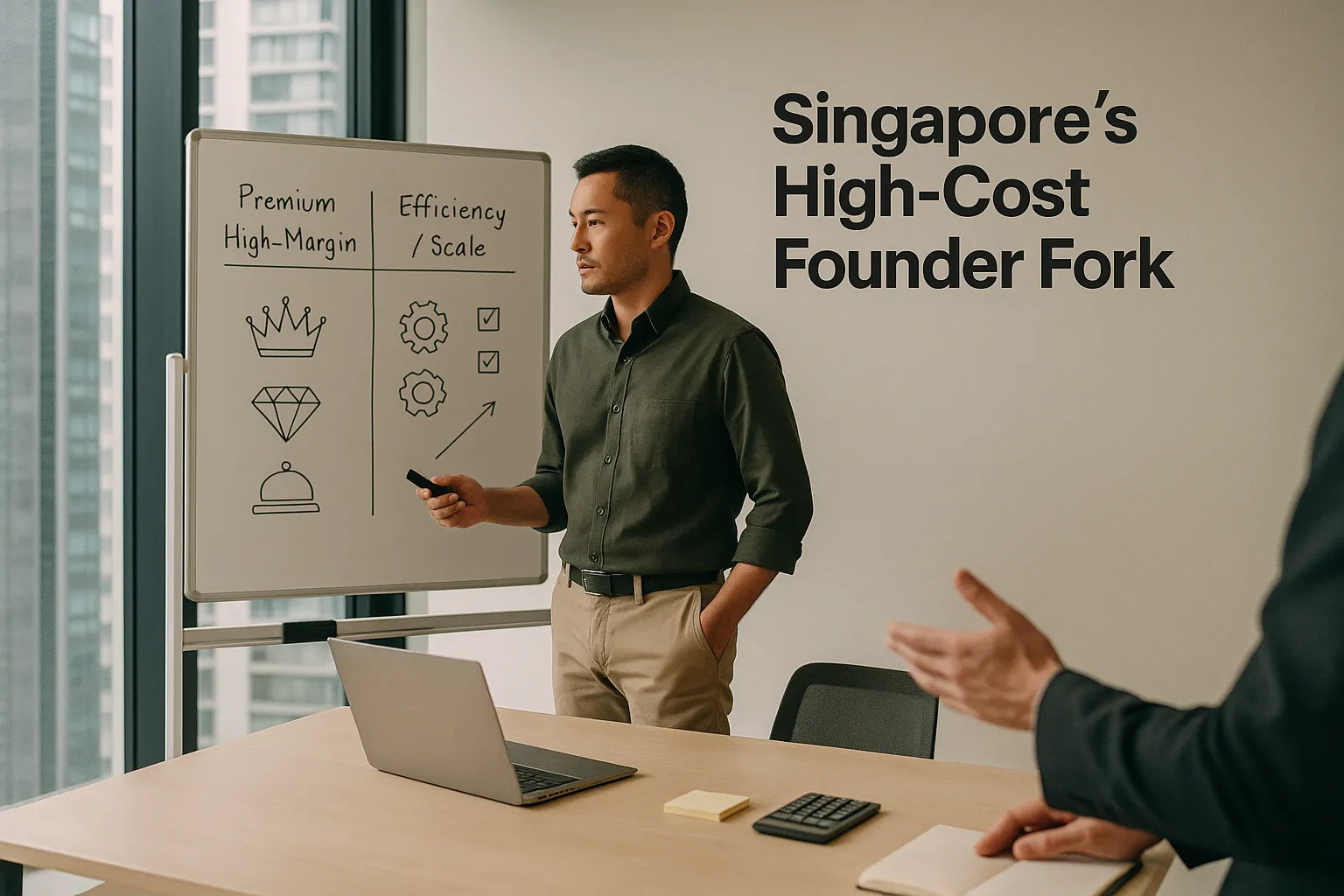
As Singapore’s costs rise like a premium city, many SMEs face margin squeeze because their pricing and delivery model no longer match their overheads. This guide helps founders choose between an ultra-premium HNW play or an efficiency-and-scale model, with practical operating changes to avoid the “mushy middle”.

Singapore’s AI hardware upswing can tempt founders and SMEs into fast capex and fragile single-customer bets, even as qualification cycles, pricing pressure, and downcycles make mistakes expensive. This guide offers a decision framework to choose where to play in the supply chain, prove demand before capex, reduce concentration risk, and build more durable service-tail revenue into 2027 scenarios.
Singapore SMEs can move from AI trials to real productivity gains by starting with a few measurable workflows and clear ownership. This guide outlines low-risk pilot use cases, PDPA-aware data governance guardrails, and a simple ROI model to scale safely into 2027.

Singapore’s expected 2026 Companies Act amendments will tighten how selective off-market share buybacks are approved, with greater focus on conflict-sensitive voting and documentation. SMEs should review their constitution, shareholder agreements, and resolution/minute templates early to avoid invalid approvals and audit or due diligence issues.
MOM COS 2026 is expected to reshape Singapore SMEs’ foreign workforce planning through Local Qualifying Salary (LQS) shifts, work pass eligibility, and levy cost changes. Learn how to update payroll structures, budgets, and HR documentation early to stay compliant and avoid last-minute pass or levy issues.
January – March 2026 | Singapore Guides

Iran war 2026 oil-supply headlines can quickly translate into higher landed costs, freight surcharges, FX swings, and working-capital strain for Singapore SMEs. This guide explains how stronger accounting policies, audit-ready documentation, and tax planning can keep decisions defensible and cash flow resilient through 2026–2027 volatility.
MOM COS 2026 updates signal higher Employment Pass and S Pass expectations that can raise total hiring costs for Singapore SMEs through 2027–2028. Learn how to plan EP vs S Pass choices, payroll structure, LQS 1,800 alignment, and renewal timelines to stay compliant without margin shocks.

With the ACRA Amendment Bill 2026 expected from April 2026, directors should prepare for tighter enforcement and greater personal exposure for late filings, weak governance, and inaccurate reporting. Use 2025–early 2026 to strengthen your compliance calendar, company secretarial controls, and finance/audit readiness so your board has a defensible oversight trail.
Tax Season 2026 in Singapore is increasingly digital—IRAS e-Filing checks, consistent reconciliations, and timely ECI submissions matter more than ever for SMEs. Learn the practical steps to reduce penalties, avoid cash-flow shocks, and stay audit-ready with clean, supportable records.
The Singapore GDP 2026 forecast points to AI-driven productivity and stronger trade flows—but growth only helps if your back office can keep up. Here’s what to do in 2025 to incorporate correctly, plan tax and accounting, secure key hires, open the right bank accounts, and scale with audit-ready controls.

Singapore SMEs can potentially use the Enterprise Innovation Scheme (EIS) to claim up to 400% tax deductions on qualifying AI and innovation costs for YA 2026–2027—if the project is structured, tracked, and documented properly. This guide explains what typically qualifies, what IRAS expects to see, and how to set up project codes, contracts, and evidence packs to make claims defensible.
Singapore Budget 2026 measures on AI, wage support, and post‑SG60 reliefs only become real cashflow when your payroll, CPF alignment, and bookkeeping are clean and claim-ready. Learn how to structure wage changes, tag qualifying AI spend, and keep IRAS/MOM compliance tight so incentives translate into measurable savings.

Singapore’s GTP extension to 2031 and the expected inclusion of Environmental Attribute Certificates (EACs) from 13 Feb 2026 can reshape tax modelling, accounting policies, and transfer pricing for trading groups. This guide outlines how to build audit-ready substance, documentation, and controls to sustain concessionary tax rates through 2026–2031.

Singapore SMEs can potentially claim enhanced tax deductions (often cited as “up to 400%”) under the Enterprise Innovation Scheme when AI spend is structured and substantiated as qualifying innovation work. This guide explains how to scope AI projects, classify costs, and build IRAS-ready documentation now (Feb 2026) to reduce YA 2027 claim risk.
The enhanced Progressive Wage Credit Scheme (PWCS) and expected 30% co-funding for 2026–2028 can materially offset wage increases—but only when payroll, CPF submissions, and documentation are consistent and audit-ready. This guide shows Singapore SMEs how to structure wage reviews, map wage components, run monthly reconciliations, and forecast cashflow so PWCS support is measurable and claim-ready.

Rising business closures in Singapore aren’t a prediction—they’re a prompt to tighten reporting, cash runway visibility, and decision triggers before pressure forces reactive cuts. Learn the red flags to watch, how stronger accounting and compliance improves outcomes, and when regional expansion (Malaysia, Indonesia, Hong Kong) can diversify risk for 2026–2028.

Singapore PR and citizenship outcomes are usually assessed through a broader, evidence-based view than language and credentials—especially your sustained economic contribution, compliance record, and integration over time. This 2026–2028 guide explains how Employment Pass strategy, tax filings, and accounting compliance can strengthen (or weaken) the narrative authorities can verify.
October – December 2025 | Singapore Guides

Singapore–China RMB and capital market initiatives are reshaping how businesses manage banking, foreign exchange, accounting, and tax exposure. This guide explains what SMEs should review and adjust in their finance strategy to stay compliant and prepared for 2026.

Singapore’s S Pass levy will rise to as high as S$650 by 2026, pushing employers to rethink their manpower strategy. Shifting suitable roles toward Employment Pass (EP) talent can reduce long-term labour costs while strengthening workforce capability and MOM compliance.
ACRA’s 2025 reporting updates mark a major shift in Singapore’s financial compliance standards, particularly for SMEs preparing their year-end accounts. This article explains the updated requirements and outlines how businesses can prepare for stricter enforcement in 2026.
The BizAdapt Grant offers SMEs a strategic opportunity to strengthen accounting systems, tax governance, and operational resilience ahead of 2026. With global compliance standards rising, using BizAdapt to modernise financial foundations today helps SMEs stay competitive and expansion-ready tomorrow.
MOM’s updated Employment Pass processing timelines mean HR teams must redesign recruitment cycles, documentation workflows, and candidate screening processes ahead of 2026. This guide explains how employers and foreign professionals can prepare early to avoid delays, strengthen applications, and adapt to Singapore’s evolving hiring landscape.

Singapore’s labour market continues to expand, but wage growth is projected to slow sharply in 2026, creating a rare window for founders to build teams at more sustainable cost levels. For new and foreign-owned companies, this shift offers a strategic opportunity to establish operations before manpower pressures rise again.
July – September 2025 | Singapore Guides

A stronger 2026 NODX outlook can amplify cash flow strain, FX exposure, inventory/WIP errors, and revenue cut-off risk for Singapore exporters. This guide shows how to translate the forecast into a month-by-month plan for faster closes, working capital control, and defensible GST export documentation.

As AI literacy becomes a baseline expectation, many Singapore SMEs risk mis-hires and uneven adoption because job designs and interviews can’t distinguish real AI-enabled operators from confident tool talkers. This guide provides a practical 60–90 day plan to redesign roles around judgment versus automatable work, upgrade hiring signals with work samples and scorecards, and build measurable upskilling supported by lightweight people analytics and HR tech.

Singapore private companies are generally expected to have their financial statements audited each year unless they qualify for an exemption. This guide shows how to apply the small company (and, where relevant, small group) tests using the 2-out-of-3 thresholds over two consecutive financial years, and what you still need to do if you are exempt.

Setting up a business in Singapore, there are a few entities you can choose from. The most popular would be a private company.

Integrating the IIA’s updated Internal Audit Standards with Singapore’s National Risk Assessment (NRA) creates a powerful framework for businesses to enhance their risk management and governance practices. This integration ensures compliance with both global best practices and local regulatory requirements, boosting credibility and investor confidence.

The Business Grants Portal (BGP) in Singapore is an essential tool for early-stage startups, streamlining access to multiple government grants, licenses, and permits through a single platform. It offers significant funding opportunities for entrepreneurs, helping them grow their businesses smarter, faster, and more efficiently.