Outline
- How should you think about IFRS vs SFRS(I) without getting stuck in technicalities?
- What is the direct comparison between IFRS and SFRS(I) that matters for execution?
- Where does Singapore FRS fit alongside SFRS(I), and why does it still matter for groups?
- Which Singapore entities typically apply SFRS(I) vs FRS—and how should you confirm eligibility?
- How do IFRS/SFRS(I) differences show up in group consolidation workflows?
- What do foreign investors and lenders typically expect, and how should you prepare without overpromising?
- If you’re considering moving from FRS to SFRS(I), what is a workable implementation roadmap?
- What should your team do about accounting policy elections and estimates during conversion?
- How do you design reporting packages that work for both statutory reporting and group reporting?
- What are the common implementation traps when teams assume ‘IFRS-aligned’ means ‘no work’?
- Conclusion
- Need to operationalise IFRS/SFRS(I) group reporting?
- FAQs
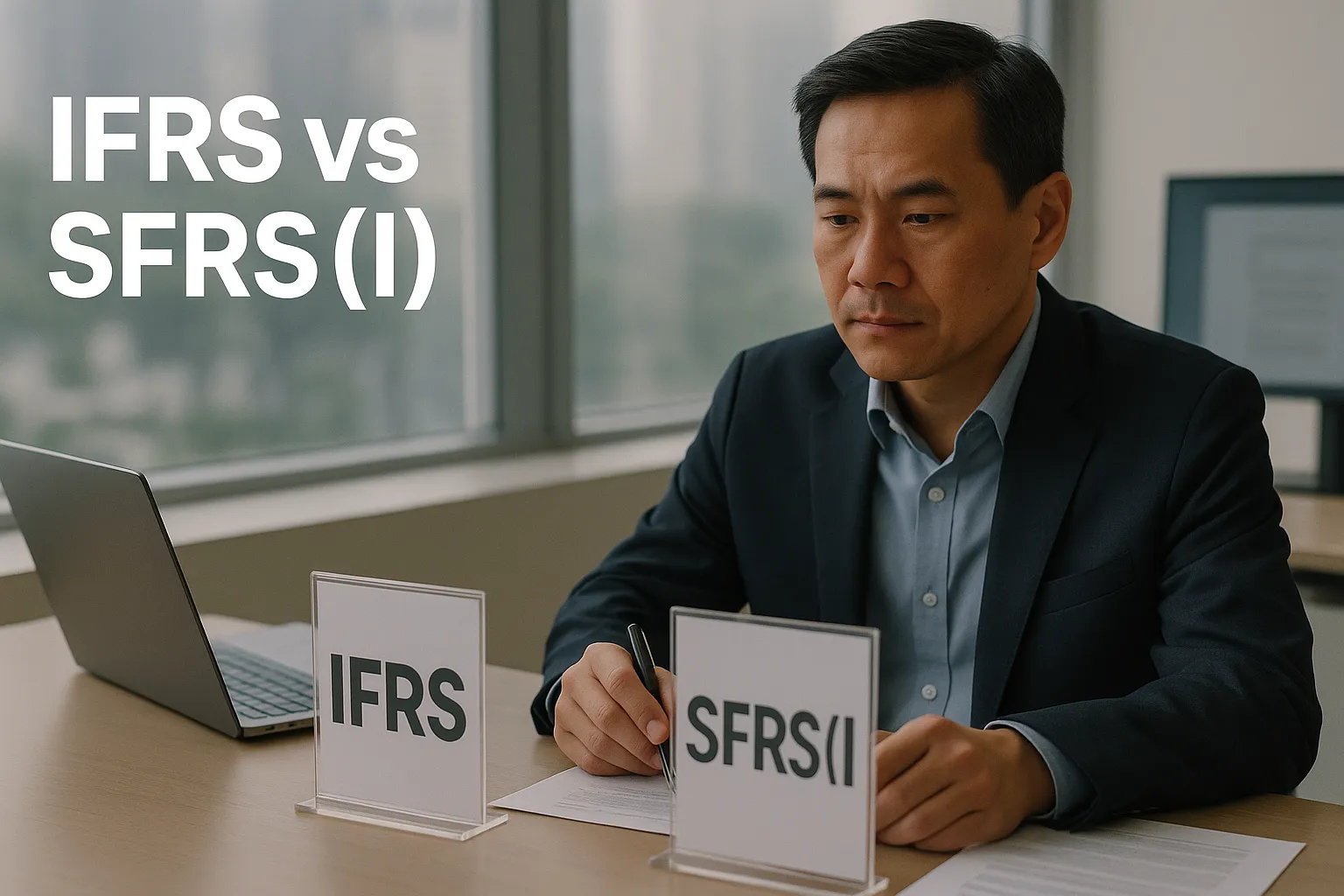
For Singapore finance leaders reporting to overseas parents, investors, or lenders, “IFRS vs SFRS(I) Singapore” is rarely an academic question. It shows up in consolidation instructions, reporting package templates, covenant definitions, valuation work, and audit planning—often at the worst possible time (month-end, fundraising, or an acquisition). Singapore Financial Reporting Standards (International) [SFRS(I)] is Singapore’s IFRS-aligned framework, but “aligned” doesn’t always mean identical in effective dates, transition provisions, or local issuance details. At the same time, Singapore FRS remains relevant for many entities. This guide gives a practical comparison of IFRS vs SFRS(I) (and where FRS still fits), plus an implementation roadmap for group reporting and any FRS→SFRS(I) conversion—anchored to the Accounting Standards Council (ASC) as the authoritative reference.
How should you think about IFRS vs SFRS(I) without getting stuck in technicalities?
At an operational level, the question is not “Which framework is better?” The workable question is: what basis does each stakeholder expect, and how do you produce consistent numbers efficiently and defensibly?
A practical definition you can use internally
- IFRS Standards (IFRS): International standards issued by the International Accounting Standards Board (IASB). Often used by listed groups and multinational parents as the group reporting basis.
- SFRS(I): Singapore-issued standards designed to be substantially aligned with IFRS, issued locally. Alignment helps comparability, but you still need to treat SFRS(I) as its own issued framework (with its own effective dates, local issuance and transition features).
- Singapore FRS: Singapore’s older/mainstream framework used by many non-publicly accountable entities. It is not “wrong” or “obsolete”—it remains the applicable framework for many companies.
The operational takeaway
Treat the three labels as three layers of decision-making:
- Statutory reporting basis (what the Singapore entity must apply).
- Group reporting basis (what the parent/investor wants for consolidation or monitoring).
- Bridging mechanics (how you convert, reconcile, or align numbers and disclosures between the two).
If your team gets those layers clear, the rest becomes a workflow problem—policies, data, templates, controls, and deadlines.
What is the direct comparison between IFRS and SFRS(I) that matters for execution?
Most execution problems happen because teams assume either (a) SFRS(I) is always identical to IFRS so there’s nothing to do, or (b) it must be materially different so everything needs rework. Neither assumption is a good starting point.
Side-by-side: what’s typically the same vs where differences show up
What is typically the same (in substance):
- Recognition and measurement principles are intended to track IFRS closely.
- Key technical areas (revenue, leases, financial instruments, impairment, consolidation) are designed for international comparability.
Where differences can show up in practice (what to test, not assume):
- Effective dates: A standard or amendment may be effective at different times when issued in Singapore.
- Transition provisions: The choices and reliefs available on first-time adoption or on specific amendments can differ in how they are applied locally.
- Local modifications or guidance: Singapore may issue the standards with limited local tailoring or clarifications.
A finance team’s “do we care?” filter
You usually need detailed checking only if one of these is true:
- You’re preparing dual reporting (statutory SFRS(I) + group IFRS).
- You are moving from FRS to SFRS(I).
- You’re executing a transaction sensitive to measurement and disclosures (fundraising, acquisition, major lease/contract restructuring, impairment event).
Anchor point for governance
Because alignment and effective dates can change over time, your internal guidance should explicitly reference the ASC website as the authoritative source for the current SFRS(I) standards, amendments, and transition guidance. Build that reference into your accounting policy manual and close checklist so it survives staff turnover.
Where does Singapore FRS fit alongside SFRS(I), and why does it still matter for groups?
For many groups, the real friction isn’t IFRS vs SFRS(I); it’s FRS subsidiaries inside an IFRS- or SFRS(I)-reporting group.
How to explain FRS vs SFRS(I) to stakeholders
- FRS is a Singapore financial reporting framework still used by many entities.
- SFRS(I) is Singapore’s IFRS-aligned framework, typically associated with entities with public accountability or those that need IFRS-level comparability.
Why it matters even if the group consolidates under IFRS
If a Singapore subsidiary uses FRS for statutory reporting, the group may still require reporting packages aligned to IFRS/SFRS(I). That creates three practical tasks:
- Policy mapping: Identify where FRS accounting policies differ from the group’s basis.
- Adjustment mechanics: Build repeatable journals/adjustments for consolidation.
- Disclosure planning: Ensure group disclosures can be supported from the subsidiary’s data.
If you skip these tasks, the pain shows up later as late consolidation adjustments, audit queries, and “why did EBITDA move?” questions from management or lenders.
Which Singapore entities typically apply SFRS(I) vs FRS—and how should you confirm eligibility?
Eligibility and requirements should be verified against official sources (ASC guidance and, where relevant, ACRA-related financial reporting requirements). The goal here is not to give a definitive classification, but to provide a working map to structure your internal decision.
Principle-level mapping (typical, not definitive)
- SFRS(I): Often associated with entities with public accountability and/or where IFRS comparability is expected (for example, in capital markets contexts).
- FRS: Commonly used by many non-publicly accountable Singapore companies for statutory reporting.
How to confirm (what to do inside your finance function)
Create a short “reporting basis memo” (1–2 pages) that you refresh annually:
- Current statutory framework applied (FRS or SFRS(I)).
- Reasoning for applicability (principle-level, with citations/links to the relevant ASC materials).
- Whether the group requires IFRS-aligned reporting packages regardless of statutory basis.
- Any expected change triggers (IPO plans, new investor requirements, acquisition by an IFRS parent).
This memo becomes a practical control: it avoids last-minute debates with auditors or parent finance teams when deadlines are tight.
How do IFRS/SFRS(I) differences show up in group consolidation workflows?
Even when IFRS and SFRS(I) are substantially aligned, consolidation failures often come from workflow design, not the standards themselves.
The three friction points finance teams actually face
1) Inconsistent accounting policies across entities
- Same transaction, different policy elections or estimates.
- Different interpretations applied by different controllers.
Control to implement:
- A group accounting policy pack with mandatory elections/positions.
- A quarterly policy attestation from each entity controller.
2) Reporting packages that don’t collect what group needs Common gap: the statutory trial balance exists, but the group needs additional breakdowns (e.g., revenue disaggregation, contract asset movements, lease maturity analysis, ECL inputs).
Control to implement:
- A reporting package built from data requirements, not from the trial balance.
- A mapping that ties each disclosure line to a data owner and source system.
3) Late or unstable consolidation adjustments Adjustments get posted “at group” with limited subsidiary support, creating audit friction and management distrust.
Control to implement:
- Push adjustments downstream: where possible, have subsidiaries calculate and submit standard adjustment schedules (even if not booked in statutory ledgers).
- Maintain a “standing adjustments register” with rationale, calculation, and reversal logic.
Practical example: the ‘two books’ reality
A Singapore subsidiary may produce statutory accounts under FRS, while group reporting is IFRS. The objective is not to run two full ledgers; it’s to run:
- One statutory ledger;
- One repeatable set of group reporting adjustments (journals or schedules);
- One evidence file that makes audits and due diligence survivable.

What do foreign investors and lenders typically expect, and how should you prepare without overpromising?
International stakeholders rarely demand a specific label for its own sake—they want comparability, transparency, and controllable risk.
Where IFRS alignment matters commercially
- Due diligence: Faster review when policies and disclosures map cleanly to international norms.
- Covenants and KPI definitions: EBITDA, net debt, and working capital can move depending on revenue recognition, leases, and impairment approaches.
- Valuation models: Comparable metrics require consistent revenue cut-off, lease treatment, and segment/disaggregation data.
- Audit and timetable expectations: Cross-border groups often run tight close calendars.
How to manage expectations in a term sheet or lender discussion
Avoid blanket statements like “We are IFRS.” Instead, use controlled language:
- “Statutory financial statements are prepared under FRS/SFRS(I). For group reporting, we provide IFRS-aligned reporting packages and reconciliation schedules.”
- “Key accounting policies are aligned to the group’s reporting basis, subject to confirmation against current ASC-issued standards and our auditors’ review.”
A practical investor-ready artefact
Maintain an “Accounting Basis & Reconciliations” pack (kept current):
- Summary of reporting frameworks used across the group.
- List of recurring consolidation adjustments and why they arise.
- High-level reconciliation bridges for sensitive KPIs (revenue, EBITDA, net debt, equity).
This is the kind of pack that reduces friction in diligence without claiming outcomes you can’t guarantee.
If you’re considering moving from FRS to SFRS(I), what is a workable implementation roadmap?
An FRS→SFRS(I) move is rarely just an accounting exercise. It is a project that touches systems, data, contracts, and stakeholder communications.
Phase 1: Scope and governance (2–4 weeks in many cases)
Decisions to lock early:
- Why convert? (Parent alignment, investor expectations, growth plans, audit efficiency)
- What’s the target reporting date? (Confirm current effective dates and transition rules via ASC resources before finalising.)
- What entities are in scope? (Standalone entity vs subgroup vs full group)
Ownership model:
- Project sponsor: CFO/Finance Director
- Workstream leads: Financial reporting, consolidation, tax, systems, payroll (where impacts exist), and audit liaison
- Steering cadence: bi-weekly during design/build
Phase 2: Gap assessment (the highest ROI step)
Build a gap register that is specific and testable:
- Policy differences (recognition/measurement and presentation)
- Disclosure differences
- Transition choices/reliefs available and implications
- Data gaps (what you don’t currently capture)
Output: a prioritised list of changes with estimated effort and dependencies.
Phase 3: Design the “to-be” reporting model
This is where most teams either simplify their future close—or recreate complexity.
Design choices to make explicitly:
- Will you post conversion adjustments in the statutory ledger, or only in consolidation/reporting layer?
- What’s the minimum level of chart of accounts granularity needed for disclosures?
- Which schedules become standard monthly (leases, revenue contracts, ECL/credit risk, provisions)?
Phase 4: Build and data readiness
Typical build items:
- Chart of accounts mapping updates
- Reporting package redesign
- Consolidation system mapping (if applicable)
- Templates for recurring calculations
- Documentation standards (calculation files, assumptions, review sign-offs)
Data readiness checks:
- Do you have contract data for revenue analysis?
- Do you have complete lease data and renewal/variable payment logic?
- Do you have credit risk data needed for impairment models (where relevant)?
Phase 5: Transition and comparatives planning
Conversion often fails when teams underestimate comparatives and the workload around transition disclosures.
Practical planning steps:
- Decide the comparative periods required and work backwards.
- Build a timeline for parallel runs.
- Align early with auditors on evidence expectations (not for “permission”, but to avoid rework).
Phase 6: Training, controls, and go-live
Make it stick:
- Short training for finance users (what changes in journals, estimates, disclosure support).
- Close checklist updates (new schedules, new reviews).
- Controls: review sign-offs, reasonableness checks, variance thresholds.
If Paul Hype Page & Co. is supporting a conversion, the most valuable role is typically project structuring (gap register, workplan, templates, audit coordination, and reporting package redesign) so finance teams can execute without losing control of month-end.
What should your team do about accounting policy elections and estimates during conversion?
In IFRS-aligned reporting, many outcomes depend less on “rules” and more on elections, assumptions, and consistent estimates. That’s where implementation discipline matters.
Policy elections: treat them as business decisions with accounting consequences
Examples of what to formalise (illustrative only; confirm current standards and applicability):
- Practical expedients/reliefs available on transition
- Componentisation and useful life frameworks for fixed assets
- Revenue disaggregation approach that matches your business model
Implementation control: Create an Accounting Policy Decision Log:
- Decision
- Rationale
- Alternatives considered
- Data impact
- Effective date and transition handling
- Approver
Estimates: standardise the model and the review
If each entity estimates differently, consolidation becomes negotiation.
Implementation control:
- Set group-wide estimation methodologies (impairment triggers, provisioning approach, discount rates where relevant).
- Define who owns each assumption (Finance vs business owner).
- Require a quarterly assumptions pack with variance explanations.
The goal is not to remove judgement; it’s to make judgement repeatable and reviewable.
How do you design reporting packages that work for both statutory reporting and group reporting?
A good reporting package is the difference between a predictable close and a monthly fire drill.
Start from outputs, not inputs
Build the pack backwards from:
- Group consolidation entries needed
- Management KPI pack requirements
- Expected note disclosures (especially those that require movement schedules)
Minimum components of a “dual-use” reporting package
- Trial balance with mapping to group chart of accounts
- Movement schedules: PPE, intangibles, leases, provisions
- Revenue and receivables breakdowns aligned to your business lines
- Related party and intercompany matrices (with settlement status)
- Tax and deferred tax support schedules (if needed at group level)
- Representation checklist: key cut-off confirmations, completeness statements
Workflow integration (so it doesn’t become extra work)
- Tie each schedule to a month-end task owner and due date.
- Automate extraction where possible (ERP reports, lease system exports).
- Apply review tiers: preparer → reviewer → approver.
A practical target: if a schedule exists only for the audit, it will be neglected. If it is used monthly for management and group reporting, it becomes reliable.
What are the common implementation traps when teams assume ‘IFRS-aligned’ means ‘no work’?
The biggest problems come from under-scoping.
Trap 1: Treating conversion as a one-time journal exercise
What goes wrong: Adjustments are booked at year-end, but monthly reporting remains inconsistent. Next year the same issues recur.
Fix: Build recurring schedules and integrate them into close.
Trap 2: Ignoring disclosures until late
What goes wrong: You can’t support note disclosures because data wasn’t captured during the year.
Fix: Identify disclosure-driven data needs during gap assessment and add them to monthly packs.
Trap 3: Not aligning early with parent reporting requirements
What goes wrong: Subsidiary converts, but the parent wants a different mapping, different materiality thresholds, or different segment breakdown.
Fix: Obtain and lock the parent’s reporting package template and accounting policy pack early.
Trap 4: Underestimating systems and master data impacts
What goes wrong: Chart of accounts lacks required dimensions; lease or contract data is incomplete.
Fix: Run a data completeness test and design minimal new fields/dimensions before go-live.
Trap 5: Weak documentation and review evidence
What goes wrong: Auditors challenge adjustments and assumptions; timelines slip.
Fix: Standard calculation templates, sign-offs, and a central evidence repository.
These are execution issues—solvable with project management and finance operations discipline.
Conclusion
For Singapore finance teams, the practical answer to IFRS vs SFRS(I) is: SFRS(I) is Singapore-issued and substantially aligned with IFRS, but you still need to manage local issuance details, effective dates, and transition mechanics—while many entities will continue to use FRS for statutory reporting. The operational priority is to design a repeatable group reporting workflow: aligned accounting policies, fit-for-purpose reporting packages, and controlled reconciliation/adjustment processes. If you are considering an FRS→SFRS(I) move, treat it as a cross-functional implementation project—start with a gap register, confirm current ASC-issued requirements before locking timelines, and build the data and controls needed to sustain the new basis after go-live. When done well, you reduce consolidation friction and improve credibility with auditors, investors, and lenders.
FAQs
SFRS(I) is designed to be substantially aligned with IFRS, but it is a Singapore-issued framework and differences can arise in local issuance details such as effective dates and transition mechanics—so teams should check rather than assume.
Confirm the subsidiary’s statutory basis (FRS or SFRS(I)), obtain the parent’s accounting policy pack and reporting package template, then identify recurring differences and build a standard adjustments register and evidence file.
Treat it as a project: set scope and target date, run a gap assessment (policies, disclosures, data), design the to-be reporting model and reporting packs, prepare data and templates, plan transition/comparatives and parallel runs, then train users and embed the new schedules into month-end controls.
FRS remains relevant where a Singapore entity uses FRS for statutory accounts but the group consolidates under IFRS or SFRS(I), requiring policy mapping and repeatable consolidation adjustments.
Use the Accounting Standards Council (ASC) website as the authoritative reference for current SFRS(I) standards, amendments, and related transition guidance.
Share This Story, Choose Your Platform!
Related Business Articles