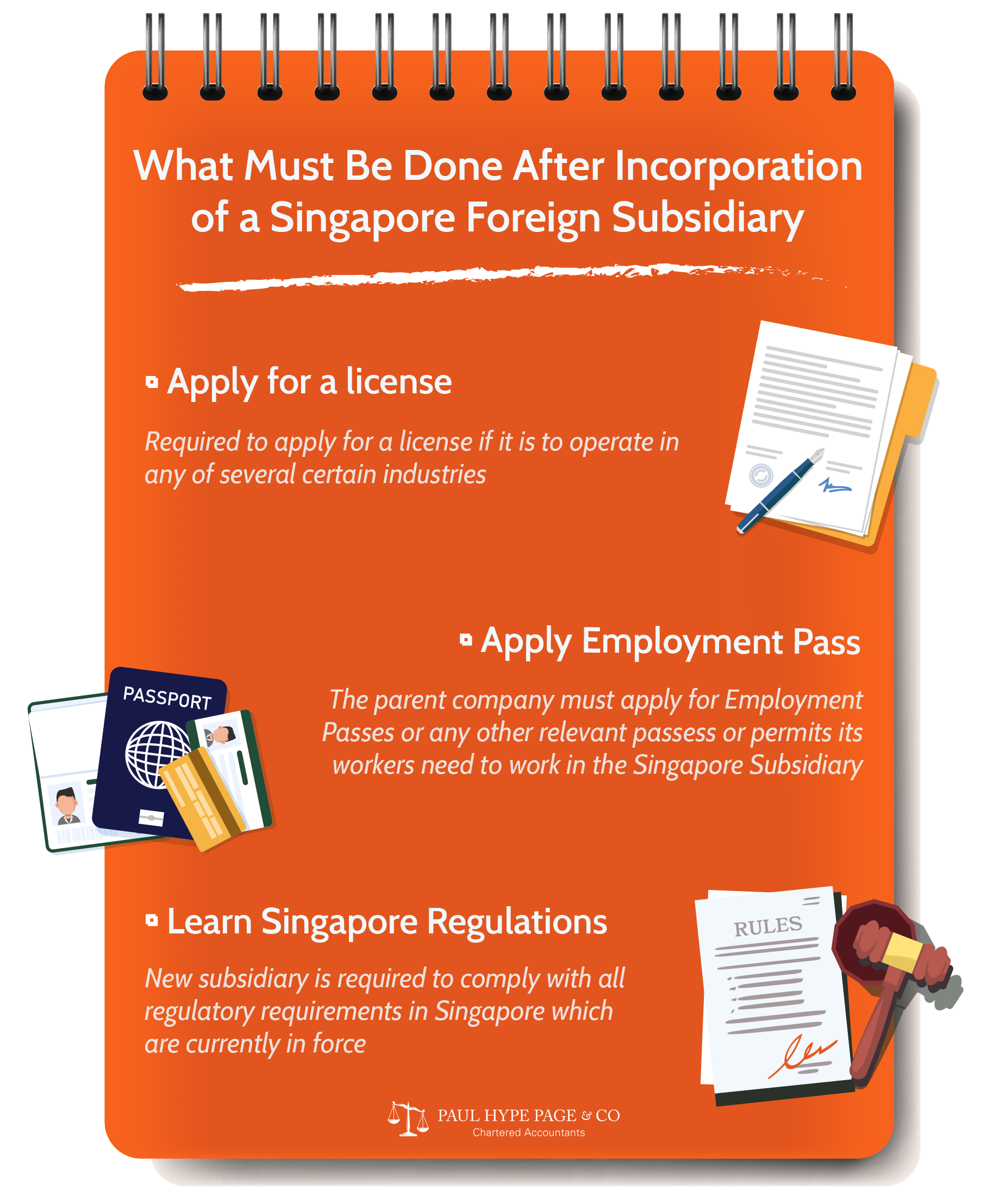
A comprehensive guide to a subsidiary incorporation requirement in Singapore, tailored for people who want to open a subsidiary in Singapore!
A comprehensive guide to a subsidiary incorporation requirement in Singapore, tailored for people who want to open a subsidiary in Singapore!
The requirements for registering a company in Singapore are simple and straightforward. They are:
Q: Can a foreigner be a director of a Singapore company? Yes. Every company needs at least one director ordinarily resident in Singapore (a Singapore citizen, PR or EP/EntrePass holder), or a nominee director if none of the directors lives here.
Relocating to Singapore through your own company
What is Singapore Employment Pass?
Singapore Employment Pass, often referred to as the ‘EP,’ a work visa is issued to foreign professionals, managers, executives, and experts relocating to work in Singapore.
Nominee director: S$3,800 for 12 months, or S$400 per 2 months short-term, plus a S$5,000 refundable deposit.
EP fees: EP from S$900; company assessment and EP preparation S$2,800; MOM fees extra. 96% EP success rate across 1,000+ applications (PHP internal records). If MOM rejects your EP, we appeal for free.
If you are a foreigner, you will need a nominee director (local director) to incorporate your company in Singapore.
What is a Nominee Director?
Nominee director is an individual who is appointed to act as a director of the company on behalf of another individual or entity. For all foreigners establishing businesses in Singapore, having a nominee director is essential due to regulations from the Accounting & Corporate Regulatory Authority (ACRA).
There are 2 types of Nominee Director services in Singapore.
They are:
If you are planning to establish a business in Singapore, opening a corporate bank account is a mandatory step upon incorporation. A dedicated corporate account ensures that business transactions remain separate from personal finances, allowing for clearer cash flow management, accurate income tracking, and efficient expense monitoring.
Our focus is to demonstrate your company’s tax substance and assist in selecting a banking solution tailored to your business needs. Most importantly, you do not need to be physically present—we collaborate with our trusted banking partners to enhance your chances of a successful corporate account opening.
Expanding overseas? Explore the EDGE Grant
Are you a business owner in Singapore looking to expand your operations and reach new markets? MRA, EDG and PSG ceased on 29 September 2026; from 30 September 2026 businesses apply for grant support under Enterprise Singapore’s EDGE Grant.
Enterprise Singapore describes the EDGE Grant as covering 8 business areas, including expanding overseas. Talk to us about whether the EDGE Grant fits your plans.
The Singapore Employment Pass (EP) is a work visa for foreign professionals, managers, and executives relocating to Singapore.
You can apply for an EP if you:
✔️ Have a job offer in a managerial, executive, or specialized role from a Singapore company
✔️ Earn a fixed monthly salary of at least S$5,600 (S$6,200 in financial services), rising with age
✔️ Hold a recognized diploma or degree from a reputable university
✔️ Possess specialist skills, professional qualifications, or relevant work experience
✔️ Score at least 40 points under the COMPASS framework
✅ Legally live and work in Singapore
✅ Hassle-free travel without requiring an entry visa
✅ Potential pathway to Permanent Residency
✅ Flexibility to start and manage your own business
✅ Benefit from Singapore’s low tax rates
Relocating to Singapore through your own company
Nominee director: S$3,800 for 12 months, or S$400 per 2 months short-term, plus a S$5,000 refundable deposit.
EP fees: EP from S$900; company assessment and EP preparation S$2,800; MOM fees extra. 96% EP success rate across 1,000+ applications (PHP internal records). If MOM rejects your EP, we appeal for free.
Setting up from overseas? ACRA requires every Singapore company to have at least one director who is ordinarily resident in Singapore. If none of your directors lives here, a nominee director can fill this role until your Employment Pass is approved, and then you can take over as resident director. Nominee director from S$3,800 for 12 months (S$400 per 2 months short-term) + S$5,000 refundable deposit. Talk to us on WhatsApp A nominee director acts on behalf of the business owner but does not hold ownership or management control.
For Employment Pass (EP) holders, nominee director services allow for a smooth transition of ownership once the EP is approved. Options include Short-Term Nominee Director (STND) services for 2 months, ensuring compliance while awaiting EP approval.

Paul Hype Page provides you with strategic business expansion and business compliance services for over 2 decades, servicing the best of the South East Asia region. We make your entrepreneurial experience seamless for both locals and foreign expats.
We can issue an IRAS-approved audit report that meets both the Singapore government’s requirements and your company’s needs. The audit function of your company is in good hands with our professional Singapore-certified auditors.
ACRA
ACRA is Singapore’s business regulator. It ensures a trusted business environment by overseeing companies, accountants, and corporate service providers. Its functions include registration, financial reporting, auditing, governance, and disclosure. ACRA’s online platform, BizFile+, simplifies business processes.
IRAS
IRAS is Singapore’s tax authority. It assesses, collects, and refunds taxes. IRAS also educates taxpayers and investigates non-compliance. The MyIRAS portal offers online tax services.
Auditing in Singapore
In essence, ACRA sets the rules, and IRAS enforces them. Both agencies work together to maintain the integrity of financial reporting and ensure that companies are operating within the law. This is essential for investors, lenders, and other stakeholders who rely on accurate financial information.
Auditing Practices in Singapore
A company is deemed exempt from audits in Singapore, which means these companies will not need to appoint an auditor to have their accounts audited. However, they need to qualify to be a ‘small’ company based on at least 2 of these 3 criteria:
Despite such small companies are exempt from auditing, they still need to prepare accurate financial statements that comply with the standards in Singapore.