Outline
- What does the CCCS probe change for founders and management teams in practice?
- Where can liability and accountability sit across brands, sellers, agencies, and platforms?
- What are the real business costs of review manipulation beyond regulatory risk?
- How does AI change the fake-review risk profile and the evidence you’ll need?
- What should a Singapore SME include in a “reviews and testimonials” internal policy?
- How do you harden contracts with agencies, freelancers, and affiliates to prevent review manipulation?
- What operational controls reduce risk while still growing reviews and social proof?
- If something goes wrong, what does a practical incident response plan look like?
- How can you build “trust-as-a-service” without manipulating reviews?
- What should board or management reporting look like for “trust health” in 2027-ready SMEs?
- Conclusion
- Want a workable review-governance playbook?
- FAQs
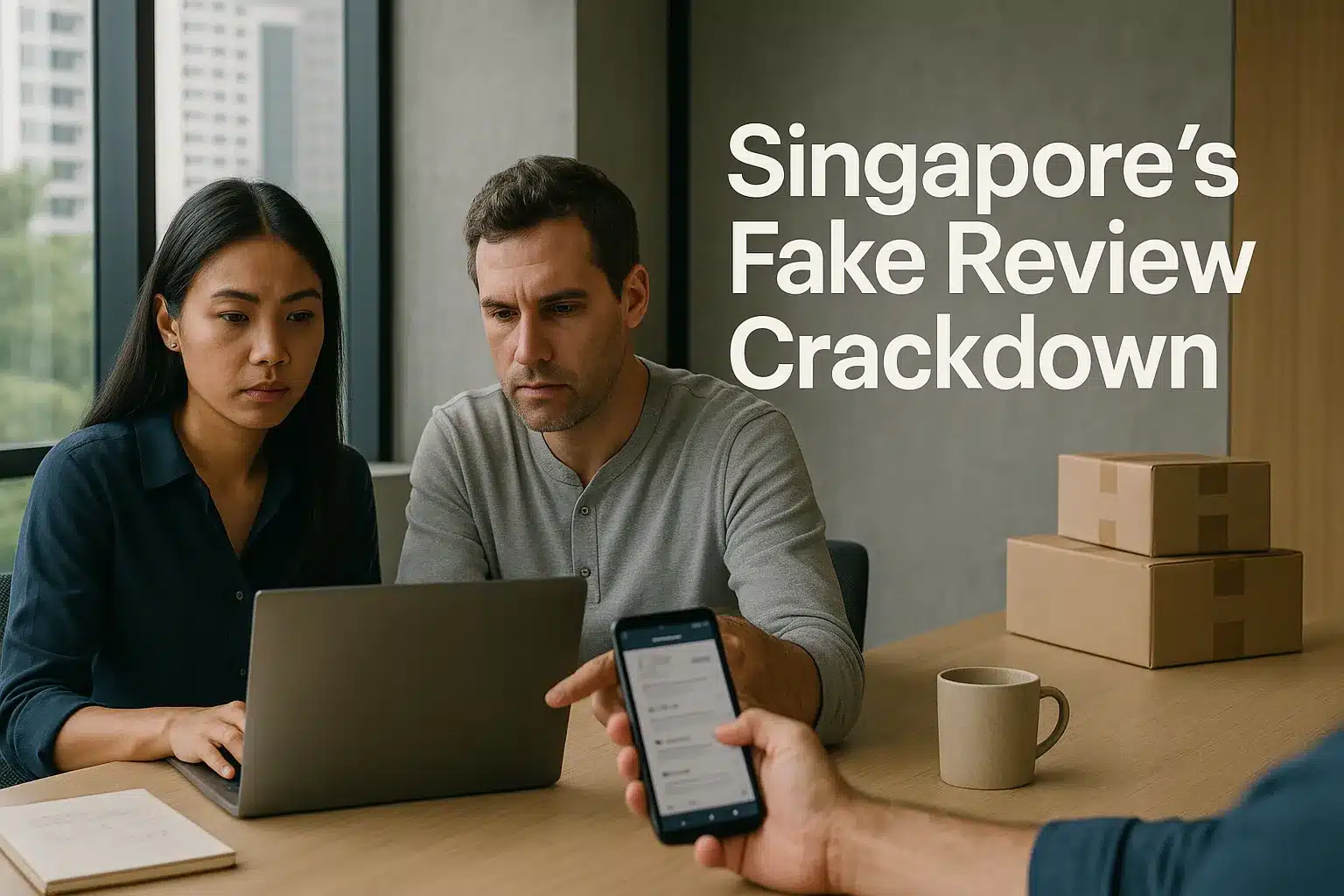
The CCCS fake review investigation is a signal that “trust” has become a regulated business layer in Singapore, not a marketing tactic you can outsource and forget. With AI-generated content and review-buying networks now cheap and hard to attribute, many founders and marketing leads are discovering they don’t just have a brand problem—they have a governance problem: unclear accountability across staff, agencies, freelancers, affiliates, and marketplace sellers. The practical question is no longer “Can we get more reviews?” but “Can we prove our reviews reflect genuine customer experience, and can we stop bad behaviour quickly if it happens?” This guide provides a Singapore-specific playbook to map where exposure sits, design controls, harden contracts, and build “trust-as-a-service” that scales into 2027.
What does the CCCS probe change for founders and management teams in practice?
Treat the probe less as a news item and more as a control-design trigger.
In Singapore, enforcement tends to be evidence-driven and operationally focused. The practical shift for management is that online reviews now sit in the same risk category as advertising claims, pricing representations, and customer communications: if it influences purchase decisions, you need governance.
What has changed operationally (even if your product hasn’t)
- Review supply chains have become complex. Reviews can be “managed” by agencies, freelancers, affiliates, or seller teams across marketplaces—often without a clear audit trail.
- AI makes volume cheap; provenance becomes the scarce asset. The problem is no longer only “fake reviews exist”, but “can you evidence authenticity when challenged?”
- Platforms enforce quickly and bluntly. Marketplace or social platform penalties can hit before any regulator does (de-ranking, suspension, listing removal, ad account restrictions).
The management decision you should make now
Move reviews from “marketing KPI” to “trust control system”:
- Assign accountable owners.
- Define what is prohibited.
- Build monitoring and escalation.
- Keep records that prove intent, governance, and corrective action.
The goal is not perfection; it’s demonstrable control and fast containment.
Where can liability and accountability sit across brands, sellers, agencies, and platforms?
Most review issues become expensive because accountability is fragmented.
A useful way to map exposure is to separate who benefits, who acts, and who controls access.
1) Brand owners and founders (benefit + decision authority)
Even if a vendor “handled marketing”, regulators and platforms typically look for the party that:
- benefits commercially from improved ratings
- set targets (explicitly or implicitly)
- approved campaigns or budgets
- failed to supervise third parties
Control implication: founders/directors need minimum governance: policy, vendor controls, and reporting.
2) Marketplace sellers and operators (act + day-to-day execution)
For marketplace-led growth, the seller team often:
- runs chat scripts and post-delivery messages
- decides whether to offer incentives
- manages disputes/returns (which directly affect review sentiment)
Control implication: SOPs and training matter more than “a one-page policy”.
3) Marketing leads and growth teams (targets + channel execution)
Risk often starts with ambiguous KPIs:
- “Increase rating to 4.8 in 60 days”
- “Get 200 reviews this month”
- “Fix negative reviews quickly”
If the KPI is aggressive but the method is unspecified, teams may “find a way”.
Control implication: set KPIs with guardrails and require method disclosure.
4) Agencies, freelancers, affiliates, and “review networks” (act, often off-book)
The highest-risk zone is where work is:
- subcontracted
- paid as “misc marketing services”
- executed through Telegram/WhatsApp groups
- bundled into “reputation management” without clarity
Control implication: contract hardening + audit rights + explicit prohibitions + subcontractor controls.
5) Platforms and marketplaces (control access)
Platforms are not just channels; they are enforcement actors. They may:
- remove reviews
- freeze listings
- reduce visibility
- restrict seller accounts
Control implication: your incident response must include platform workflows (takedown requests, appeals, evidence packets).
What are the real business costs of review manipulation beyond regulatory risk?
Many SMEs underweight the commercial downside because fake reviews look like a low-cost growth lever. In practice, the costs show up as second-order effects.
Platform enforcement risk (often the fastest impact)
- Loss of listing visibility or “Buy Box” type positioning
- Removal of “top seller” badges or category rankings
- Ad account restrictions that increase CAC overnight
Revenue and unit economics distortion
Fake/AI reviews don’t improve product-market fit; they hide it.
- Higher refund and return rates when expectations are inflated
- Increased support load (“this isn’t what reviews said”)
- Lower repeat purchase and higher churn
Reputational and hiring costs
Once customers believe the brand “manufactures trust”, recovery is slow:
- higher skepticism in sales conversations
- more price sensitivity
- harder to recruit good marketers/operators who don’t want grey tactics
Management distraction and opportunity cost
Investigations—regulatory, platform, or public—consume:
- founder attention
- legal/comms spend
- staff time collecting evidence
A practical CFO lens: review manipulation is a hidden liability that compounds—because it triggers platform penalties, increases operating costs, and slows real learning loops.
How does AI change the fake-review risk profile and the evidence you’ll need?
AI doesn’t only create “more fake reviews”. It changes how you should think about detection, attribution, and proof.
Detection has limits—so focus on prevention and provenance
AI text can be:
- grammatically clean
- varied in tone
- tailored to product features
Relying on “we can tell” is not a control. A better approach is to design a system where you can show:
- how reviews were solicited
- who approved the copy/messages
- what incentives were offered (and disclosed)
- what records exist of genuine transactions
“Provenance” becomes your defensive asset
When challenged by platforms, customers, or regulators, you want an evidence pack that can answer:
- Were reviewers actual customers (or at least legitimate recipients/users)?
- Did the business request reviews in a way that was transparent?
- Did any vendor use prohibited methods?
- What corrective actions were taken once detected?
Practical evidence sources to retain (without over-engineering)
- Campaign briefs and approval emails/messages
- Copies of review request templates and in-app messages
- Vendor invoices with clear scope descriptions (avoid vague “reputation services”)
- Transaction references (order IDs, service tickets) linked to solicitation batches
- Logs of complaints and how they were resolved
This isn’t about building a legal archive; it’s about being able to demonstrate governance and intent.
What should a Singapore SME include in a “reviews and testimonials” internal policy?
A policy works only when it tells staff what they can do on Monday morning—and what gets them into trouble.
Core policy components (write them plainly)
1. Principle: Reviews must reflect genuine customer experience.
2. Scope: Applies to all channels (Google, Meta, marketplaces, industry directories, app stores, internal testimonial pages).
3. Prohibited practices (non-negotiables):
- buying or arranging fake reviews
- using AI to generate reviews presented as customer reviews
- asking employees, friends, or family to post as customers (unless clearly disclosed and permitted by the platform)
- posting competitor reviews or “review bombing”
- offering incentives that are not transparently disclosed where required/appropriate
4. Allowed practices (with guardrails):
- requesting reviews from actual customers post-purchase
- offering a courtesy benefit for feedback with clear terms (see incentives section below)
- using surveys to collect feedback, then requesting public reviews from satisfied customers
5. Approval rules:
- who can launch review solicitation campaigns
- what needs pre-approval (message templates, incentive wording, vendor onboarding)
6. Record-keeping: what must be saved and where.
7. Disciplinary steps: consequences for breaches (important for credibility).
Incentives: the part most teams get wrong
If you use incentives, your policy should define:
- whether incentives are allowed at all
- what types are allowed (e.g., small voucher, points)
- whether incentives are for “a review” or for “feedback regardless of rating”
- required disclosure language and where it appears
Commercial reality: incentives can be legitimate, but only if they don’t become pay-for-positive-review schemes.
Training and adoption (make it operational)
- Short onboarding module for marketing, customer service, and marketplace ops
- Refresher every 6–12 months
- A “when in doubt” escalation channel (named person, not a generic inbox)

How do you harden contracts with agencies, freelancers, and affiliates to prevent review manipulation?
Most review scandals start with vague scopes like “reputation management” and no enforceable controls.
Below is a practical contract hardening checklist you can adapt with your counsel.
Contract clauses and schedules that matter
1) Explicit prohibited practices Define prohibited acts clearly (buying reviews, using bots, AI-generated reviews presented as genuine, undisclosed incentives, subcontracting to review farms, competitor review attacks).
2) Subcontractor controls
- no subcontracting without written consent
- vendor remains responsible for subcontractor acts
- require subcontractor list and locations (as commercially appropriate)
3) Audit and information rights
- right to request campaign logs, outreach lists (where privacy allows), and proof of consented marketing methods
- right to review instructions given to any third party
4) Reporting obligations
- monthly activity report describing methods used (not just results)
- immediate reporting of suspected fake review activity or platform warnings
5) Indemnities and remedies (proportionate but real)
- indemnity for platform penalties or direct losses caused by prohibited practices
- obligation to cooperate in investigations and takedowns
6) Termination triggers
- immediate termination for prohibited practices
- termination if vendor refuses to provide requested evidence
7) Payment structure alignment Be careful with compensation models that reward only outcomes like “ratings increase” without method constraints. If you use performance components, tie them to:
- verified-customer review volume
- complaint resolution metrics
- response time to negative reviews
- adherence to approved solicitation SOPs
Record trail: protect the company and the individuals
Keep a clean trail showing intent to comply:
- written briefs that prohibit fake reviews
- approval notes rejecting risky tactics
- vendor onboarding checklist completion
Paul Hype Page & Co. often supports clients by translating these controls into workable vendor onboarding and documentation routines—so your team can execute consistently, not just sign better paper.
What operational controls reduce risk while still growing reviews and social proof?
Controls need to sit inside workflows, not in a PDF.
Control 1: A review solicitation SOP that matches your customer journey
Build a standard process for when and how you ask.
Example SOP flow (adapt to your business):
- Trigger: delivery confirmed / service ticket closed
- Cooling period: 24–72 hours (reduce emotional extremes)
- Ask channel: email/SMS/in-app/WhatsApp (consistent with your consent practices)
- Message template: approved text + disclosure if incentive exists
- Routing: one-click to platform review page (no “scripted” review text)
- Exception handling: if customer reported an issue, route to support before requesting a review
Control point: marketing can’t launch ad-hoc solicitations outside the SOP.
Control 2: Incentive transparency and separation
If you offer incentives:
- make them for “feedback” or “time spent”, not “positive reviews”
- separate private feedback collection (survey) from the public review request
- document the incentive terms and keep a copy of the wording
Control 3: Moderation rules and response playbooks
Define:
- who responds to negative reviews
- tone and timing standards
- escalation thresholds (e.g., safety issues, allegations of fraud, data/privacy complaints)
Avoid knee-jerk takedown attempts that look like suppression. Focus on resolution and evidence.
Control 4: Anomaly monitoring (simple, not fancy)
You don’t need advanced AI to spot suspicious patterns.
Monitor weekly:
- sudden rating jumps or spikes in review volume
- repeated phrasing across reviewers
- reviews from new accounts with no history (platform-dependent)
- mismatch between review positivity and refund/complaint trends
Control point: when anomalies appear, pause campaigns and investigate.
Control 5: Escalation + takedown workflow
Prepare a checklist:
- internal investigation owner
- evidence to collect (campaign details, vendor comms, order IDs)
- platform reporting steps
- customer comms rules (what you will and won’t say)
Speed matters: platforms respond better when you show you are controlling the issue, not denying it.
If something goes wrong, what does a practical incident response plan look like?
A good response plan reduces damage by showing control, not panic.
Step 1: Contain (within 24–48 hours)
- pause all review solicitation campaigns
- freeze vendor activity related to reviews/UGC
- preserve records (don’t delete chats, briefs, invoices)
- assign a single incident lead (often ops or compliance, not marketing)
Step 2: Diagnose (2–7 days)
Establish facts:
- which channels are affected (Google, marketplaces, social)
- whether the issue is internal, vendor-led, affiliate-led, or unknown
- what instructions were given and by whom
Create a timeline: campaigns, payments, review spikes, platform warnings.
Step 3: Correct (1–4 weeks)
- remove or report suspicious reviews where possible
- terminate or remediate vendor relationships based on findings
- retrain teams and update SOPs
- adjust KPIs that incentivised risky behaviour
Step 4: Communicate (only what you can support with evidence)
Have pre-approved principles:
- acknowledge concerns without admitting unverified facts
- state corrective actions taken
- provide customer support channels
Avoid speculative statements or blaming unnamed third parties without proof.
Step 5: Remediate root causes (ongoing)
- improve complaint handling loops
- fix product/service gaps that drove negative sentiment
- enhance provenance controls for future solicitation
The operational aim is to demonstrate: you have governance, you investigated, and you corrected.
How can you build “trust-as-a-service” without manipulating reviews?
The safest way to scale social proof is to scale reality—then document it.
1) Strengthen customer experience loops (trust grows from operations)
- shorten response times and measure them
- publish clearer delivery/service expectations
- reduce preventable refunds and chargebacks
Trust signal: fewer disputes often correlates with more organic positive reviews.
2) Use verified mechanisms where possible
Depending on channel capabilities:
- verified purchase tags
- post-transaction review prompts tied to order IDs
- testimonials linked to named case studies (with consent)
3) Build transparent testimonials and case studies
If you publish testimonials on your own site:
- get written consent
- keep proof of the underlying transaction/engagement
- use specific outcomes (time saved, error reduced) rather than vague praise
4) Run post-purchase surveys as a “truth layer”
Surveys won’t replace public ratings, but they:
- provide early warnings
- help you target remediation
- create an evidence base for continuous improvement
5) Measure remediation, not just reputation
Create a small set of operational metrics that management reviews:
- % issues resolved within SLA
- repeat complaint rate
- refund rate by product/service line
- delivery defect rates
Over time, these metrics become your “trust engine”—and review volume follows.
This is where many SMEs benefit from advisory support: not to generate more reviews, but to connect trust metrics to operational fixes, budgeting, and accountability.
What should board or management reporting look like for “trust health” in 2027-ready SMEs?
If your only metric is star rating, you will incentivise shortcuts. A better dashboard combines reputation signals with operational reality.
A practical trust-health dashboard (monthly)
Reputation signals
- rating by channel (Google / marketplace A / marketplace B)
- review volume and volatility (spikes, sudden drops)
- % reviews responded to within target time
Operational trust indicators
- refund/return rate (by SKU/service)
- chargeback or payment dispute rate
- complaint volume and top drivers
- on-time delivery / SLA achievement
Control effectiveness indicators
- % staff in scope trained in last 12 months
- vendor compliance attestations received
- number of anomalies investigated and time to closure
- control testing results (spot checks on campaigns and vendor outputs)
Ownership and cadence
- Assign a senior owner (e.g., COO, Head of Ops, or Finance Controller) to coordinate.
- Marketing contributes data, but doesn’t “own” the control system alone.
- Include trust health in quarterly management reviews—especially if you rely on marketplaces.
Periodic control testing (lightweight but consistent)
Quarterly or biannually:
- sample 1–2 campaigns: check approvals, templates, disclosures, vendor reports
- sample vendor invoices and deliverables: ensure scope aligns with allowed practices
- test escalation workflow: can the team execute it quickly?
For SMEs, consistency beats complexity. A repeatable control test is more valuable than a one-off overhaul.
Conclusion
The CCCS probe should be read as a management signal: in Singapore, trust is not just brand equity—it’s a governed layer of your operating model. The practical path forward is to (1) map your review supply chain and accountability, (2) implement internal policies that remove ambiguity for staff, (3) harden vendor and affiliate contracts so “reputation management” can’t become a black box, and (4) run simple monitoring, escalation, and incident response routines that protect platform access and customer confidence. If you want growth that lasts into 2027, build “trust-as-a-service” from real customer experience, verified mechanisms, and measurable remediation—so your social proof reflects reality rather than trying to manufacture it.
FAQs
Retain solicitation templates and approvals, campaign briefs, clear vendor scopes and invoices, and transaction references (like order IDs or service tickets) tied to review-request batches.
Pause solicitation, freeze any vendor activity related to reviews, preserve records, assign an incident lead, then investigate and prepare an evidence pack for platform reporting and corrective actions.
Risk is often traced to the business that benefited and set targets or budgets, so founders and management should set clear prohibitions, supervise vendors, and keep an evidence trail of instructions and approvals.
Use a documented SOP to request reviews post-transaction, avoid scripting what customers should say, and if incentives exist, make them for feedback (not positivity) and keep the wording consistent and transparent.
In practice, yes—treat reviews as a trust control area because they influence purchase decisions, and be ready to show governance, intent, and corrective action if challenged.
Share This Story, Choose Your Platform!
Related Business Articles