Outline
- What business problem are you actually solving—and what should you refuse to automate?
- Where can robots and AI fit in a spa, clinic, salon, F&B, or retail workflow—at task level?
- How do you redesign service packages and pricing so tech improves margins without breaking trust?
- What does a customer trust plan look like—scripts, opt-in/opt-out, and service recovery when tech fails?
- How do you position this to front-line staff so it reduces burnout instead of triggering attrition?
- How should you run a pilot that is small enough to be safe—but real enough to prove ROI?
- What operational changes do you need for scale—layout, maintenance, vendor SLAs, and integration?
- How do you measure service quality and ROI without fooling yourself?
- What are the most common execution failures in Singapore service automation—and how do you prevent them?
- Conclusion
- Need help turning automation into an operating model?
- FAQs
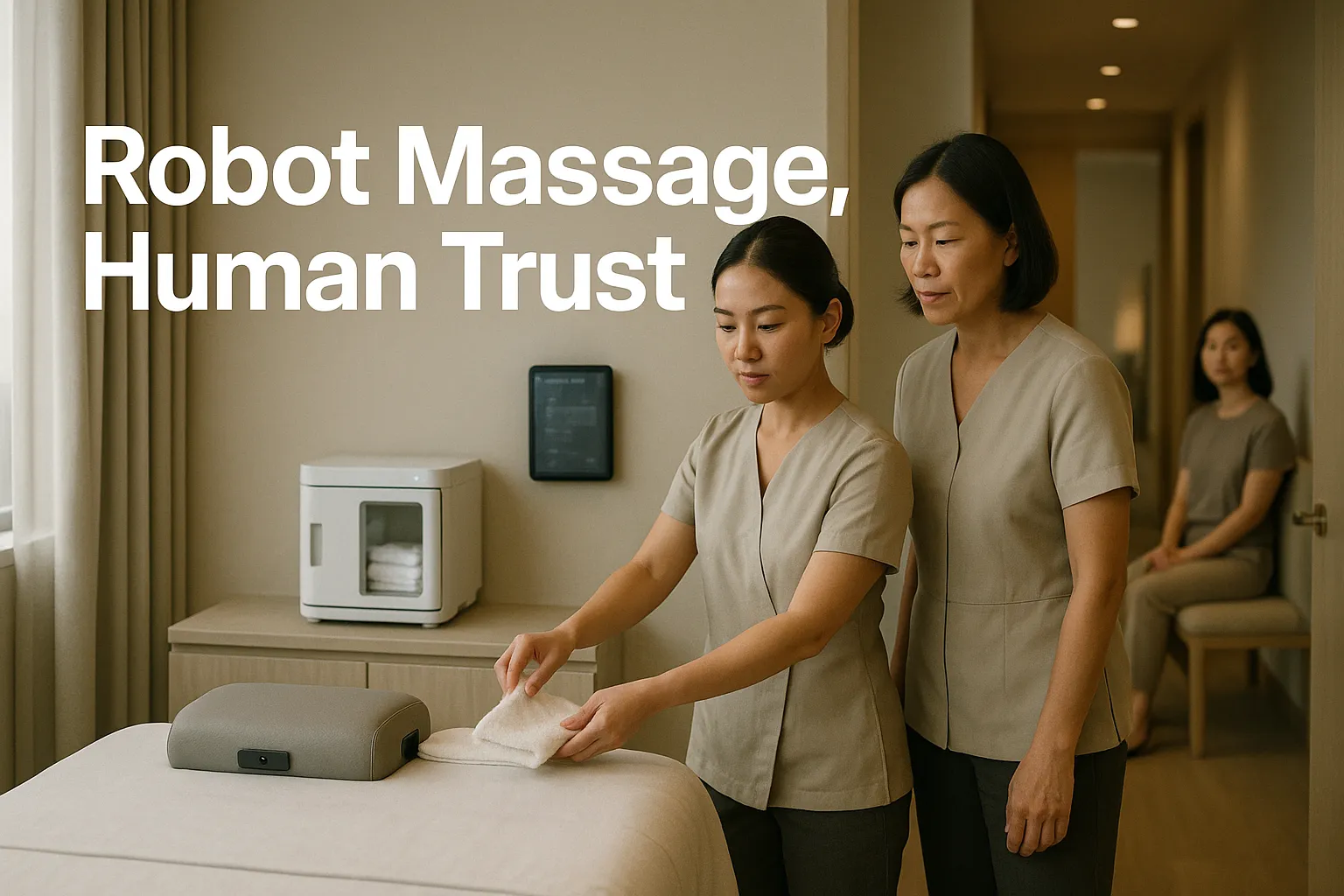
Singapore service automation is no longer a “nice-to-have” project for spas, clinics, salons, F&B, and retail—it’s a practical response to 2027’s tightening manpower, wage pressure, and customers who still expect consistent service. The Natureland story (a human-touch wellness business trialling robot-assisted massage and AI tools) is useful not because “robots are coming”, but because it forces the right operational questions: where does automation actually fit in a live outlet, how do you price and package the new service without harming trust, and how do you pilot without burning out the front line? This guide gives founders an execution roadmap: task-level use cases, customer messaging, service redesign, staff change management, pilot-to-scale governance, and metrics that protect quality while making ROI measurable.
What business problem are you actually solving—and what should you refuse to automate?
Robots and AI tend to get discussed as a “technology decision”. In a high-touch service business, it’s primarily an operating model decision.
Start by writing your problem statement in business terms. Common ones in Singapore people-heavy services:
- Capacity constraint: You cannot sell more peak-hour slots because therapist/crew hours cap out.
- Quality variance: Service depends too heavily on a few star staff; consistency slips with turnover.
- Hidden labour: Too many paid hours go into non-revenue tasks (cleaning, prep, closing, admin).
- Rising unit cost: Wages increase faster than price tolerance; margins compress.
- Customer expectations: Customers demand both “human warmth” and “fast + predictable”.
Then set two “red lines” early—what you will not automate (at least in phase 1):
- Moments of trust: diagnosis, consultation, handling discomfort, complaints, upsell conversations. These are where customers decide whether you are safe and professional.
- Brand-defining craft: any step where your differentiation is tactile skill, judgement, or personalised care.
A practical decision filter (use before you buy anything)
Score candidate tasks 1–5 on each dimension:
- Repeatability: the same steps, same environment.
- Risk of harm or embarrassment: if it fails, can someone get hurt or feel exposed?
- Customer sensitivity: will customers notice and judge the change?
- Measurability: can you measure output quality (time, cleanliness, error rate)?
- Staff acceptance: will staff feel threatened or supported?
High repeatability + high measurability + low sensitivity is your phase 1. High sensitivity tasks need stronger messaging and fallbacks—even if the ROI looks attractive.
The Natureland-style framing—“augment, not replace”—works because it aligns with this filter: automate the supporting work first, and treat high-touch moments as human-led with optional tech support.
Where can robots and AI fit in a spa, clinic, salon, F&B, or retail workflow—at task level?
Founders get stuck when they think in terms of “we need a robot” rather than “we need to redesign a workflow”. Use a task-level map.
Pre-service (before the customer experience starts)
Look for automation that improves readiness and reduces delays:
- Appointment and queue orchestration: AI-assisted scheduling rules (buffer times, staff skill matching, room allocation) to reduce idle rooms and late starts.
- Pre-visit forms and consent capture: structured digital intake (health considerations, preferences) so staff spend time confirming, not collecting.
- Stock and linen readiness: simple automation for inventory alerts, par level triggers, or barcode scanning to reduce last-minute scrambles.
- Staff briefing prompts: shift dashboards that highlight VIPs, special notes, and cross-sell opportunities—without forcing staff into long admin.
During service (the “high-touch” window)
This is where you must be careful. Typical augmentation use cases:
- Standardised warm-up or repetitive motions: where appropriate, a device/robot can handle a consistent step while staff focus on judgement-heavy work (pressure adjustment, customer comfort checks).
- Real-time note-taking assistance: voice-to-text summaries for therapists/consultants, used as internal notes (with clear customer consent boundaries).
- Service timing support: prompts for transitions (e.g., “next step ready in 2 minutes”) to reduce overruns.
Rule of thumb: if it changes how the customer feels cared for, treat it as a brand decision, not a productivity project.
Post-service (where many margins leak)
Post-service is often the fastest ROI because it’s less emotionally sensitive:
- Auto-generated aftercare messages: personalised but controlled templates based on service type.
- Membership renewal nudges: timed and segmented messages triggered by behaviour, not manual follow-up.
- Incident logging and service recovery workflows: structured capture of complaints, refunds, rework, and root cause analysis.
Cleaning, logistics, and facility operations
Often the least controversial, and extremely relevant in Singapore due to labour scarcity:
- Floor cleaning and sanitisation support: robots or semi-automated equipment reduce closing time labour.
- Linen movement and storage discipline: check-in/check-out scanning to reduce losses and stockouts.
- Consumables replenishment routes: simple workflows and checklists supported by scanning or sensors.
Admin, finance, and HR (quietly powerful)
Many “AI wins” happen away from customers:
- Invoice and reconciliation assistance: draft coding suggestions and anomaly flags (still reviewed by finance).
- Payroll exceptions handling: spotting unusual overtime patterns or allowance mistakes for review.
- Recruitment screening support: structured scoring against role requirements (with human review to avoid bias and bad hires).
If you run a multi-outlet operation, prioritise tasks that scale: scheduling rules, inventory discipline, QA checklists, and training content—because they reduce variance outlet-to-outlet.
How do you redesign service packages and pricing so tech improves margins without breaking trust?
The biggest mistake is treating automation as “internal efficiency” while keeping the same menu and promises. Customers then experience change (different feel, timing, interaction) without a clear value story.
Your goal is not to sell “robot massage” or “AI”. Your goal is to sell more consistent outcomes, better hygiene, shorter waiting, more customisation, or more recovery value.
Step 1: Define the “human promise” and the “tech promise”
Write two short statements:
- Human promise: what only your staff can do (comfort, judgement, adaptation, discretion).
- Tech promise: what the system improves (consistency, speed, availability, standard checks, reduced delays).
This prevents over-claiming. You’re not saying “AI is better than humans”; you’re saying “we use tools to deliver a more reliable experience.”
Step 2: Create tiers that bundle expertise + tech steps
Practical tiering options that work in high-touch services:
- Classic (human-led): the baseline service, no mention of tech.
- Assisted (human + tech support): includes one or two tech-supported steps that improve consistency (e.g., standardised warm-up, enhanced sanitation protocol, faster intake).
- Premium (human-led + measurable extras): add-ons with clearer value: extended consult time, targeted recovery plan, priority booking windows, or enhanced privacy.
Be cautious with a tier that implies “robot replaces therapist”. In wellness and personal services, that framing triggers fear (safety, modesty, awkwardness).
Step 3: Use add-ons to monetise without forcing adoption
Add-ons reduce resistance because customers can opt in:
- “Express check-in + priority start time”
- “Enhanced recovery plan (digital aftercare)”
- “Extra sanitation assurance” (only if you can operationally deliver and verify it)
Step 4: Price increases must be backed by consistency metrics
Singapore customers accept price adjustments faster when:
- start times are on schedule
- service duration is reliable
- hygiene is visibly controlled
- outcomes are consistent across outlets
That means you need internal proof before you change the menu widely. Tie price decisions to measurable indicators (see metrics section).
A simple menu test before rollout
Before you rename services or reprint menus across outlets:
- test scripts and packaging in 1–2 outlets
- track conversion to the new tier/add-on
- monitor complaints, refunds, and “awkwardness” feedback
If customers choose “Classic” at high rates, that’s still useful: you can keep tech behind the scenes (cleaning, intake, scheduling) where it improves margins without customer friction.
What does a customer trust plan look like—scripts, opt-in/opt-out, and service recovery when tech fails?
Trust is operational, not philosophical. Customers decide trust based on what you do when something feels unfamiliar or goes wrong.
Build a three-layer communication approach
Layer 1: Quiet transparency (default)
- Staff mention tools only when relevant: “We use equipment to standardise the warm-up and help us focus on the areas you care about.”
- Avoid grand claims like “AI will fix your pain” or “robot gives better results.”
Layer 2: Clear opt-in/opt-out (for sensitive steps)
- If a device/robot changes touch, privacy, or data capture, offer a choice.
- Script example: “We can do the standard warm-up using our assisted system, or we can do it fully manual—your preference.”
Layer 3: Visible reassurance (for first-time users)
- Short signage or a one-liner in booking confirmation: “Some sessions may include assisted steps supervised by our therapist.”
Prepare for the “tech failed” moment before it happens
In high-touch services, failure isn’t just downtime; it’s customer embarrassment and staff panic.
Build a service recovery SOP that answers:
- Who decides to switch to manual mode?
- How do you keep the customer comfortable while switching?
- What compensation rules apply (if any), and who approves them?
- What do you log for root cause analysis?
A practical recovery script:
- “We’re going to switch to a manual step so your session continues smoothly. Your therapist will take over from here.”
Notice the framing: customer experience first, no blaming the machine, no oversharing.
Set privacy boundaries early (without turning it into a legal lecture)
Even when you’re not making this a compliance-led project, you need clear internal rules:
- Don’t collect audio/video “just because you can.”
- Don’t store sensitive notes in personal devices.
- Keep marketing claims aligned with actual capability.
If your workflow includes customer data capture, align your practices with Singapore’s PDPA principles in a practical way (purpose limitation, access control, retention discipline). When needed, get professional advice for your specific process design rather than copying another business’s approach.
Customer trust is earned by consistency: the same explanation, the same option to choose, the same calm recovery when something doesn’t work.
How do you position this to front-line staff so it reduces burnout instead of triggering attrition?
In people-heavy Singapore businesses, staff response determines whether automation becomes leverage—or a slow morale leak.
Start with job redesign, not “training on a device”
If staff hear “robot/AI”, many translate it into “management wants to cut headcount.” You have to show the opposite through job design:
- Remove low-value tasks first: cleaning, repetitive admin, stock counts, long note-taking.
- Add higher-value tasks: consult time, upsell conversations, service recovery ownership, mentoring juniors.
Tell staff what changes in their daily work, not what the robot can do.
Use a clear internal narrative (and repeat it)
A practical internal narrative that works:
- “We’re protecting service quality with fewer hands available.”
- “Tools handle repetitive steps; you handle judgement and care.”
- “We’re using productivity gains to stabilise rosters and reduce end-of-day rush.”
Avoid promising “no impact on roles ever”. Instead, commit to transparency: “We will pilot, measure, and redesign roles with you.”
Training that actually sticks (micro, in-shift, scenario-based)
High-touch services can’t pause for long classroom training. Use:
- 10–15 minute micro-sessions at shift start
- role-play scenarios (customer hesitant, tech fails, customer asks privacy questions)
- buddy system for the first 2–4 weeks
- competency checklist: can they explain it, operate it, and recover when it fails?
Incentives: reward the behaviours you need
If you want adoption, tie recognition to measurable behaviours:
- correct use of SOP
- customer satisfaction markers
- reduction in rework or overruns
- good incident logging (not hiding mistakes)
Avoid incentives that push staff to “force” customers into tech-assisted steps. That backfires on trust.
Change fatigue control
If you’re also changing menus, booking rules, and devices, don’t do it all at once.
Sequence the change:
- back-of-house automation
- staff workflow updates
- customer-facing assisted steps
- packaging and pricing changes
This sequencing protects morale because staff experience benefits (less closing rush, fewer admin headaches) before they have to sell or explain new concepts to customers.

How should you run a pilot that is small enough to be safe—but real enough to prove ROI?
A pilot is not a demo. A demo proves the tool works; a pilot proves your operation can run with it.
Choose pilot sites with intention
Pick 1–2 outlets (or 1 shift) that have:
- stable supervisors
- typical customer mix (not only your most forgiving regulars)
- enough volume to generate data
- a layout that can accommodate the equipment safely
Avoid your worst outlet (too chaotic) and your best outlet (too many hero staff masking problems).
Define the pilot scope in a “thin slice”
A thin slice includes:
- one workflow (e.g., pre-service intake + one assisted step + post-service follow-up)
- one customer segment (e.g., weekday regulars)
- one staff group (e.g., 6 therapists across two shifts)
Set success criteria before day 1
Use both hard metrics and trust metrics:
Hard metrics (examples):
- start-time punctuality
- session overrun rate
- closing time labour hours
- rework/refund incidence
Trust metrics (examples):
- opt-out rate
- “awkwardness” or discomfort mentions
- repeat booking rate for pilot customers
Update SOPs during the pilot, not after
Treat SOP as a living document:
- what to do when the system is down
- cleaning and maintenance steps
- customer explanation scripts
- escalation paths
If SOP changes are not captured, the pilot “works” only because a few people remember what to do.
Build the fallback manual process (BCP) upfront
Business continuity planning here is simple but essential:
- define the manual alternative for every assisted step
- define who takes over and how long it adds
- define how you protect staff from overload during fallback
A good pilot includes at least one controlled “fallback drill” so staff practice switching calmly.
Maintenance and uptime are part of the pilot
Don’t wait for scale to think about uptime.
During pilot, track:
- downtime minutes per week
- time to recover
- parts/consumables usage
- cleaning time and responsibilities
These numbers often determine whether the business case survives beyond the excitement phase.
What operational changes do you need for scale—layout, maintenance, vendor SLAs, and integration?
Scaling automation across outlets fails when businesses underestimate operational friction. “It worked in one outlet” is not a plan.
Facility layout implications (often overlooked)
For any robotic or semi-automated equipment, confirm:
- power points and safe cable routing
- storage space (when not in use)
- cleaning workflow (where it’s cleaned, where it dries)
- customer sightlines (what customers will see and how it feels)
- noise and privacy considerations
Do a physical walk-through with operations, not just the vendor.
Vendor management: focus on outcomes, not features
Your real dependency is uptime and support response.
In vendor discussions, push for clarity on:
- response times and support hours
- replacement unit policy (if downtime exceeds X)
- preventive maintenance schedule
- training included for new hires (not just initial team)
- software update policy and how changes are communicated
Avoid locking yourself into a model where only one person knows how to troubleshoot.
Integration: keep it simple, but deliberate
You don’t need a perfect tech stack. You do need control points:
- booking system → staff schedule → room allocation
- customer records → post-service follow-up triggers
- incident logs → management review cadence
If you’re using AI to generate notes or messages, set rules:
- what data can be used
- who approves templates
- where records are stored
Governance: appoint a single owner
Automation programmes die by shared responsibility.
Assign:
- Business owner (P&L): usually ops lead or founder
- Process owner: responsible for SOP and training
- Tech owner: responsible for devices, access, vendors
- Data/quality reviewer: tracks metrics and customer feedback
This can be four hats on two people in an SME—but the roles must be explicit.
Rollout sequencing across outlets
A practical rollout sequence is:
- outlets with stable supervisors
- outlets with high closing labour and repetitive tasks
- outlets with higher customer sensitivity last (more premium, more privacy concerns)
Scaling is a multiplication of weak points. Fix training, SOP discipline, and maintenance routines before you add more outlets.
How do you measure service quality and ROI without fooling yourself?
If you only measure labour savings, you will miss why high-touch customers leave. If you only measure customer happiness, you may never recover the cost.
Use a balanced scorecard that management reviews weekly during pilot, then monthly at scale.
Quality and trust metrics (protect the brand)
Choose 5–7 metrics you can actually capture:
- Start-time punctuality (percentage on-time starts)
- Overrun rate (sessions exceeding planned duration)
- Complaint rate and categories (discomfort, privacy, awkwardness, cleanliness)
- Repeat booking rate (pilot cohort vs control)
- Opt-out rate (if customers can decline assisted steps)
- Service recovery resolution time (time to close an incident)
Important: track categories, not just volume. One serious safety or privacy incident matters more than ten minor delays.
Productivity and cost metrics (prove the business case)
Measure what changes in unit economics:
- labour hours per revenue hour (or per transaction)
- closing shift hours (before/after)
- throughput (customers served per peak hour)
- consumables waste (linen loss, product usage variance)
- downtime impact (lost slots, refunds)
Revenue and pricing power metrics (the real strategic prize)
Automation should help you charge for consistency, not just cut cost.
Track:
- take-up rate of new tiers/add-ons
- average spend per visit
- membership conversion and retention
- discounting frequency (are you discounting less?)
How to avoid common measurement traps
- Trap: measuring during novelty only. Customers behave differently in the first two weeks. Run pilots long enough to see “normal”.
- Trap: hero staff effect. If one outlet manager makes everything work, you may be measuring the manager, not the model.
- Trap: ignoring hidden labour. Maintenance, cleaning, and troubleshooting time can erase labour savings.
A simple ROI discipline (without over-promising)
Treat ROI as a range, not a guarantee.
Build three scenarios:
- conservative: minimal labour reduction, minor revenue uplift
- base: modest labour reduction + improved throughput
- upside: throughput + pricing add-ons + fewer refunds
If you can’t articulate what must be true for the base case to happen (adoption rate, uptime, opt-out rates), you’re not doing ROI—you’re hoping.
This is where firms like Paul Hype Page & Co. often support operators: not by “selling tech”, but by helping build the measurement model, cost tracing, and management reporting so the initiative is governed like a business programme, not an experiment.
What are the most common execution failures in Singapore service automation—and how do you prevent them?
Most failures are not technical. They are workflow and change-management failures.
Failure 1: Automating the wrong step first
Symptom: customer friction, awkwardness, complaints.
Fix: start with back-of-house (cleaning, scheduling, admin), then move to customer-facing augmentation.
Failure 2: No manual fallback, so staff panic
Symptom: tech downtime creates chaos and overtime.
Fix: write fallback SOP per step, run drills, and protect staff workload during fallback.
Failure 3: Staff feel monitored or replaced
Symptom: passive resistance, higher turnover, “we tried and it didn’t work”.
Fix: job redesign that removes low-value tasks first, adoption incentives tied to quality (not forcing tech use).
Failure 4: Over-claiming AI capability
Symptom: trust loss when results don’t match marketing.
Fix: keep claims modest and outcome-based (consistency, scheduling, hygiene), not “AI cures”.
Failure 5: Pilot success doesn’t scale
Symptom: rollout stalls at outlet 3–4.
Fix: standardise training, maintenance routines, and governance before adding outlets; require readiness gates.
Failure 6: Financials don’t reflect reality
Symptom: “productivity improved” but cash flow didn’t.
Fix: track total cost of ownership (maintenance, consumables, downtime) and tie metrics to P&L lines (labour, refunds, revenue per hour).
If you prevent these six failures, you’re already ahead of many Singapore SME automation efforts—because you’re treating the change as an operating model redesign, not a gadget purchase.
Conclusion
Robots and AI can fit inside a human-touch Singapore service business—but only if you implement them as workflow redesign, not as a headline. The most transferable lesson from a spa chain experimenting with robot-assisted massage is the sequencing: automate low-sensitivity tasks first, package customer-facing augmentation with clear opt-in/opt-out, and protect trust through scripts and a real service recovery plan. Treat staff adoption as job redesign with incentives, not a one-off training session. Pilot in a thin slice, measure both quality and unit economics, then scale with disciplined SOPs, maintenance planning, and vendor accountability. If you want support turning the idea into an operational plan—process selection, cost tracing, reporting, and rollout governance—Paul Hype Page & Co. can act as an implementation partner alongside your operations and finance team so the programme stays commercially grounded and execution-ready going into 2027.
FAQs
Use quiet transparency, offer opt-in/opt-out for sensitive steps, and keep claims outcome-based (consistency, hygiene, punctuality) with a clear script for switching back to manual when needed.
Track both hard metrics (on-time starts, overruns, closing labour hours, refunds/rework, downtime) and trust metrics (opt-out rate, discomfort/awkwardness feedback, repeat bookings), then update SOPs and fallback processes during the pilot.
Start with low-sensitivity work such as scheduling and intake workflows, post-service follow-ups, cleaning and closing tasks, inventory discipline, and back-office admin support.
Lead with job redesign that removes low-value tasks, add higher-value responsibilities, train in short in-shift scenarios, and recognise quality behaviours—without pressuring staff to force customers into tech-assisted steps.
Keep “moments of trust” human-led (consultation, handling discomfort, complaints, sensitive upsell) and avoid automating brand-defining craft where your differentiation is judgement and personalised care.
Share This Story, Choose Your Platform!
Related Business Articles