Outline
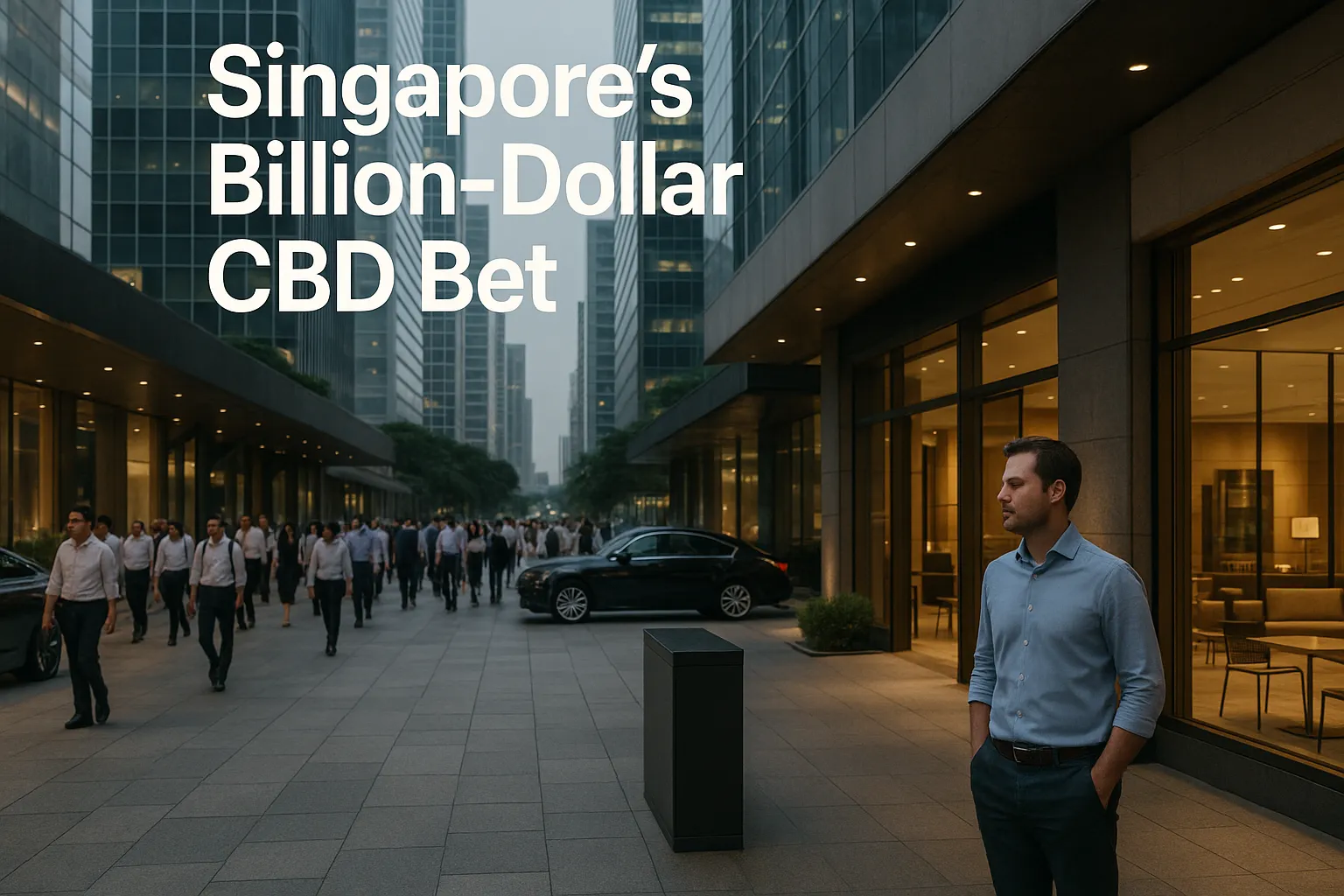
IOI’s billion‑dollar CBD investment is not just a developer headline—it’s a positioning signal that Singapore is still building hard around a wealth-hub, HQ, and premium-visitor narrative into 2027. For founders, that turns into an operating question, not a property question: does your model get stronger when you plug into the “best address” economy, or does it get crushed by its cost structure and expectations? This guide uses a Singapore CBD property strategy lens to help you decide whether to anchor in (or sell into) ultra-prime mixed-use nodes—and then translate that choice into location, pricing, channel, and customer decisions that protect margins. The goal is practical fit: you should leave with a clear path, a few non-negotiables, and a plan for what to test next.
What is IOI’s CBD bet really signalling to operators (not investors)?
IOI’s presence in Singapore’s CBD is best read as a directional signal: Singapore continues to prioritise ultra-prime, mixed-use nodes that bundle Grade-A offices, luxury hospitality, retail/F&B, and curated public space. For operators, the lesson is less about the project’s IRR and more about what these nodes do to demand.
“Address as asset” mechanics: why a few streets matter disproportionately
Ultra-prime mixed-use developments tend to:
- Concentrate decision-makers: regional HQ teams, global functions, family office principals, and high-spending visitors.
- Create predictable footfall bands: weekday office pulses, evening hospitality pulses, and event-driven surges.
- Raise baseline expectations: speed, discretion, service recovery, and “no friction” payment and booking.
- Stiffen competition: the tenant mix is curated; the customer has more alternatives within a short walk.
The practical consequence
Your “address” becomes part of your product:
- It can replace some marketing spend (visibility, social proof, concierge referrals).
- Or it can force costly upgrades (fit-out, staffing profile, operating hours, service level).
Founders should treat this as a strategic fork: you either design to monetise the ecosystem—or you design to avoid being priced into a model you can’t operationalise.
How do you decide whether to build for the CBD/HNW ecosystem or take a deliberate non-CBD path?
Think in two deliberate paths. Both can work; what fails is drifting into one while building like the other.
Path 1: “Build for the CBD/HNW/tourist-corporate ecosystem”
This path is for businesses that can win on at least two of:
- High gross margin per transaction (not just high revenue per square foot on paper).
- High trust / high stakes (customer values expertise, privacy, reliability).
- Time sensitivity (customer pays to save time and reduce hassle).
- Network-driven acquisition (concierge, hotel, corporate EA, relationship managers, building community).
Path 2: “Avoid CBD economics; win via heartland, distributed, or digital scale”
This path is for businesses that win on at least two of:
- Repeat volume and operational efficiency.
- Price clarity and standardisation.
- Wider geographic catchment (delivery, multiple outlets, digital acquisition).
- Talent model that doesn’t require ‘premium’ staffing to meet brand promise.
A simple decision test: 7 questions founders should answer
Score yourself honestly (High/Medium/Low):
- Can we lift prices 15–30% without hurting conversion materially if service and experience improve?
- Do we have a credible reason for customers to come to us (expertise, exclusivity, convenience, brand)?
- Is customer acquisition likely to be referral-led (vs paid ads and walk-in)?
- Can we manage peak demand without breaking service (queues, response times, appointment discipline)?
- Do we have operating controls for higher payroll, wastage, and shrinkage?
- Does our offering travel well (can we sell into CBD without being physically inside it)?
- Is the founder willing to run a tighter playbook (service standards, training, incident handling)?
If you’re “High” on (1–4) and at least “Medium” on (5–7), CBD anchoring is viable. If not, you’re often better building a non-CBD growth engine—and selectively “selling into” CBD via partnerships and channels (without taking on the full fixed-cost load).
What does “address as asset” change in your unit economics and operating design?
Ultra-prime locations change the shape of your P&L. Many SMEs underestimate how it changes—not just how much.
The unit economics that typically move
- Rent becomes a strategy variable: it’s not just a cost; it dictates your minimum viable price and throughput.
- Labour mix shifts: you need more customer-facing capability (language, service recovery, product knowledge). That pushes payroll and training.
- Cost of “non-visible quality” rises: uptime, cleanliness, security, queue management, booking systems, payment flows.
- Marketing mix pivots: less broad-reach discounting, more relationship and reputation management.
The operational design choices that follow
If you anchor in the CBD ecosystem, plan for:
- Appointment-first models (even for categories that historically relied on walk-in), to smooth peaks and protect experience.
- Higher service specification: scripted handoffs, escalation rules, and recovery offers.
- Shorter feedback loops: daily dashboards (conversion, average ticket, wait times, refund reasons), not monthly reviews.
Common mistake: importing a heartland playbook into a CBD cost base
Examples of mismatch:
- A mid-market F&B concept with thin margins trying to “make it up on volume” while footfall is volatile and competition is dense.
- A professional services firm assuming the address alone will generate leads, without a referral network and proof-of-trust assets.
A strong address amplifies a good business model; it does not repair a weak one.
If you choose the CBD path, where exactly do you locate—and what are you really buying?
“CBD” is not one market. Founders should define what they are buying: proximity to HQ procurement, to hotels, to high-end residential flows, or to event venues.
Choose your anchor: four micro-ecosystems
- Office-tower core: weekday demand, corporate procurement, predictable lunch and after-work peaks.
- Hotel-adjacent belts: concierge referrals, visitor conversion, higher appetite for bundled experiences.
- Mixed-use lifestyle nodes: curated retail, evening/weekend activity, event-driven surges.
- Appointment corridors (clinics, consultancies): customer travels intentionally; signage matters less than ease, privacy, and booking.
A location checklist that’s more operational than aesthetic
Before signing anything, pressure-test:
- Demand calendar: weekday vs weekend dependence; seasonality; events nearby.
- Access friction: drop-off points, parking, lift lobby flow, wayfinding.
- Building ecosystem: tenant mix, management rules, permitted activations, delivery constraints.
- Operating hours reality: can you staff the hours customers expect in that zone?
What you’re buying when you pay for a premium address
You’re paying for:
- Trust acceleration (especially for high-consideration services).
- Higher willingness to pay when experience matches expectations.
- Network proximity (EAs, concierges, corporate buyers, relationship managers).
If your model cannot convert those into margin, you are mostly buying expensive rent.
If you avoid the CBD, how do you still monetise CBD demand without taking CBD costs?
Avoiding the CBD does not mean ignoring the “best address” economy. Many SMEs do better with a hybrid approach: keep fixed costs sane while building channels that reach CBD buyers.
Three practical “sell-into-CBD” models
1. Partnership-led distribution
- Hotels, serviced apartments, concierge desks
- Corporate EAs and office managers
- Building community/event organisers
2. Pop-up and event capture
- Short runs during peak conferences or seasonal visitor windows
- Private previews for corporate clients
3. Mobile/concierge delivery
- Appointment-based on-site services (for select categories)
- Premium delivery radius design (CBD + near-CBD only) to protect service quality
What you must design if you “sell in” rather than “sit in”
- A referral-ready offer: clear packages, service promises, response times.
- Operational reliability: punctuality, discreet comms, clean handoffs.
- Pricing integrity: referral channels dislike constant discounting.
The strategic advantage: you get CBD spending optionality—without committing the whole business to CBD unit economics.

How should different business types change their offer, pricing, and service level for the ultra-prime ecosystem?
The same address affects verticals differently. The right move is often not “upgrade everything”, but “upgrade the parts that customers pay for—and operationalise the rest.”
F&B: what tends to work—and what breaks
Works better when:
- Average ticket can rise with experience (tasting sets, premium lunch, chef’s counter, private dining).
- The concept is reservation-capable (queue chaos kills perception).
- You have a corporate-friendly offer (set menus, invoice options, fast service).
Breaks when:
- Margin relies on high turnover but kitchen and staffing can’t handle peaks.
- You depend on heavy discounting to fill seats (brand mismatch in ultra-prime nodes).
Implementation moves:
- Engineer menus for speed and margin (fewer SKUs, predictable prep).
- Build two service modes: “express corporate lunch” and “experiential dinner”.
Retail: visibility is not enough
Works better when:
- There is a story, craftsmanship, scarcity, or high-touch personal selling.
- You can capture customer data ethically and follow up (appointments, VIP drops).
Implementation moves:
- Shift from walk-in dependency to clienteling: appointment slots, private viewings.
- Tighten shrinkage controls and inventory accuracy; premium areas punish stockouts.
Medical / wellness: trust and privacy are the product
Works better when:
- Patients value discretion, short wait times, and continuity.
- You can systemise booking, reminders, and post-visit follow-up.
Implementation moves:
- Appointment discipline, no overbooking.
- Service recovery plan for delays (clear comms, options, compensation boundaries).
Wealth / professional services: the address helps, but proof closes
Works better when:
- You have demonstrable expertise, structured discovery, and strong referrals.
Implementation moves:
- Create “proof assets”: case narratives, clear scope boundaries, response SLAs.
- Train front-of-house: how enquiries are handled is part of perceived competence.
B2B services (including corporate support): procurement reality matters
Works better when:
- You can meet corporate onboarding needs (documentation readiness, invoicing, service SLAs).
Implementation moves:
- Build a procurement-friendly pack: company profile, insurance where relevant, standard terms, escalation contact.
Hospitality-adjacent businesses: win through partnerships
Works better when:
- You can integrate into hotel/serviced apartment flows without disrupting operations.
Implementation moves:
- Agree handoff rules: booking window, guest privacy, cancellations, service boundaries.
Across verticals, the common thread is service specification: in ultra-prime ecosystems, ambiguity creates friction—and friction kills conversion.
What pricing strategy protects margin in the “best address” economy without alienating customers?
Pricing in ultra-prime nodes fails in two ways: (1) raising prices with no corresponding service uplift, or (2) keeping prices flat while costs surge. The fix is to price what the customer values and operationalise delivery.
Use a 3-layer pricing architecture
- Core offer: the default package that most customers buy.
- Priority layer: faster access, preferred timeslots, dedicated contact.
- Premium layer: private sessions, bundled add-ons, concierge handling.
This works because CBD/HNW customers often pay for time certainty and reduced hassle more than “more product”.
Practical controls to keep pricing credible
- Published price ranges where appropriate (reduces negotiation drag).
- Deposit and cancellation rules for appointment-based services.
- Boundaries on customisation (custom work should be priced, timed, and approved).
Avoid two common traps
- The ‘silent upgrade’ trap: you add costs (better ingredients, more staff) but don’t repackage and reprice.
- The ‘discount-to-fill’ trap: short-term occupancy at the expense of long-term positioning.
A useful rule: if you can’t explain your price increase in one sentence tied to a customer outcome (speed, privacy, quality, certainty), it will be hard to sustain.
Which go-to-market channels actually work around CBD geography—and what should you build first?
CBD go-to-market is less about broad awareness and more about high-trust nodes that funnel qualified customers.
Channel options that map well to ultra-prime mixed-use areas
- Concierge and referral networks
- Hotels, serviced apartments, premium transport providers
- Relationship managers and lifestyle managers (where relevant)
- Corporate procurement and EA networks
- Office managers, executive assistants, HR/people teams for corporate benefits (category-dependent)
- Building ecosystems
- Landlord-led tenant communities, app-based building directories, lobby activations
- Event and community loops
- Small breakfasts, private demos, founder-led roundtables
- Partnerships with adjacent premium brands
Decide early: appointment-based vs walk-in reliance
- If your service quality degrades in peaks, design appointment-first.
- If your offer is truly impulse-friendly and operationally robust, walk-in can work, but you still need queue and conversion discipline.
A sequencing plan (what to build first)
- Referral-ready packaging: clear offers, turnaround times, who it’s for.
- Response system: who answers enquiries, within what time, with what script.
- Partnership targets: 10–20 specific partners, not “hotels in general”.
- Measurement: track lead source, conversion, repeat rate, and average ticket by channel.
Many SMEs overbuild marketing assets and underbuild response and fulfilment. In the CBD ecosystem, a slow or messy first reply can lose the deal before the second message.
How do you plan delivery radius and service logistics when your customers are offices, hotels, and premium residences?
Even if you don’t anchor physically in the CBD, delivery and on-site service can let you capture premium demand—if you design geography like a control system.
Build a “radius logic” that protects experience
Define:
- Core zone: CBD + near-CBD where you guarantee best service (fastest lead time, most experienced staff).
- Extended zone: served only on selected days/times.
- Out-of-zone: available at premium pricing or not at all.
This prevents the common failure: trying to serve everyone, arriving late, and disappointing high-value clients.
Operational controls that matter in premium zones
- Time windows and buffers (don’t stack bookings too tightly).
- Standardised prep and handover (checklists, photos where relevant, completion confirmation).
- Discrete comms (customer preference notes; minimal back-and-forth).
- Contingency playbook (traffic, access issues, last-minute changes).
Measure what actually indicates health
- On-time rate (by zone)
- Rework rate / complaint rate
- Staff utilisation vs burnout
- Contribution margin by zone (not just revenue)
Premium customers are often loyal when you are reliable; they churn quickly when you are inconsistent.
What internal capabilities must be true before you pay for a premium address (or premium customers)?
CBD readiness is less about brand and more about management control. Before stepping into ultra-prime economics, founders should pressure-test capability in four areas.
1) Financial discipline: can you see margin quickly enough?
Minimum practical capabilities:
- Weekly view of sales, gross margin, payroll, and key cost drivers
- Simple scenario planning (base/best/worst)
- Cashflow forecasting that reflects seasonality and ramp-up
2) People and service: can you deliver consistently?
- Hiring profile aligned to customer expectations (language, composure, judgement)
- Training and service scripts (greeting, needs discovery, escalation)
- Incentives aligned to margin and customer outcomes—not just volume
3) Systems and data: can you run appointment + service recovery?
- Booking/payment tools that don’t break under peak load
- Customer records and preference notes (kept appropriately)
- Clear ownership for lead handling and follow-ups
4) Governance and risk controls: can you avoid expensive mistakes?
- Approval limits for discounts and refunds
- Supplier and inventory controls (premium areas punish stock failures)
- Incident handling process (service failures, social media complaints, safety issues)
This is where firms like Paul Hype Page & Co. typically support operators in a practical way—budgeting, management reporting cadence, payroll planning, and operating controls—so the location decision doesn’t outpace the business’s ability to execute.
Conclusion
IOI’s CBD investment is best treated as a signal that Singapore will continue to concentrate wealth, HQ activity, and premium visitor flows into a small number of ultra-prime mixed-use nodes into 2027. For founders, the actionable question is not “will CBD rents rise?” but “does my model convert address-driven demand into margin—and do I have the operating control to deliver premium expectations?” Choose deliberately: either build for the CBD/HNW ecosystem with an appointment-capable, referral-led, service-specified playbook, or avoid CBD economics and sell into CBD demand through partnerships, pop-ups, and tightly designed delivery zones. Your next step should be a short decision sprint: define your path, run a unit-economics scenario, pick one channel to validate (concierge, corporate, or building ecosystem), and implement the controls—reporting cadence, service standards, and pricing architecture—that keep growth profitable.
FAQs
Use a 3-layer structure—core, priority (time certainty), and premium (private/concierge handling)—with clear deposits/cancellation rules where relevant, and only raise prices when tied to an outcome customers value (speed, privacy, certainty).
Use a simple fit test: if you can sustain higher pricing with better experience, win on trust/time sensitivity, and acquire customers through referrals—and you have controls for payroll and service peaks—CBD can work; otherwise build a non-CBD engine and sell into CBD via channels.
Rent becomes a strategic constraint on minimum pricing and throughput, labour shifts toward higher-touch service, “non-visible quality” costs rise (uptime, queue/booking systems, cleanliness), and marketing shifts from discounts to relationships and reputation.
It means the location becomes part of the product: it can accelerate trust and referrals, but it also raises customer expectations and forces higher costs in rent, staffing, and operational reliability.
Use partnership-led distribution (hotels, concierges, corporate EAs), pop-ups around conferences and peak seasons, or appointment-based mobile delivery with a tight CBD/near-CBD service radius.
Share This Story, Choose Your Platform!
Related Business Articles