Outline
- What does a S$209k “pre-opening” budget actually include (and what should you reclassify before you model runway)?
- How should you map the S$209k into a payment timeline from LOI to opening day (so you can see the peak cash hole)?
- How do you build a line-by-line cost map from the S$209k case (one-time vs recurring; refundable vs sunk) that’s actually usable?
- How do you translate S$209k of pre-opening spend into break-even sales math (per month, per day, per cover/order)?
- What runway should you plan for if the real risk is timing (rent starts, fit-out delays, hiring starts) rather than the budget total?
- How do Singapore commercial rent terms change your downside risk (and how should you price that risk into your plan)?
- How should you treat fit-out and equipment as capex decisions (and avoid “cheap now, expensive later”)?
- What should you assume for early-month unit economics (covers, ticket, gross margin) so your break-even plan isn’t fantasy?
- How do you decide what to fund with equity, loans, or internal cash (and what should never be underfunded)?
- What should your “opening-ready” financial control pack look like before you unlock the doors?
- Conclusion
- Want a second set of eyes on your runway and break-even model?
- FAQs
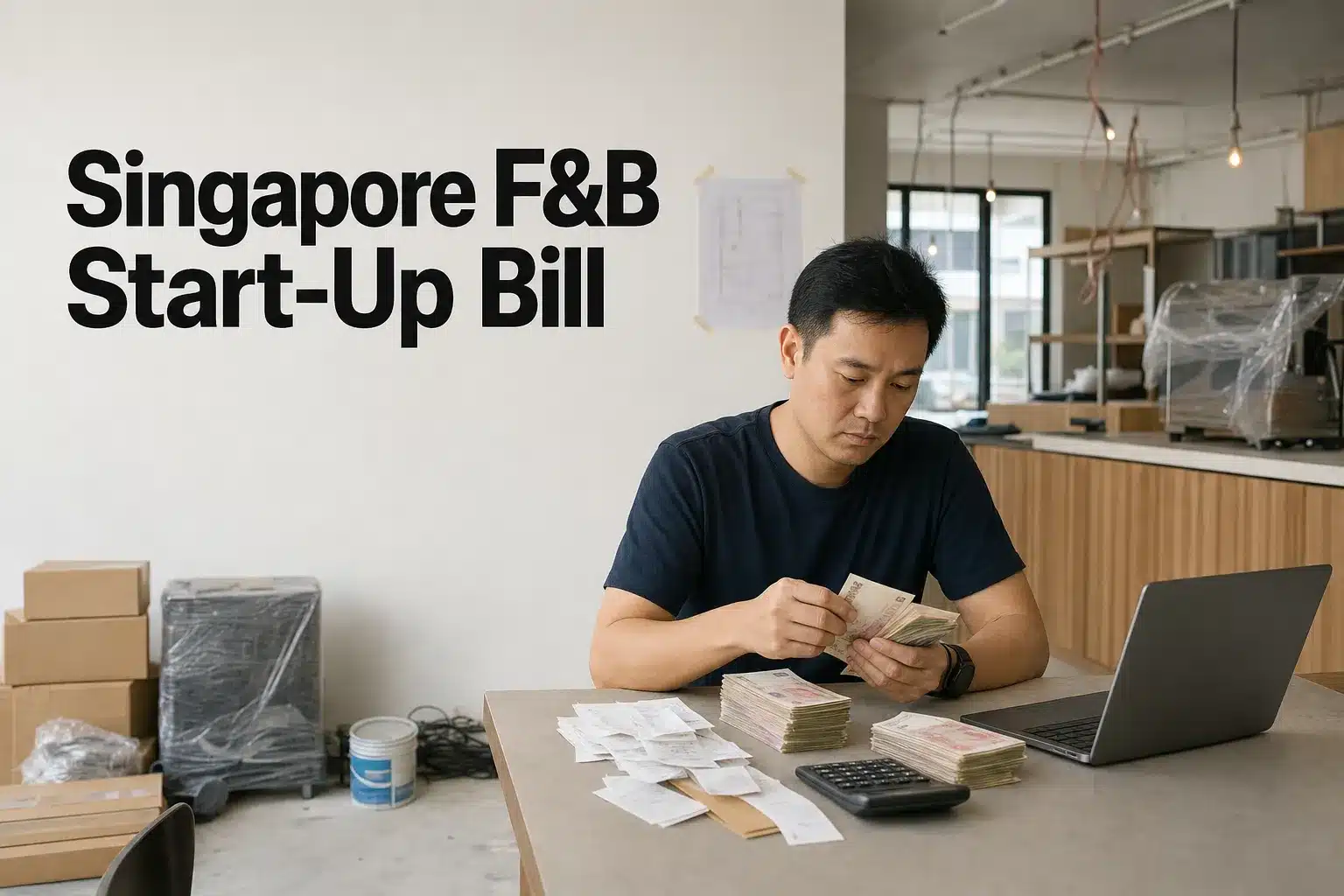
Singapore F&B costs have become less about “starting small” and more about surviving a long, expensive pre-revenue period. A founder sharing a S$209k pre-opening budget is useful not because it’s dramatic, but because it forces the real work: separating refundable deposits from sunk capex, mapping when each payment hits, and translating that into the sales you must generate from week one. If you can’t explain your peak negative cash position, your required revenue per day, and a realistic payback window, you’re not planning—you’re hoping. This guide shows how to convert a real S$209k-style budget into a capex map and cash runway plan, with break-even maths tied to covers/orders, average ticket, and margins, plus the rent and fit-out decisions in Singapore that usually decide whether the outlet lives or dies.
What does a S$209k “pre-opening” budget actually include (and what should you reclassify before you model runway)?
Treat S$209k as a starting dataset, not a truth. Founders often lump everything into “startup cost”, then wonder why cash disappears.
Your first job is to reclassify every line into four buckets. This determines how you fund it, how you recover it (if at all), and how you model break-even.
Bucket A: Refundable deposits (cash out now, potentially back later)
These reduce liquidity but are not an expense—until you forfeit them.
- Lease security deposit (often expressed in months of rent; terms vary by landlord)
- Utilities deposits (electricity, water; amounts depend on account type and landlord requirements)
- Equipment deposits (if you place deposits for custom equipment)
Planning implication: Deposits can be your largest pre-opening cash drain. Model the return timing conservatively (end of lease; after final bills). In runway planning, treat them as “cash locked up”.
Bucket B: One-time sunk setup costs (spent once; no resale value)
These are real expenses and usually non-recoverable.
- Professional fees directly tied to opening (e.g., design drawings; certain submission/consultant fees)
- Branding and creative (logo, packaging design, menu design)
- Pre-launch marketing and content (photography, influencer/media sampling, launch events)
- Training materials and SOP development (if outsourced)
Planning implication: These costs don’t “pay back” unless you design operations to earn more (higher conversion, higher ticket, lower wastage). Treat them as an investment with an expected outcome.
Bucket C: Capex with resale/usage life (equipment + fit-out components)
This is not “just spending”; it’s an operating capability decision.
- Fit-out and renovation (carpentry, M&E works, ventilation, plumbing, grease trap where relevant, flooring, counters)
- Kitchen and bar equipment (ovens, chillers, ice machines, dishwashers, POS hardware)
- Furniture and fixtures (tables, seating, display units)
Planning implication: Capex creates depreciation in accounts, but your bank balance feels the full hit upfront. Model cash as paid per milestone (deposit/progress/final) rather than as a single number.
Bucket D: Recurring costs that begin before opening
These are often missed because founders think they “start after launch”.
- Rent during renovation (depending on lease start date and rent-free period)
- Staff wages during training/soft opening
- Software subscriptions (POS, accounting, inventory, scheduling)
- Insurance (if required for handover)
Planning implication: Recurring costs starting early are the silent runway killer. Your runway plan must start at LOI/lease signing, not opening day.
Founder takeaway: Before modelling anything, rebuild the S$209k into a table with columns: (1) refundable vs sunk vs capex vs recurring, (2) payment timing, (3) vendor milestone terms, (4) what would happen if you exit in month 6.
How should you map the S$209k into a payment timeline from LOI to opening day (so you can see the peak cash hole)?
The most practical runway model is time-based: what you pay, when you pay it, and what triggers each payment.
Below is a realistic sequencing framework for a Singapore F&B outlet. Your dates differ, but the pattern is consistent.
Phase 1 (Week 0–2): Site commitment and “non-negotiable” cash-outs
Typical cash events:
- Option/booking fee or initial deposit tied to the Letter of Offer/Intent (commercial terms vary)
- First security deposit tranche (if required upfront)
- Initial professional fees (space planning, concept feasibility)
Control points:
- Don’t “commit” until you have: landlord’s approved usage, a fit-out feasibility view (especially exhaust/grease/water points), and a base-case unit economics model.
Phase 2 (Week 2–8): Design, approvals, and long-lead procurement
Typical cash events:
- Design development fees
- Authority/third-party submission costs (only model as cost + time driver; don’t treat as a checklist)
- Deposits for long-lead equipment (custom counters, chillers, signage)
Control points:
- Lock your “scope boundaries” early (what is included in contractor quote, what is excluded, who pays for M&E upgrades).
- Create a long-lead list with target delivery dates; late equipment delivery can extend rent-without-revenue.
Phase 3 (Week 8–16): Fit-out execution (where cash burn accelerates)
Typical cash events:
- Contractor progress claims (e.g., 20/40/30/10 type structures—varies)
- M&E variation orders (the most common budget blowout)
- Signage fabrication and installation
Control points:
- Variation order discipline: no work proceeds without written change order, cost, and schedule impact.
- Weekly site meetings that track: cost-to-complete, delays, defects list, and handover date.
Phase 4 (Week 14–20): Hiring, training, inventory build, soft launch
Typical cash events:
- Initial inventory (ingredients, packaging, smallwares)
- Staff payroll begins (training wages + CPF contributions)
- Pre-launch marketing spend
- POS setup and subscription
Control points:
- The soft launch should be designed to test throughput and wastage, not to “make money”. Keep menus tighter.
Phase 5 (Week 20+): Opening and early months (cash still negative)
Even after opening, cash can worsen before it improves due to:
- Supplier credit terms (or lack of them)
- Refund policies and promo discounts
- Ramp-up period for traffic
How to model the peak negative cash position:
- Create a weekly cashflow sheet from Week 0 to Week 26.
- Input payments at the week they are due (not averaged monthly).
- Include rent and payroll starting at the first date they legally/contractually start.
- Track the lowest cash point—this is the minimum funding requirement + buffer.
Buffer rule (practical, not a regulation): For a first-time operator, plan a contingency buffer for (a) fit-out delays and (b) first 8–12 weeks of under-target sales. The exact buffer size is your risk choice; what matters is you consciously fund it.
How do you build a line-by-line cost map from the S$209k case (one-time vs recurring; refundable vs sunk) that’s actually usable?
A usable cost map is a spreadsheet your lender/investor (or your future self) can interrogate.
Below is a founder-ready structure using the S$209k as a reference point. You are not trying to match exact market prices; you are building decision visibility.
1) Commercial rent and deposits (refundables + early recurring)
Include:
- Security deposit (refundable)
- Advance rent (timing depends on lease)
- Renovation period rent (recurring)
- Service charge/maintenance (recurring, if applicable)
What to add as decision fields:
- Rent-free period (if any) and when it starts
- Break clause conditions (if any)
- Reinstatement obligation estimate (end-of-lease cash risk)
2) Fit-out and renovation (capex, but paid in cash milestones)
Split into sub-lines:
- Demolition and hacking
- Carpentry and fabrication
- Flooring and wall finishes
- M&E works (electrical load, water, gas where relevant)
- Ventilation / exhaust and fire-related works where required for concept
- Lighting and signage infrastructure
Decision fields:
- Base scope vs optional scope (nice-to-have)
- “Landlord provision” vs tenant scope
- Warranties and maintenance access
3) Equipment and smallwares (capex + working cash)
Separate:
- Major equipment (capex)
- POS hardware (capex)
- Smallwares (often treated as consumable/operating supplies)
Decision fields:
- Purchase vs lease/rental for specific items
- Service contract costs
- Downtime impact (what happens if the ice machine fails on a Saturday)
4) Licences, approvals, and compliance-as-timeline (cost + delay risk)
Model:
- Application fees and required inspections (where applicable)
- Third-party reports or consultants if needed for your site/concept
Important: Don’t turn this into a compliance article. For budgeting, what matters is:
- which items can delay opening,
- which are prerequisites for handover/operations,
- and what the realistic lead time is.
5) Branding, menu development, and pre-launch marketing (sunk)
Break down:
- Brand identity and packaging
- Menu boards, printed collaterals
- Photography/content production
- Launch campaign (ads, sampling, collaborations)
Decision fields:
- What you expect this spend to change (conversion rate, repeat rate, ticket size)
6) Pre-opening payroll and training (recurring starting early)
Include:
- Recruitment costs
- Training wages
- CPF contributions and basic HR setup costs
Decision fields:
- Minimum staffing for soft launch vs full roster
- Training duration and productivity assumptions
7) Opening inventory and initial working capital (cash that moves fast)
Include:
- Ingredients and beverages
- Packaging
- Cleaning supplies
- Petty cash / float
Decision fields:
- Supplier credit terms
- Minimum order quantities and wastage risk
Founder takeaway: The goal is not a perfect number. The goal is a map that tells you: (1) what is locked cash, (2) what is irreversible, (3) what can be staged, and (4) what changes your opening date.
How do you translate S$209k of pre-opening spend into break-even sales math (per month, per day, per cover/order)?
Break-even is not a vibe. It’s a small set of assumptions that must be explicit.
Step 1: Separate fixed costs vs variable costs
Fixed costs (monthly): rent, payroll base, software, insurance, utilities baseline, accounting fees, loan repayments (if any).
Variable costs (per sale): ingredients/COGS, packaging, delivery platform commissions (if relevant), variable labour (if you scale headcount by volume), merchant fees.
Step 2: Contribution margin is your real friend
Define:
- Gross margin = (Sales – COGS) / Sales
- Contribution margin = (Sales – COGS – variable costs tied to sales) / Sales
For many F&B models, contribution margin is what pays rent and payroll. If your concept relies heavily on delivery platforms or expensive packaging, contribution margin can drop materially even when gross margin looks “fine”.
Step 3: Build a base-case break-even equation
Let:
- Fixed costs per month = F
- Contribution margin = CM
Then required monthly sales to break even:
- Sales_break-even = F / CM
Example (illustrative, not market-claim):
- F = S$45,000/month (rent + payroll + overheads)
- CM = 55%
- Sales_break-even ≈ S$81,800/month
Convert to daily (assume 30 days):
- ≈ S$2,700/day
Convert to orders:
- If average ticket = S$18, required orders/day ≈ 150 orders/day
- If average ticket = S$12, required orders/day ≈ 225 orders/day
That difference is why pricing, upsell, and menu engineering matter as much as rent.
Step 4: Add capex payback expectations (don’t confuse with break-even)
Break-even pays today’s bills. Payback answers: how long until the S$209k is recovered.
A simple payback view:
- Monthly operating profit after break-even = Sales × CM – F
- Payback months ≈ 209,000 / monthly operating profit
Illustration:
- If you generate S$15,000/month operating profit, payback ≈ 14 months.
- If you generate S$7,500/month operating profit, payback ≈ 28 months.
Reality check: If your lease is short or your concept risk is high, a long payback period may be commercially fragile—especially if a refit is needed before you’ve recovered the initial spend.
Step 5: Do the “bad month” test
Model one realistic downside month:
- Sales 25–35% below plan
- Some costs don’t fall (rent, base payroll)
If that downside month wipes out multiple good months, you need to redesign either:
- fixed cost base,
- contribution margin,
- or ramp-up plan.
Founder takeaway: The S$209k only matters when paired with (1) fixed monthly cost base and (2) contribution margin. Everything else is storytelling.
What runway should you plan for if the real risk is timing (rent starts, fit-out delays, hiring starts) rather than the budget total?
Two outlets can both “cost S$209k” and one still fails—because the second ran out of cash at Week 14.
Build runway around three dates, not one
Most founders only track opening day. Track these instead:
- Lease financial start (when rent and deposits begin)
- Fit-out start (when progress payments begin)
- Payroll start (when you begin paying for training/operations)
Runway is the time from the earliest of these dates until the business becomes cash-positive.
Identify the cash peak (lowest point) and fund it, not the average
A practical runway plan includes:
- Peak negative cash position
- A contingency buffer
- A rule for when you stop spending (kill-switch) if opening is delayed or sales underperform
Design a staged spending plan (so you can pause without wasting everything)
Not every spend should happen upfront.
Good candidates to stage:
- Certain branding deliverables (e.g., full packaging suite after menu is final)
- Some equipment purchases (buy closer to handover if lead time allows)
- Hiring ramp (train core team first; expand after stable demand)
Bad candidates to stage (usually backfires):
- Critical M&E works
- Core production equipment
- Essential fire/life-safety related requirements
Use a simple “cash gates” system
Before releasing the next tranche of spending, require:
- confirmed handover date,
- confirmed equipment delivery dates,
- approved menu with tested prep times,
- recruitment status vs roster plan.
This is not bureaucracy—it’s preventing death by a thousand small approvals.
Track runway weekly for the first 16 weeks after opening
Monthly reporting is too slow early on. Weekly dashboard:
- sales vs plan
- labour %
- COGS %
- promo/discount %
- cash in bank and next 4 weeks’ payables
Where an advisor helps without turning it into a sales pitch: Firms like Paul Hype Page & Co. often support founders by turning “a budget” into a working cash model and management reporting rhythm—so the operator sees problems while they’re still fixable.

How do Singapore commercial rent terms change your downside risk (and how should you price that risk into your plan)?
In Singapore, rent is rarely just rent. Your downside is shaped by deposits, fit-out exposure, lease length, and reinstatement.
1) Deposits turn into locked cash
Even if refundable, deposits are cash you cannot use for:
- payroll during ramp-up,
- emergency repairs,
- marketing when sales dip.
Planning move: Treat deposits as a separate “liquidity reserve consumed” line, not part of “capex”.
2) Lease length vs fit-out payback must match
If your fit-out and equipment spend is large, you need enough lease term to recover it.
Decision logic:
- Larger fit-out spend → you need either longer certainty or a plan to reuse/relocate assets.
- Shorter lease or uncertain renewal → push harder on modular fit-out and equipment with resale value.
3) Reinstatement is an end-of-lease cash bomb
Many first-time tenants ignore reinstatement until the last month.
Planning move: Include a reinstatement provision in your model from day one. You don’t need a perfect number—just acknowledge the liability so you don’t over-distribute cash in good months.
4) Location-quality tradeoffs should be modelled as “traffic certainty vs fixed cost”
A premium location can be rational if it reduces ramp-up risk and stabilises sales. But it only works if your concept can convert that traffic at a healthy contribution margin.
Practical test:
- If rent increases by S$X per month, your required sales increase by S$X / CM.
- Translate that into additional daily orders and ask: is that plausible for this concept, this footprint, this team?
5) Negotiate with a model, not with hope
You don’t need to be aggressive; you need to be prepared. Bring:
- your fit-out timeline,
- your ramp-up plan,
- and your cashflow constraints.
Ask for terms that reduce timing risk (examples):
- clearer rent commencement alignment to handover readiness,
- practical rent-free structure,
- phased deposit schedule.
Terms vary widely by landlord and market cycle; the value is knowing exactly which clauses move your cash survival odds.
How should you treat fit-out and equipment as capex decisions (and avoid “cheap now, expensive later”)?
Founders often value-engineer the wrong things: visible finishes instead of operational reliability.
Cost drivers you should expect (and control)
- M&E complexity: power load, drainage, ventilation. If your concept needs heavy cooking, your M&E is not optional.
- Site condition: older units can hide expensive constraints.
- Custom carpentry: beautiful but costly, slow, and hard to modify.
- Programme risk: every additional week of renovation can mean another week of rent + payroll without full sales.
Value engineering that protects operations
Good “save money” moves typically:
- simplify menu production to reduce equipment count,
- choose modular counters and accessible service routes,
- standardise parts (easier maintenance),
- reduce custom one-off fabrication.
Risky “save money” moves typically:
- under-spec critical cold storage (leads to spoilage and downtime),
- buy low-reliability equipment without local servicing,
- ignore cleaning and maintenance access (labour hours quietly rise).
Treat equipment downtime as a financial variable
A single critical equipment failure can reduce sales, increase refunds, and damage ratings.
Build a “critical equipment list”:
- What item, if down, stops sales?
- Do you have a workaround?
- What is the expected service response time?
Then decide:
- buy new vs used,
- service contract vs ad-hoc,
- redundancy for one or two mission-critical items.
Control scope creep with a one-page scope boundary document
Include:
- what the contractor quote includes/excludes,
- assumptions (site power capacity, floor trap locations),
- who pays for landlord-required upgrades,
- variation order process.
Scope creep is not just cost—it’s delay. Delay is often the bigger killer because it multiplies your recurring burn while you earn nothing.
What should you assume for early-month unit economics (covers, ticket, gross margin) so your break-even plan isn’t fantasy?
A strong plan avoids heroic assumptions.
1) Start with throughput constraints, not just demand
Your maximum sales is constrained by:
- number of seats (if dine-in),
- order processing time,
- kitchen capacity,
- staffing.
If you need 200 orders/day to break even but your line can only process 120 without quality collapse, your model is broken.
2) Use three scenarios, not one
Build:
- Base case: realistic ramp
- Downside case: slower traffic + higher wastage
- Upside case: strong traction but with higher variable labour
What changes by scenario:
- daily orders/covers
- average ticket
- discount rate
- COGS % and wastage
- labour scheduling
3) Average ticket is not just pricing; it’s mix
Increase ticket responsibly through:
- bundles,
- add-ons,
- size upgrades,
- limited-time items that use existing prep.
Be careful with:
- items that increase complexity and labour minutes per order,
- promos that raise volume but crush contribution margin.
4) Gross margin targets must reflect your channel mix
If delivery platform commissions and packaging are meaningful, contribution margin can drop sharply.
Practical measurement from Week 1:
- Dine-in CM vs delivery CM
- Item-level margin for top 20 sellers
- Labour minutes per order during peaks
5) Labour is both cost and capacity
Common early mistake: cutting labour too hard, causing slow service, bad reviews, and lost repeat business.
Instead:
- define service standards,
- roster for peak hours,
- tighten the menu during ramp.
Founder takeaway: Unit economics is operational, not just financial. Your break-even plan must be consistent with what your team and layout can physically deliver.
How do you decide what to fund with equity, loans, or internal cash (and what should never be underfunded)?
Funding is not only about cost of capital. It’s about survivability under delay and underperformance.
Match funding type to cost type
- Refundable deposits: ideally funded with stable capital (equity or longer-tenor funding), because the cash is locked up.
- Fit-out/equipment capex: can be funded with term financing if available, but only if repayments won’t strangle early cashflow.
- Pre-launch marketing and sunk setup: fund with equity/internal cash; don’t rely on “we’ll make it back next month”.
- Working capital: must be liquid and flexible; this is where many first-time outlets fail.
Never underfund these three areas
- Working capital for the first 8–12 weeks (inventory, payroll, rent)
- Critical equipment reliability (downtime cost is nonlinear)
- Contingency for delays (because delays are common even with good contractors)
Use a “repayment stress test” if you borrow
If you take a loan/financing, test:
- Sales at 70–80% of plan for 3 months
- Higher labour cost due to training inefficiency
If repayments make you cash-negative even in the base case, the funding structure is wrong.
Build an investor-ready narrative without hype
Investors (formal or informal) want clarity on:
- where the S$209k goes,
- when it is spent,
- what it changes operationally,
- how long to payback under base/downside.
A clean model builds trust faster than big claims.
(At this stage, some founders involve an external finance partner like Paul Hype Page & Co. to sanity-check the model assumptions and set up cash reporting—less to “raise money”, more to avoid building a plan that fails the first contact with reality.)
What should your “opening-ready” financial control pack look like before you unlock the doors?
You don’t need corporate-level reporting. You need a minimum control pack that stops small leakage from becoming fatal.
1) A weekly cash dashboard (first 16 weeks)
Include:
- cash in bank
- next 4 weeks payables (rent, payroll, suppliers, loan)
- weekly sales and channel mix
- COGS % and wastage notes
- labour % and overtime
Owner: founder/GM, reviewed every week.
2) A simple P&L structure that matches operations
Set up categories that mirror decisions:
- rent and occupancy
- payroll (base vs variable)
- COGS (with key subcategories)
- delivery commissions
- marketing (launch vs maintenance)
- repairs and maintenance
If your accounts lump everything into “miscellaneous”, you’ll manage by gut feel.
3) Three operating KPIs linked to break-even
Pick KPIs that directly drive your model:
- orders/covers per day
- average ticket
- contribution margin (or proxy metrics: COGS % + discount % + channel commission %)
4) Payment discipline and approvals
Create a basic rule set:
- who can approve supplier onboarding,
- who can approve discounts/promotions,
- who can sign off variation orders.
5) Inventory and wastage controls that don’t slow the team
Minimum viable controls:
- top 20 items counted weekly
- wastage log with reasons
- recipe cards for best-sellers
Founder takeaway: The goal is speed with control. Early-stage F&B doesn’t die from one big fraud; it dies from unmanaged drift—extra wastage, casual discounting, untracked promo costs, and maintenance surprises.
Conclusion
A S$209k pre-opening budget is only “useful” when you convert it into three founder-ready outputs: (1) a line-by-line cost map that distinguishes refundable deposits, sunk costs, capex, and recurring burn; (2) a payment timeline that shows your peak negative cash position from LOI to post-opening ramp; and (3) break-even maths that translates fixed costs and contribution margin into daily sales, orders/covers, and a realistic payback window. In Singapore, rent terms and fit-out decisions tend to dominate downside risk—so your plan should stress-test delays, under-target sales, and end-of-lease obligations before you sign and spend. If you build the model early and review it weekly through the first months, you shift from “opening a shop” to running a financeable, survivable retail business.
FAQs
Estimate monthly fixed costs (rent, base payroll, overheads) and your contribution margin (sales minus COGS and other sales-tied variable costs), then use Sales_break-even = Fixed Costs ÷ Contribution Margin and convert it into daily sales and orders using your average ticket.
Run a downside month with sales 25–35% below plan while keeping rent and base payroll largely unchanged, then check whether cash stays survivable and whether multiple good months would be wiped out by one bad month.
Refundable deposits (like lease and utilities deposits) lock up cash but aren’t a P&L expense unless forfeited, while pre-opening expenses (like branding or certain professional fees) are usually sunk and non-recoverable; separating them prevents you from understating your liquidity risk.
Build a weekly cashflow from LOI/lease signing through at least the first few months of trading, enter payments in the weeks they are due (rent, progress claims, payroll, inventory), and take the lowest cash balance as your peak cash hole to fund plus buffer.
Often stage nice-to-have branding deliverables, some equipment purchases if lead times allow, and hiring ramp; avoid staging critical M&E works, core production equipment, and items that can delay handover or opening if they slip.
Share This Story, Choose Your Platform!
Related Business Articles