Outline
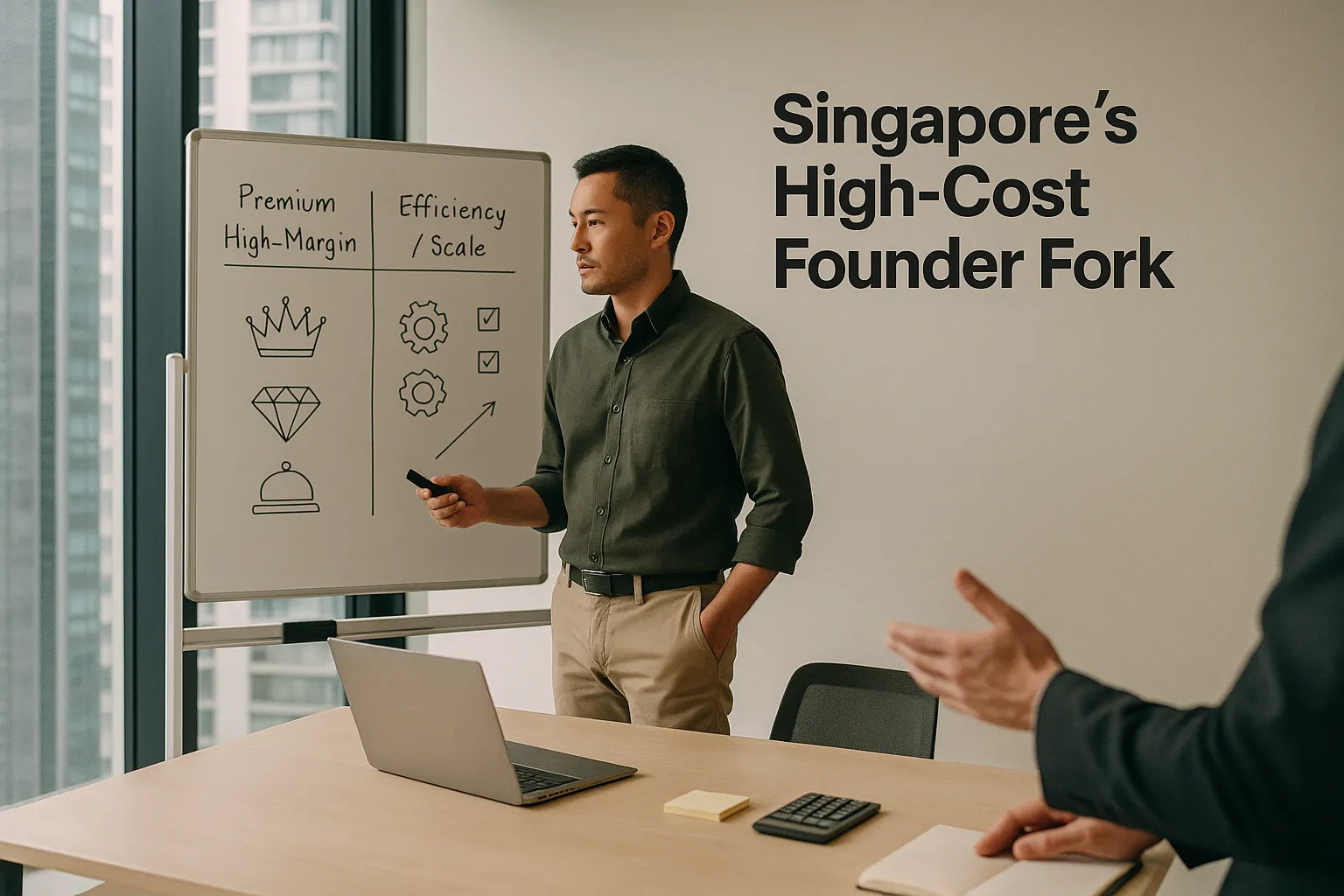
Singapore’s positioning as a Singapore high-net-worth hub is no longer just a tourism or prestige headline—it is a market signal that reshapes what customers will pay, what staff expect, and what it costs to deliver. For founders, the real problem is not “Singapore is expensive”. It’s that costs (rent, wages, vendor pass-through) move like a premium city, while many SMEs still run on founder-led delivery, broad service menus, and pricing built for a cheaper era. That gap creates the mushy middle: rich-city pricing with SME margins and weak systems. This guide gives a decision framework for the fork in the road—build an ultra-premium HNW offering or defend affordability through efficiency and scale—and the practical operating moves to make that choice real before 2027.
What does the HNW “most expensive city” narrative change in the market—beyond headlines?
Founders should treat the HNW cost ranking as a proxy for three commercial shifts that typically show up in Singapore first, then cascade into the broader SME market.
1) Customer expectations reset faster than your cost base
When affluent customers anchor their spending locally, service expectations harden:
- Faster response times and higher service availability
- More “done-for-you” packaging
- Clear privacy and discretion norms
- Premium environments (or premium digital experiences)
Even non-HNW customers absorb these expectations through exposure to premium brands—then apply them to everyday services (renovation, accounting, wellness, education, property-related services).
2) Input costs move in a premium-city pattern
You feel this even if you don’t serve wealthy clients:
- Rent/space strategy pressure: higher base rent, shorter negotiation leverage, and more “value capture” by landlords if your footfall improves.
- Wage pressure: competition for the same talent pool; higher baseline expectations for compensation, flexibility, and career progression.
- Vendor pass-through: your suppliers face the same rent and wage issues and reprice accordingly.
3) Positioning polarises (and the middle gets punished)
In a premium city, customers increasingly choose:
- Ultra-premium: fewer providers, higher trust, higher prices, higher standards.
- Efficient value: transparent pricing, streamlined delivery, and predictable outcomes.
The “in-between” offer becomes hard to defend because you are neither special enough to justify high prices nor efficient enough to preserve margins.
Practical takeaway: The ranking is not a trophy or a crisis—it’s a forcing function. Your operating model must match one of the two ends of the barbell, or you’ll experience margin compression disguised as growth.
Are you heading toward the “mushy middle”—and how do you diagnose it early?
The mushy middle is not a branding problem. It’s an operating mismatch: premium-city pricing and overheads, with delivery designed like a small shop.
Early warning signs (commercial + operational)
If you recognise 5–6 of these, you’re likely drifting into the middle:
- Prices have risen, but gross margin hasn’t improved (or gets wiped by discounts and exceptions).
- Every quote is bespoke, because your service menu is wide and your scope boundaries are soft.
- Founder (or a few seniors) must touch every job for quality control.
- Lead times are increasing, but you can’t confidently hire your way out without losing margin.
- Customer acquisition is inconsistent: referrals are strong, paid channels are weak, and partnerships aren’t systemised.
- Complaints aren’t about outcomes, they’re about communication, speed, and “value for money”.
- Your team is busy, but utilisation is unclear: you can’t easily see which client types and jobs make money.
- You keep adding services to justify price increases.
The core problem: you’re selling complexity without charging for it
In Singapore, costs rise whether your processes improve or not. If your operations stay manual and exception-driven, higher prices just increase customer scrutiny.
A simple diagnostic: “Premium signal” vs “Efficiency signal”
Ask two questions:
- Do customers choose you for trust, discretion, and outcomes under uncertainty? (premium signal)
- Do customers choose you for speed, transparency, and predictable scope? (efficiency signal)
If the honest answer is “a bit of both” and you cannot articulate what you refuse to do, you’re in the danger zone.
Practical takeaway: The mushy middle is fixable—but only if you commit to a clear trade-off: either deepen premium differentiation or redesign for scale. Trying to do both with the same team and the same workflows usually fails.
Which path should you choose in Singapore: ultra-premium HNW or efficiency-and-scale?
This decision should be made like a portfolio choice—based on demand, capability, risk tolerance, and time horizon.
Choose ultra-premium HNW if most of these are true
- Your work involves high stakes, material sums, or reputational risk for clients.
- You can access trust-based channels (private banker referrals, family office networks, professional circles, premium property ecosystems).
- You have (or can hire) senior talent who can sell and deliver, not just execute.
- You can enforce capacity discipline (saying no, waitlists, minimum engagement sizes).
- You are willing to invest in brand proof points (not “marketing”), such as documented case types, governance, and service reliability.
Choose efficiency-and-scale if most of these are true
- Your market is price-sensitive or comparisons are easy.
- The service can be standardised into clear steps and templates.
- You can win through speed, convenience, and clarity, not bespoke expertise.
- You can reduce delivery cost through automation and role redesign, not heroic effort.
- You are comfortable with higher volume, lower margin per unit, and tight scope control.
The constraint that decides for many founders: talent and throughput
In Singapore, wage pressure is real. If your model depends on a small number of high-cost people doing high-touch work for mid-tier prices, the economics eventually break.
A timing lens: what must be true by 2027?
- Premium path: you need a reputation engine and operational excellence (not just nicer branding).
- Scale path: you need repeatable workflows, reliable data, and channel economics that work without heavy founder involvement.
Practical takeaway: Your “path” is a business design choice. It should show up in your pricing architecture, service menu, hiring plan, and the systems you build—not just in your website copy.
If you go ultra-premium, what does it mean operationally (not just branding)?
Ultra-premium in Singapore is a service level agreement with the market. It requires deliberate design in packaging, onboarding, delivery, and capacity.
Packaging—sell outcomes, not hours
Premium buyers pay for reduced uncertainty and fewer decisions.
- Productise around client situations (e.g., “cross-border household structuring support” style outcomes) rather than task lists.
- Use tiered engagement levels that explicitly differ in access, turnaround, and senior involvement.
- Include defined governance rhythms: monthly/quarterly reviews, decision logs, and escalation paths.
Service levels—define “premium” in measurable terms
Examples of measurable standards:
- Response time windows (business hours vs extended hours)
- Meeting cadence and who attends (partner-led vs manager-led)
- Turnaround targets with clear inputs required from the client
- Confidentiality handling and document control
The point is not to promise perfection—it’s to reduce ambiguity.
Onboarding—premium clients want certainty fast
A premium onboarding should feel like a controlled process:
- A structured discovery that captures objectives, stakeholders, risk areas
- A documented scope and “what we do / don’t do” boundary
- A clear map of decisions required from the client (and when)
- A secure channel for document exchange and approvals
Exclusivity and capacity management—protect the delivery standard
Premium businesses fail when they chase volume.
- Maintain a capacity plan: how many active clients per partner/lead.
- Use minimum engagement sizes or retainer structures to reduce fragmentation.
- Build a “refusal list”: services you will not offer because they dilute quality.
Brand proof points—evidence beats claims
In affluent markets, trust is built through signals:
- Senior team continuity and credentials (presented plainly)
- Process maturity (governance, documentation, client reporting)
- Quality control routines (peer review, second sign-off for critical deliverables)
Practical takeaway: Ultra-premium is operational discipline. If you can’t define and measure service levels, you don’t have a premium offer—you have expensive bespoke work.
How should pricing architecture change to match premium positioning (without scaring off good clients)?
Premium pricing fails when it’s implemented as a blanket uplift. It works when it is tied to clear value drivers and controlled delivery.
Move from “rates” to “risk-and-complexity pricing”
Even if you still track time internally, avoid selling time as the main unit. Price based on:
- Decision complexity
- Stakeholder count
- Turnaround requirements
- Confidentiality and coordination load
This aligns pricing with what actually consumes senior attention.
Introduce deliberate frictions to protect margin
Not every client should be able to buy every service instantly.
- Use qualification calls and documented acceptance criteria.
- Offer premium availability as a paid feature, not an implied promise.
- Use change-control: when scope changes, price changes—politely and consistently.
Design “good-better-best” tiers that are operationally real
The tiers should differ by:
- Senior time included
- Speed/availability
- Depth of advisory vs execution-only
Avoid fake tiers where the team still delivers everything the same way.
Protect the relationship with transparency, not discounting
Premium clients often accept price increases when you:
- Explain what has changed in service level, governance, or turnaround
- Provide a stable rhythm of reporting and decision support
- Keep surprises low
Practical takeaway: Premium pricing is not about charging more; it’s about charging in a way that funds a higher standard of delivery and protects capacity.

If you defend affordability, how do you redesign for efficiency and scale without destroying quality?
The affordability model is not “work harder”. It is redesigning unit economics so predictable work is delivered cheaply, reliably, and with tight scope.
Simplify SKUs and narrow what you sell
Scale needs repeatability.
- Cut rarely sold services that generate exceptions.
- Convert bespoke work into standard packages with clear boundaries.
- Standardise inputs: what documents/data you need and in what format.
Automation-first operations (beyond buying software)
Start with process selection:
- High-volume, rules-based tasks
- Clear inputs/outputs
- Low exception rates (or exceptions that can be routed)
Implementation essentials:
- Redesign workflow before automation (remove unnecessary steps)
- Define ownership: process owner, system owner, data owner
- Integrate systems where possible to avoid rekeying
- Train staff on the “new way” and track adoption
Where AI may help (practically):
- Drafting first-pass client communications from templates
- Categorising documents and routing cases
- Exception triage (flagging missing inputs)
Guardrails matter: approval steps, audit trails, access controls, and clear “no AI” zones for sensitive data.
Self-serve and guided journeys
Affordability improves when customers can do part of the work:
- Online intake forms
- Client portals for document upload and status tracking
- Standard updates and milestone notifications
The goal is not to reduce service—it’s to reduce back-and-forth.
Tight scope control as a customer experience feature
Clear boundaries reduce disputes:
- Publish what’s included and what triggers additional work
- Use change requests as a normal mechanism
- Keep turnaround dependent on client input quality (and make that explicit)
Practical takeaway: If you want affordable pricing in a premium-cost city, your operating model must look like a system, not a craft.
What cost pressures matter most in Singapore for founders—and what decisions actually move the needle?
Macro narratives don’t help unless they translate into controllable levers. In Singapore, three cost areas tend to decide whether your chosen positioning holds.
Rent and space—stop treating office footprint as identity
Decisions that matter:
- Hybrid-by-design: not “work from home”, but planned presence for client-facing and team collaboration.
- Client experience without permanent footprint: meeting suites on demand, smaller core office, better digital onboarding.
- Space-per-revenue targets: measure revenue per square foot (or per seat) and track it quarterly.
Premium path nuance: you may still need a premium environment—but you can separate “experience space” from “production space”.
Wage pressure—design roles, not just headcount
Decisions that matter:
- Clarify which work must be done by senior staff vs trained juniors vs automated workflows.
- Create progression pathways tied to process mastery (reduces churn).
- Build a performance system based on throughput, quality, and client outcomes—not only hours.
Vendor pass-through—renegotiate the operating stack
Decisions that matter:
- Consolidate vendors where integration reduces manual work.
- Demand better reporting from vendors (usage, outcomes, support response).
- Build a “make vs buy” view for recurring tasks.
Practical takeaway: Cost control in Singapore is less about one-off cuts and more about structural decisions: footprint design, role architecture, and operational tooling that reduces rework.
How do you align channel mix and customer acquisition with your chosen positioning?
Many SMEs price like a premium brand but acquire customers like a mass-market business—then wonder why CAC rises and conversion falls.
Premium/HNW channel mix—trust travels through networks
Effective channels are typically:
- Professional referrals (lawyers, tax advisors, private bankers, fiduciaries)
- Curated partnerships (premium property ecosystem, private education, concierge networks)
- Thought leadership that signals judgment (not content volume)
Operational requirement: referral partners need confidence your onboarding and delivery are consistent. A single poor experience can shut a channel.
Scale/affordable channel mix—clarity converts
Effective channels typically:
- Search and marketplace discovery (where comparison is expected)
- Partnerships with platforms and communities
- Paid acquisition that works only if onboarding is frictionless
Operational requirement: your funnel must be measurable end-to-end (lead → qualification → onboarding → delivery). If you can’t measure drop-offs, you can’t lower CAC.
Don’t mix signals
Common failure patterns:
- Premium pricing with couponing and heavy discount tactics
- Affordable positioning with slow turnaround and bespoke quoting
Practical takeaway: Channel strategy is not a marketing exercise. It is an operating choice: can your business reliably deliver what the channel promises?
Where does regional delivery fit—and how do you avoid losing control as you “move work out”?
For many Singapore SMEs, regionalisation is the practical bridge that makes either model viable:
- Premium businesses keep senior advisory and relationship management in Singapore.
- Scale businesses shift standardisable work to lower-cost delivery centres.
What to keep in Singapore vs what to regionalise
Keep in Singapore when it is:
- Client-facing, trust-heavy, or requires senior judgment
- High-risk decision support
- Brand-defining interactions
Regionalise when it is:
- Repeatable production work with clear QA standards
- Document processing, reconciliation, preparation, and templated outputs
- Tier-1 support with escalation rules
The control system you need before you move work
Regionalisation fails when it’s treated as “cheaper labour”. Treat it as an operating redesign:
- Standard operating procedures (SOPs) that reflect reality
- Quality checkpoints and sampling plans
- Clear RACI (who is Responsible/Accountable/Consulted/Informed)
- Shared tools and version control
- Data access governance and security controls
Measure outcomes, not activity
Track:
- Turnaround time by workflow stage
- Rework rate (how often work is returned for fixes)
- Client satisfaction tied to specific touchpoints
- Cost per completed unit of work
Paul Hype Page & Co. often supports regional-facing operators by helping define the finance, payroll, and compliance workflows that sit underneath regional delivery—so cost savings do not come with reporting gaps or control issues.
Practical takeaway: Regional delivery works when you move a process, not when you move tasks. Control beats proximity.
What 90-day action plan helps you commit to a path and avoid half-measures?
A 90-day window is enough to make the positioning choice operational—not perfect, but real.
Days 1–15: Decide with evidence, not instinct
- Segment customers by profitability and delivery effort (even a rough estimate).
- Identify your top 10 “exception types” that create rework.
- Map the real customer journey from first contact to delivery.
- Choose the path (premium or scale) and write down what you will stop doing.
Deliverable: a one-page positioning memo with non-negotiables.
Days 16–45: Redesign the offer and the operating rhythm
For premium:
- Define tiers, service levels, onboarding steps, and acceptance criteria.
- Set capacity rules and minimum engagement standards.
For scale:
- Cut SKUs, standardise scope, redesign workflow, and define automation backlog.
- Build self-serve intake and standard client communications.
Deliverable: updated service menu + process map + scope control rules.
Days 46–90: Implement controls and measurement
- Set weekly operational metrics (lead time, rework, utilisation proxy, margin proxy).
- Train staff on the new workflow and escalation rules.
- Pilot with a defined customer segment; refine before broad rollout.
Deliverable: dashboard + training completion + pilot results and next iteration.
Practical takeaway: Progress is not “we raised prices” or “we bought software”. Progress is: clearer offers, tighter scope, faster delivery, and measurable unit economics.
Conclusion
Singapore’s premium-city signal is forcing a strategic choice for founders ahead of 2027: build an ultra-premium model that earns trust, protects capacity, and funds senior delivery—or defend middle-class affordability by redesigning for efficiency, automation, and scale. The danger is the mushy middle: prices that drift upward while operations stay bespoke, founder-led, and margin-thin. Use the next 90 days to make the choice tangible: simplify what you sell, rebuild pricing around value and scope, redesign workflows, and put measurement in place. If you need an implementation partner to translate positioning into finance, operating, and control routines—especially where regional delivery or multi-function back offices are involved—Paul Hype Page & Co. can support the planning and execution without turning the exercise into a branding project.
FAQs
Go premium if you can win on trust, discretion, and high-stakes outcomes—and you can enforce capacity discipline with real service levels and minimum engagement sizes. Go scale if your work can be standardised, delivered with tight scope, and improved through automation and role redesign to make unit economics work at higher volume.
Look for rising prices without better gross margin, heavy bespoke quoting, founder-led delivery for quality control, unclear utilisation, and complaints about speed or value rather than outcomes. If you can’t clearly state whether customers choose you for trust/outcomes or for speed/transparency, you’re likely drifting into the middle.
Productise around outcomes, set measurable service levels (response times, cadence, senior involvement), run a structured onboarding, and protect capacity with clear acceptance criteria and a refusal list. Back it with proof points like governance rhythms and consistent quality control, not just nicer branding.
Simplify what you sell into repeatable packages, standardise inputs, redesign workflows before automating, and build self-serve intake and status updates to reduce back-and-forth. Use scope control and change requests as part of the customer experience so exceptions don’t overwhelm delivery.
Yes, if you move a process—not just tasks—by keeping client-facing judgment in Singapore and shifting repeatable production work with clear QA elsewhere. Put SOPs, checkpoints, RACI ownership, shared tools, and outcome metrics (turnaround time, rework rate, cost per completed unit) in place before scaling regional delivery.
Share This Story, Choose Your Platform!
Related Business Articles