Outline
- What should your “review response system” achieve (beyond sounding polite)?
- Who should reply, and how do you prevent founder mood from becoming the brand?
- What is a practical cooling-off rule, and how do you enforce it on busy days?
- What workflow should you run from first complaint to public closure (a simple playbook)?
- How do platform realities in Singapore change what you should say and do?
- What should your public reply templates look like (copy/paste ready)?
- How do you move the conversation offline fast without looking like you’re hiding?
- What evidence and documentation should you keep so disputes don’t become messy?
- When should you not engage at all, and what’s the safe way to respond if you must?
- How do you build escalation paths for “high-risk” complaints without a PR team?
- Conclusion
- Turn replies into a simple SOP
- FAQs
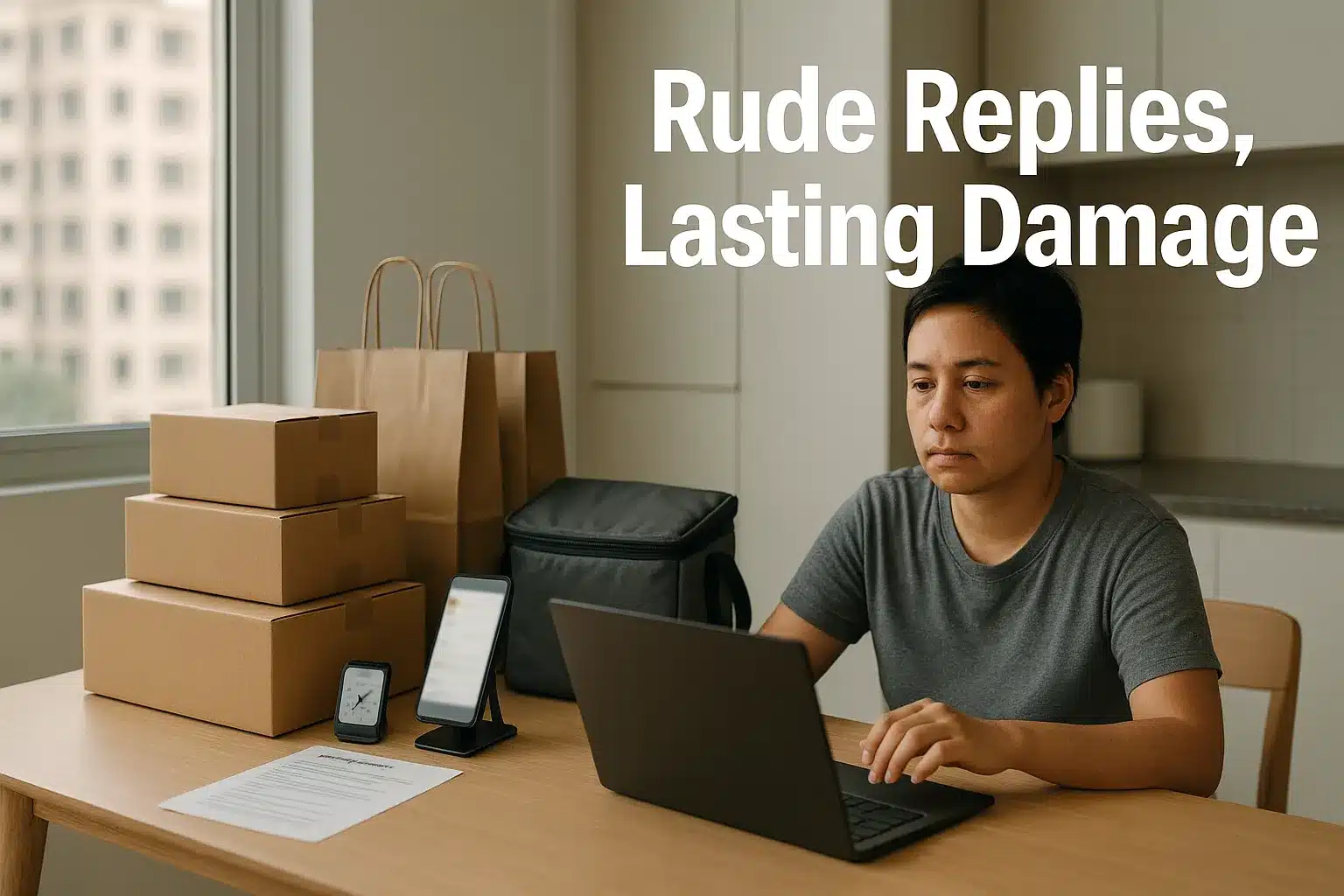
In Singapore customer experience, a single public reply can travel further than your best product photo. For home-based businesses and SMEs selling through GrabFood, Foodpanda, Google, Instagram, or Carousell, your “response behaviour” is part of your operations—because screenshots move fast, ratings are sticky, and customers often judge you more by how you handle problems than by the problem itself. The practical challenge is not knowing you should “stay calm”; it’s building a repeatable response system that works when you’re tired, emotional, and mid-service.
This guide sets up an operator-ready workflow: who replies, when to pause, how to move disputes offline quickly, what to document, and what to say—using templates you can copy/paste—so you protect ratings, repeat orders, and founder sanity without sounding defensive or escalating risk.
What should your “review response system” achieve (beyond sounding polite)?
Treat review responses as an operating system, not a personality test. Your system should consistently deliver four outcomes—especially in Singapore’s small, screenshot-heavy market.
The four outcomes to design for
- Containment (stop the spread): reduce public back-and-forth, keep the thread short, and move resolution into a private channel fast.
- Clarity (establish facts): separate what you control (prep, packaging, comms) from what platforms control (dispatch, rider routing, refunds) without blaming.
- Recovery (offer a remedy path): give the customer a clear next step that feels fair, fast, and specific.
- Closure (protect future readers): when appropriate, close the loop publicly in one calm line so future customers see you resolve issues.
Why this matters commercially
- Star averages are lagging indicators. The next 10 customers may decide based on the most recent 1–3 reviews and your replies.
- One screenshot can dominate search. A “rude reply” can become the story, even if the original complaint was minor.
- Time cost is real. Ad-hoc arguing consumes founder time and distracts from fulfilment—causing more service errors, more complaints, and a negative loop.
A good system optimises for speed, consistency, and emotional control—not perfect wording.
Who should reply, and how do you prevent founder mood from becoming the brand?
Most micro-operators default to: “I’m the owner, so I reply.” That’s exactly where reputational accidents happen.
Set roles even if you’re a team of one
Use role-hats rather than job titles:
- Responder (public): posts the public reply. Goal: short, calm, procedural.
- Resolver (private): handles the back-and-forth in DM/in-app chat/WhatsApp. Goal: gather facts, propose remedy, close.
- Approver (only for edge cases): approves replies involving threats, alleged safety issues, media attention, or abusive content.
For solo founders: you still separate hats by separating time. You do not reply “live”.
The “two-lane” rule (to protect you from yourself)
- Lane A: Standard complaints (late delivery, missing item, taste preference, packaging issues). Use templates. No improvisation.
- Lane B: High-risk complaints (allegations of contamination, discrimination, threats to “post everywhere”, doxxing attempts, abusive language). Delay, document, escalate.
Lightweight guardrails that work in real life
- No-reply-while-emotional rule: implement a mandatory cooling-off window (see next section).
- No late-night replies: set a cut-off (e.g., after 10pm) unless it’s a safety issue.
- No sarcasm, no “receipts” in public: even if you’re right, screenshots punish tone.
If you have a small team, pick one person who is temperamentally suited to calm writing to be the Responder. Founders can stay as Approver for Lane B only.
What is a practical cooling-off rule, and how do you enforce it on busy days?
A cooling-off rule is a control point: it prevents the single worst type of reply—fast, emotional, and permanent.
A Singapore-operator-friendly cooling-off standard
Choose one rule and stick to it:
- 20 minutes for standard complaints (Lane A)
- 60 minutes for high-risk complaints (Lane B)
- Overnight if you’re exhausted and it’s not time-sensitive
The goal is not delay for its own sake. It’s to reply when you can be procedural.
Enforce it with a micro-checklist (30 seconds)
Before any public reply, the Responder answers:
- Am I annoyed/defensive right now?
- Do I have the order facts (platform, date/time, items, issue type)?
- Do I know what remedy path I can offer?
- Can I write it in 4 lines or fewer?
If any answer is “no”, you wait and/or move to private.
Tactical tip: write drafts, don’t post
On GrabFood/Foodpanda in-app chat and on Google reviews, you can type a reply into Notes first. Many “brand-ending” replies happen because the platform makes posting frictionless.
What to do during the cooling-off window
Use the time to gather evidence, not to rehearse arguments:
- Pull order details and timestamps
- Check item prep checklist / packing photo (if you use one)
- Confirm inventory status (was an item substituted?)
- Identify which party controls refunds (platform vs merchant)
Cooling-off is not avoidance. It’s switching from emotion to operations.
What workflow should you run from first complaint to public closure (a simple playbook)?
Below is a practical, repeatable workflow you can run daily without a PR team.
Step 1: Classify the complaint in 60 seconds
Tag it by:
- Channel: GrabFood / Foodpanda / Google / Instagram / Carousell / WhatsApp
- Type: late delivery / missing item / wrong item / quality / hygiene allegation / staff attitude / pricing dispute
- Risk level: Lane A vs Lane B
Step 2: Acknowledge publicly (short), then move private
Your first public message should do only three things:
- acknowledge
- signal you’re taking action
- invite private details
Avoid arguing facts in public. Your objective is to reduce spectators.
Step 3: Investigate with a standard fact pack
Build a one-page internal “case note” template:
- Order ID / date-time / platform
- Items ordered
- Reported issue
- Evidence available (packing checklist, photos, chat logs)
- What you can offer (refund route, remake, voucher—only if allowed)
- Decision made + reason
Step 4: Offer remedies in a menu (not an argument)
Give 2–3 options, subject to what the platform allows and what you can operationally fulfil.
Examples:
- Remake / replacement (if quality issue and you can deliver reliably)
- Partial refund guidance (if platform-controlled)
- Store credit only if it doesn’t violate platform rules (avoid incentives tied to reviews)
Step 5: Close the loop privately, then publicly (when appropriate)
Once resolved, post a final short public closure if the thread is visible and influential:
- confirm you connected privately
- confirm a resolution path (without details)
- thank them
Step 6: Feed learning into operations
Every complaint is a process signal. Log the cause category weekly:
- packing error
- unclear menu description
- delivery delay pattern
- temperature/packaging weakness
- expectation mismatch
Then change one thing.
This playbook turns “reputation management” into routine incident handling—like finance close or stocktake.
How do platform realities in Singapore change what you should say and do?
Your workflow should reflect where the customer is complaining—because each platform has different mechanics, visibility, and expectations.
GrabFood and Foodpanda: delivery disputes and refund mechanics
Common traps:
- Blaming riders publicly: it reads as passing responsibility, even if dispatch is platform-controlled.
- Promising refunds you can’t execute: many refunds are processed by the platform, not instantly by the merchant.
Operational approach:
- Move quickly to in-app chat for order identifiers.
- Use language that separates roles without sounding evasive:
- “We’ll check the kitchen side and also guide you on the in-app support flow.”
- Keep a standard internal checklist for missing/wrong item claims.
Google Reviews: your reply becomes part of search
Google replies are indexed and can become the “headline” future customers read.
Operational approach:
- Keep replies short and calm.
- Never post personal data, order addresses, or assumptions about identity.
- Don’t “win the argument”; show you run a process.
Instagram: audience-first, fast-moving, screenshot-driven
Instagram complaints often happen in Stories, DMs, or comments.
Operational approach:
- Reply quickly with a neutral “we’re looking into it—please DM order details.”
- Avoid long public paragraphs; they invite pile-ons.
- Save templates inside “quick replies.”
Carousell and WhatsApp: trust and speed matter
These channels are conversational and personal; tone matters more.
Operational approach:
- Confirm facts and next steps quickly.
- Summarise agreements in writing (“To confirm: we’ll do X by Y time”).
- Keep a simple log so you don’t forget what was promised.
The key: your customer-response system should be channel-aware, not one-size-fits-all.

What should your public reply templates look like (copy/paste ready)?
These templates are designed to be:
- short
- non-defensive
- action-oriented
- safe for Singapore’s screenshot culture
Template A: Missing/wrong item (delivery app)
“Thanks for flagging this. We’re checking the packing record for your order now. Could you message us your order ID via in-app chat so we can confirm what happened and advise the quickest resolution route?”
Template B: Quality / taste complaint (non-safety)
“Sorry to hear it didn’t meet expectations. If you’re open to it, please DM your order details (date/time and items). We’ll review what happened and offer a remedy option.”
Template C: Late delivery (platform-controlled)
“Thanks for the feedback—sorry for the delay. We’ll review the preparation timing on our side, and if you share your order ID in DM/in-app chat we’ll also help point you to the platform support steps for delivery issues.”
Template D: Service/attitude complaint
“Appreciate you letting us know. This isn’t the experience we aim for. Please DM the date/time and what happened so we can review internally and follow up properly.”
Template E: You made it right (public closure)
“Thanks for connecting with us privately. We’ve reviewed the order and arranged a resolution. Appreciate the chance to put things right.”
Template F: Abusive language / boundaries (do not escalate)
“We’re here to help, but we can’t engage with abusive language. If you’d like to resolve this, please share the order details calmly via DM and we’ll assist.”
#### Writing constraints that prevent “rude reply” screenshots
- Max 4 lines for public replies
- No sarcasm, no jokes, no lecturing
- No “you should have…”
- No threats (“we will report you”)
- No personal data, no identifying details
Templates reduce improvisation. Improvisation is where reputations get damaged.
How do you move the conversation offline fast without looking like you’re hiding?
Customers often interpret “Please DM” as avoidance unless you frame it correctly.
Use the “public-to-private bridge”
Your public message should include:
- Acknowledgement (signals you’re not ignoring)
- Reason for moving private (order specifics needed)
- Commitment to act (review + resolution path)
Example bridge line:
- “To check properly, we’ll need the order ID and timestamps—please DM us and we’ll update you within X hours.”
Set timeboxes (so the customer feels progress)
- Response time target: within 2 hours during operating hours
- Resolution time target: within 24 hours for standard Lane A issues
If you can’t meet it, update proactively.
Make private resolution structured
In private chat, follow a script:
- Confirm order details
- Restate issue neutrally (“You received X instead of Y”)
- Apologise for impact (not for facts you haven’t confirmed)
- Offer remedy menu
- Confirm what customer chooses
- Confirm when they’ll receive it
This avoids endless back-and-forth and keeps your team consistent.
What evidence and documentation should you keep so disputes don’t become messy?
Documentation is not about “winning” online. It’s about making fair decisions quickly, consistently, and with fewer repeat errors.
Minimum viable “dispute file” for small operators
Keep a simple folder (Google Drive is enough) with:
- Screenshots of complaint + your replies
- Order ID, date/time, items
- Packing checklist tick-off (even a photo of packed order helps)
- Any delivery handover notes (where available)
- Outcome (refund guidance, remake, goodwill credit) and cost
Add one operational control: packing verification
Many missing-item reviews are preventable.
Options by maturity:
- Level 1: paper checklist per order
- Level 2: photo of packed order before sealing
- Level 3: second-person verification for peak hours
Why this matters financially
Track monthly:
- number of complaints by type
- cost of remedies (food cost + delivery cost + time)
- repeat complaint patterns
This is how you decide whether to invest in better packaging, extra staffing during peaks, or menu description changes. Reputation problems often start as process problems.
When should you not engage at all, and what’s the safe way to respond if you must?
Not every comment deserves a conversation. Some deserve a boundary.
Situations where “no engagement” is often the best move
- Obvious trolling with no order details
- Repeated abusive messages
- Attempts to provoke you into a public fight
- Comments demanding personal information about staff or customers
If the platform allows reporting, use platform tools and document.
If you must respond, do it once, then stop
Use a one-liner that:
- sets a boundary
- offers a path to resolve if legitimate
- avoids repeating allegations as facts
Example: “We take feedback seriously. We’re unable to discuss this publicly without order details. If you have an order ID, please DM it and we’ll review.”
Singapore-specific caution (high-level)
- Avoid sharing any personal data (addresses, phone numbers, order receipts with names). Keep replies PDPA-safe by default.
- Avoid implying wrongdoing by the customer. Don’t accuse, don’t threaten. Short and procedural reduces escalation risk.
Your objective is to protect the business and staff, not to score points online.
How do you build escalation paths for “high-risk” complaints without a PR team?
Escalation is simply: knowing when a standard template is not enough.
Define Lane B triggers (print this and pin it)
Escalate to the Approver if the complaint includes:
- Alleged food safety issue (foreign object, illness claim)
- Alleged discrimination/harassment
- Threats of media exposure (“I’m going to mothership/TT”) or mass posting
- Doxxing attempts or posting of private information
- Legal threats (“See you in court”)—don’t debate; switch to controlled comms
Lane B response sequence (timeboxed)
- Acknowledge briefly (no admissions, no arguments)
- Move private immediately
- Preserve evidence (screenshots, order details)
- Internal review (who handled order, what controls failed)
- Single point of contact for customer
Keep comms consistent across channels
A common failure: replying differently on Google, Instagram, and in-app chat. In Singapore, screenshots will compare them.
Use one internal “position statement” for the case:
- what you know
- what you’re checking
- what you can offer now
If you have an external advisor (e.g., your accountant/business advisory partner), they can help you design this escalation workflow and documentation discipline so you don’t improvise under stress.
Conclusion
In Singapore’s small, screenshot-driven market, a bad review is rarely the real reputational damage—an emotional, defensive reply is. The fix is not “be nicer”; it’s to install a simple response operating system: assign roles (Responder/Resolver/Approver), enforce a 20–60 minute cooling-off rule, run a consistent public-to-private workflow, document each case, and escalate only the truly high-risk issues.
If you implement the templates and timeboxes in this guide, you reduce public back-and-forth, resolve issues faster, and protect ratings and repeat orders with less founder stress. When teams want help turning these controls into day-to-day SOPs (including complaint logs, remedy costing, and channel-specific scripts), Paul Hype Page & Co. can support as an implementation partner—so your customer-response process becomes consistent even on your worst day.
FAQs
Acknowledge the issue, explain you need order details to check properly, and commit to a timeboxed update (e.g., within operating hours) so it feels like action, not avoidance.
Keep the thread short, establish basic clarity without blaming, offer a clear next step, and—once resolved—close the loop briefly for future readers.
When there’s trolling, repeated abuse, doxxing attempts, or legal/safety allegations; respond once with a boundary and a private path (if legitimate), then document and use platform tools where relevant.
Use a fixed cooling-off window (for example 20 minutes for standard issues and 60 minutes for high-risk ones), and only post when you can be calm and procedural.
Not by default; assign “Responder” and “Resolver” roles (even if you’re solo) and avoid replying live so your mood doesn’t become the brand.
Share This Story, Choose Your Platform!
Related Business Articles