Outline
- What does “domain-specific AI for engineering simulation” mean in practice (without getting lost in hype)?
- Which use cases should a Singapore industrial SME pilot first to prove value quickly?
- What data and process discipline do you need before you touch any model?
- How should you structure a 90–180 day pilot so it doesn’t derail production?
- How do you integrate simulation AI into OT/IT constraints common in Singapore plants?
- How do you decide build vs partner vs generic tools—without locking yourself in?
- What does ROI look like for AI engineering simulation, and how do you prove it credibly to finance and investors?
- What governance, security, and people changes are needed so the pilot becomes a capability?
- What should your 2027 planning roadmap look like if you want a sustained advantage (not a one-time pilot)?
- Conclusion
- Want a pilot plan your ops and finance teams can both run with?
- FAQs
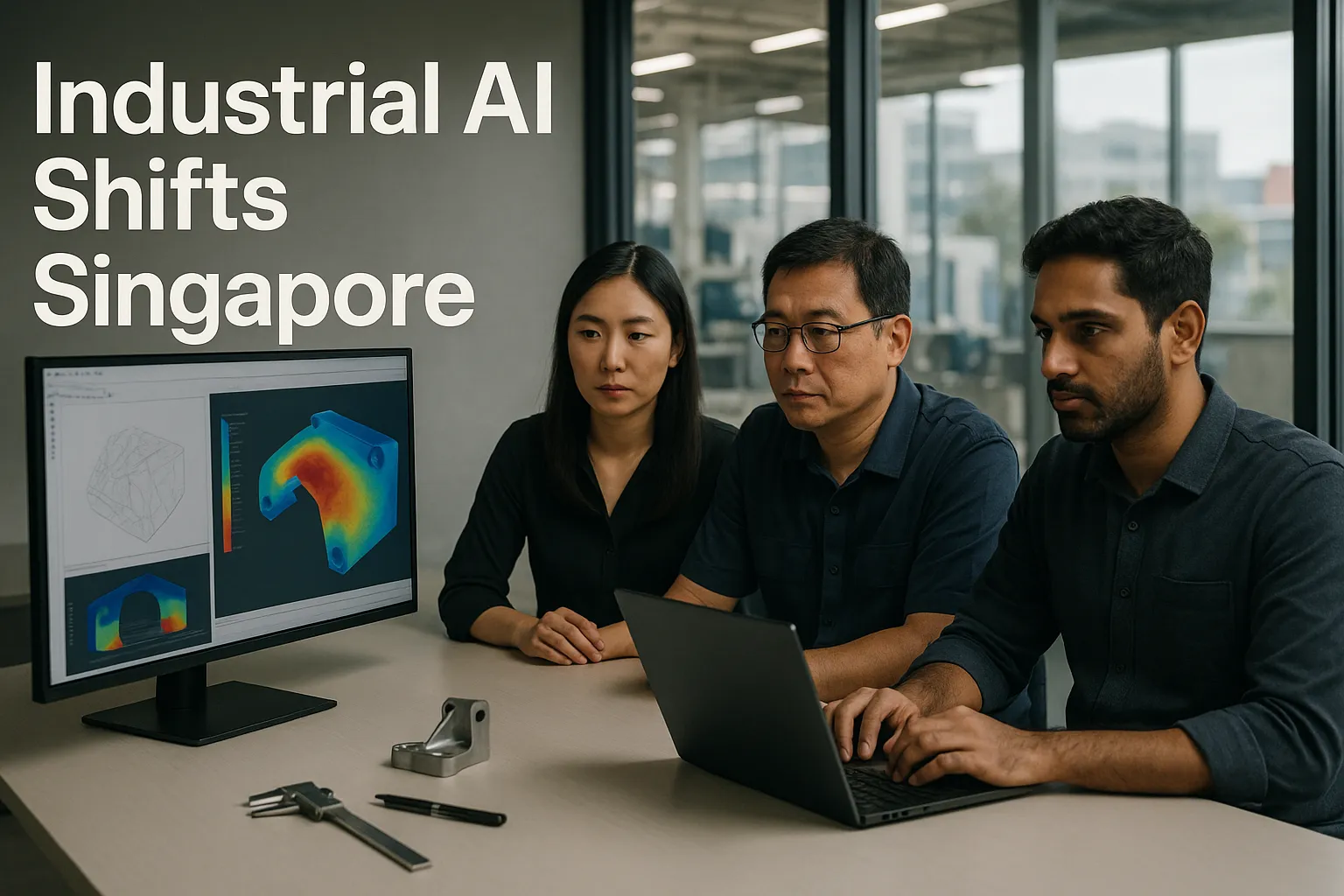
PhysicsX’s decision to deepen its APAC presence in Singapore is a useful signal—but the real story for operators is practical: “Singapore industrial AI” is shifting from generic analytics to domain-specific engineering tools that cut iterations, reduce scrap, and stabilise processes. For most industrial SMEs, the constraint is not ambition; it’s execution inside brownfield plants, mixed OT/IT stacks, and limited data engineering capacity—without disrupting production.
This guide is a Singapore-specific implementation playbook: how to pick the first pilot use case, what data and process discipline you need, how to choose build vs partner vs off-the-shelf, and how to prove ROI within 90–180 days. The goal is “more simulation, less guesswork”—with control points that plant leaders and finance teams can actually manage.
What does “domain-specific AI for engineering simulation” mean in practice (without getting lost in hype)?
Domain-specific AI in industrial engineering is not “a chatbot for engineers”. It is a workflow where AI helps you run more engineering tests (virtually), faster—so you learn sooner, fail cheaper, and lock down a process window with fewer surprises.
In practice, you’ll see four building blocks—often combined:
1) Physics-informed ML (PIML)
Models trained on plant/engineering data but constrained by known physics (mass/energy conservation, boundary conditions, material behaviour). This matters when you can’t afford a model that “fits the data” but violates reality.
2) Surrogate models for expensive simulations
Many firms already use CAE/CFD/FEA or process simulations, but runs can take hours or days. A surrogate model approximates the simulator output in seconds or minutes—good enough for screening, optimisation, and design-of-experiments.
3) Digital twins (practical, not perfect)
A digital twin is best treated as a decision model connected to a specific workflow (e.g., tune setpoints, reduce drift, or change recipe). Most SMEs don’t need a full-fidelity twin; they need a reliable model for one bottleneck.
4) Simulation acceleration and experimentation
The business value comes from multiplying experiments: exploring parameter space (temperatures, feed rates, tool wear, material lots) to find robust operating ranges.
What changes operationally:
- Your engineering team spends less time debating hypotheses and more time testing them.
- Quality and production teams get earlier warnings about drift and sensitivity.
- Finance gets a clearer link from engineering effort to measurable outcomes (yield, scrap, cycle time, warranty risk).
A useful mental model: If your process behaves like a “physics problem” (flows, heat, stress/strain, vibration, chemical kinetics), domain-specific AI tends to outperform generic approaches—because the model structure matches the mechanism.
Which use cases should a Singapore industrial SME pilot first to prove value quickly?
The first pilot should be chosen for implementation speed, not theoretical upside. A strong pilot has three traits: (1) a measurable pain point, (2) data you can access without a six-month integration project, and (3) a path to operational change (setpoints, spec limits, inspection rules, maintenance intervals).
Below are use cases aligned to “more simulation, less guesswork”, with notes on where they fit best across Singapore’s industrial base.
A) Virtual prototyping and tolerance/parameter sensitivity
Best for: precision engineering, aerospace components, marine systems, productised industrial equipment.
Pilot goal (90–180 days): Reduce physical prototypes or rework loops by identifying sensitive parameters early.
What it replaces: “Build-and-test until it works.”
Minimum viable scope: One part family, one failure mode (e.g., warpage, fatigue hotspot, leakage).
B) Accelerated design-of-experiments (DOE) for process window optimisation
Best for: semicon adjacent (packaging, test), specialty chemicals, advanced materials, high-mix machining.
Pilot goal: Find a wider, more stable process window (less drift, fewer excursions).
How AI helps: Surrogate models + constrained optimisation to run thousands of virtual DOE points.
C) Yield/quality drift diagnosis where physics matters
Best for: plants fighting intermittent defects: surface finish variability, bonding issues, dimensional drift, thermal distortion.
Pilot goal: Identify the few variables that drive most variance—and define a control plan.
Key requirement: You must be able to link defect measurements (metrology, CMM, inline inspection, test outcomes) back to process conditions.
D) Predictive maintenance for assets governed by physical degradation
Best for: rotating equipment, pumps, compressors, spindles, furnaces, thermal systems.
Pilot goal: Move from reactive breakdowns to planned interventions where the physics-based features are understandable (vibration signatures, thermal gradients, load profiles).
Avoid a common trap: Don’t start with “predict anything that might fail.” Start with one critical asset class and one failure mode.
A simple pilot selection scorecard (use this in a 60-minute management meeting)
Score each candidate 1–5:
- Business impact: scrap/yield, throughput, warranty, downtime
- Data accessibility: can you extract within 2–4 weeks?
- Actionability: can you change setpoints/spec/maintenance?
- Process ownership: is there a clear process owner on the shopfloor?
- Repeatability: can it be scaled to other lines/products?
Pick the highest combined score—not the most fashionable use case.
What data and process discipline do you need before you touch any model?
For SMEs, “data readiness” is rarely about having a data lake. It’s about making sure the data you already have can be trusted, joined, and interpreted.
Step 1: Map the decision workflow (not the dataset)
Before listing sensors and tables, write down:
- Decision to improve: e.g., “reduce bonding defects”, “stabilise thickness”, “reduce spindle downtime”
- Who decides: process engineer, production lead, quality manager
- What they change: recipe, feed/speed, temperature profile, inspection frequency
- When they change it: per lot, per shift, per setup, per maintenance cycle
If you can’t name the decision and decision-maker, the model won’t land.
Step 2: Define the “minimum viable dataset”
You need three data categories—often across different systems:
- Inputs: setpoints, machine states, operator actions, material lots
- Context: tool age, ambient conditions, shift, product variant
- Outputs: defect codes, yields, metrology, test results, downtime reasons
Brownfield reality in Singapore: These are usually split between PLC/SCADA, MES, ERP, LIMS/QMS, spreadsheets, and vendor equipment logs.
Step 3: Establish data traceability (the quiet killer)
Most pilots fail because you cannot reliably tie cause to effect.
Non-negotiables:
- A stable time base (timestamps, time zones, clock drift)
- A consistent unit discipline (°C vs K, mm vs inches, torque units)
- A join key: lot ID / work order / serial number / machine cycle ID
If you’re missing a join key, fix that first—even if it’s a manual workaround during the pilot.
Step 4: Put basic measurement governance in place
Not a bureaucracy—just control points:
- Who can change sensor calibration settings, and how changes are logged
- A “golden list” of critical tags/variables with definitions
- A simple anomaly protocol: what to do when data is missing or obviously wrong
Step 5: Capture process knowledge explicitly
Physics-informed approaches depend on knowing constraints and mechanisms.
Create a one-page “process physics sheet”:
- Known constraints (e.g., max ramp rates, safe pressure, material limits)
- Known couplings (e.g., temperature affects viscosity affects flow)
- Failure modes and their signatures
This is often faster than trying to learn everything from noisy data.
Where Paul Hype Page & Co. can help (when useful): many SMEs underestimate the operational load of data definition, change logging, and accountability. PHP often supports the project as a cross-functional PMO—aligning ops, finance, and governance so the pilot doesn’t stall on ownership or auditability.
How should you structure a 90–180 day pilot so it doesn’t derail production?
A pilot should be run like an engineering change—scoped, gated, and measurable. The goal is not a perfect model; it’s a decision improvement you can sustain.
Phase 0 (Week 0–2): Choose one bottleneck and lock scope
Deliverables:
- Use case statement: one defect/failure mode, one line or asset class
- Success metrics (baseline + target)
- Named owners: process owner (Ops), model owner (Eng), data owner (IT/OT), KPI owner (Finance/Quality)
Rule: If success metrics are not agreed in writing, your ROI discussion in month 4 becomes politics.
Phase 1 (Week 2–6): Data extraction, traceability, and baseline
Deliverables:
- Minimum viable dataset extracted and documented
- Baseline performance: defect rate, scrap cost, downtime hours, cycle time distribution
- First “sanity checks”: do variables behave as expected?
Tactic for brownfield plants: Use a “shadow pipeline” (separate from production systems) to avoid disrupting existing OT/IT.
Phase 2 (Week 6–12): Model build + engineering validation
Deliverables:
- A model that can answer one decision question (e.g., sensitivity ranking, recommended window)
- Validation against known events (past excursions, known good vs bad lots)
- Human review with engineers: does it match physical intuition where it should?
Control point: Require a “physics check” for any recommendation that seems too good to be true.
Phase 3 (Week 12–18): Controlled trial in production (limited blast radius)
Deliverables:
- A small-scope operational change: tighter setpoint guardrails, new inspection triggers, adjusted maintenance intervals
- A change log and rollback plan
- Measured outcome over enough cycles/lots to be meaningful
Do not switch everything at once. Use A/B or staged rollout by product family or shift.
Phase 4 (Week 18–26): Scale decision
Decide whether to:
- Scale to more lines/products
- Rebuild parts of the data pipeline
- Expand model scope (second defect mode, second asset type)
A scaling decision should require evidence: repeatability, stability, and a documented operating procedure.
What to avoid in pilots
- “We’ll integrate with everything later” (later becomes never)
- Proving accuracy in a notebook but not changing shopfloor behaviour
- Letting the pilot become a bespoke science project owned by one person
Pilot operating rhythm that works: weekly 30-minute triage (Ops/Eng/Quality/IT), monthly steering review (GM/Finance/Plant head).
How do you integrate simulation AI into OT/IT constraints common in Singapore plants?
Most SMEs are living with mixed vintages: older machines, vendor-locked controllers, partial MES adoption, and spreadsheet-based quality logs. Integration choices should be driven by reliability and change control—not elegance.
Integration pattern 1: “Sidecar analytics” (fastest)
- Pull data out (historian export, CSV drops, API where available)
- Build model and dashboards outside production control
- Feed back recommendations via engineering work instructions or review meetings
Good for: first pilots, sites with strict OT constraints.
Limitation: manual steps can cap scaling unless you standardise handoffs.
Integration pattern 2: “Decision support in MES/QMS” (operational)
- Model outputs become part of: lot release checks, inspection triggers, SPC rules
- Recommendations appear where operators already work
Good for: quality drift diagnosis, process window control.
Requirement: stable identifiers (lot/serial) and agreed thresholds.
Integration pattern 3: “Closed-loop control” (highest risk, highest payoff)
- Model drives automatic setpoint updates or control actions
Good for: mature environments only, after successful decision-support deployment.
Control expectations: formal change management, safety review, clear human override.
Practical OT/IT controls to plan upfront
- Network segmentation and access controls between IT and OT
- Vendor constraints: what data can you legally and technically extract?
- Patch and update policy: who can update the model runtime, and when?
- Incident handling: what happens if the model is unavailable?
Reality check: You can get meaningful ROI without touching closed-loop control in the first 6 months. Many SMEs win by improving engineering decisions and guardrails first.

How do you decide build vs partner vs generic tools—without locking yourself in?
Singapore teams often feel pressure to “own” AI capability, but scarce data engineering and MLOps talent makes full in-house builds risky. The right answer is usually a hybrid: partner for acceleration, retain control over data, interfaces, and acceptance criteria.
Option A: Partner with a deep-tech scale-up (PhysicsX-style capability)
Use when:
- Your advantage comes from better engineering outcomes, not building an AI platform
- You need physics-aware modelling expertise quickly
- You want to prove value before hiring a larger internal team
Risk controls:
- Define deliverables as workflows and decisions, not “a model”
- Insist on documentation: features, assumptions, validation results
- Contract for data handling, IP boundaries, and exit plan (see below)
Option B: Build in-house (selectively)
Use when:
- You have repeated use cases across product lines
- You can fund a small team for 12–18 months (not just one engineer)
- The model becomes a defensible capability tied to your niche
Common failure: hiring one “AI person” and expecting end-to-end delivery (data pipelines, modelling, UI, governance).
Option C: Use generic AI/analytics tools
Use when:
- The problem is primarily statistical monitoring (SPC improvements, anomaly detection) rather than physics-heavy simulation
- You can accept lower interpretability and weaker generalisation under process changes
Watch-out: tools optimised for office data can struggle with OT time series, event data, and traceability.
A practical decision filter (answer these in order)
- Is the mechanism physical and safety/quality-critical? If yes, lean physics-informed/engineering simulation approaches.
- Do we have reliable joins between inputs and outputs? If no, invest in traceability first.
- Do we need results in < 3 months? If yes, partner or use sidecar patterns.
- Will we repeat this across multiple lines/sites? If yes, plan for internal capability and standard interfaces.
How to reduce vendor lock-in while moving fast
Lock-in usually comes from data pipelines and interfaces, not the model itself.
Build these safeguards into the pilot:
- Your company retains a copy of the cleaned, documented dataset used to train/validate
- Model outputs are delivered via standard formats (CSV/JSON) and documented APIs where feasible
- Clear acceptance tests (accuracy, stability, false alarm rates, operating bounds)
- A transition plan: what happens if you switch vendor or bring it in-house?
This keeps you agile for APAC timelines where 2027 planning cycles demand speed but also continuity.
What does ROI look like for AI engineering simulation, and how do you prove it credibly to finance and investors?
Credible ROI is not “the model is 92% accurate.” It’s measurable operational improvement tied to cost and cash.
Start with a CFO-friendly value tree
Pick 1–2 primary levers and quantify them conservatively:
- Yield improvement / scrap reduction (materials, rework labour, disposal)
- Throughput / cycle time reduction (capacity release, overtime reduction)
- Prototype reduction (materials + engineering hours + lead time)
- Downtime reduction (lost output, expedite costs)
- Warranty/returns risk reduction (where traceable)
Then define what you can measure within 90–180 days.
Set up the baseline correctly (or your pilot results won’t be trusted)
- Use at least 8–12 weeks of historical data where available
- Separate special-cause events (major breakdowns, one-off supplier issue)
- Document any process changes during the baseline period
Choose “proof metrics” that match the decision
Examples:
- Process window optimisation: reduction in excursions beyond control limits; narrower distribution; fewer line stops
- Quality drift diagnosis: lower defect rate for targeted defect code; reduced variance on key dimensions
- Predictive maintenance: reduced unplanned downtime hours; improved mean time between failures
Use a staged ROI claim
In month 3–6, don’t overreach. Use three levels:
- Technical validity: model predicts/replicates known behaviour
- Operational adoption: engineers/operators use outputs in decisions
- Financial impact: measured improvement sustained over enough cycles
Cost items to plan (often missed in budgets)
- Data extraction effort (OT vendors, instrumentation checks)
- Engineering time for validation and controlled trials
- Change management: updated SOPs, training, shift handover rules
- Ongoing monitoring: drift detection, recalibration, exception handling
Where PHP can add value: As an advisory partner, Paul Hype Page & Co. often helps management translate engineering outcomes into finance-ready ROI narratives—linking KPIs to cost centres, budgeting the non-software work, and setting governance so reported gains stand up in board and investor discussions.
What governance, security, and people changes are needed so the pilot becomes a capability?
The biggest implementation risk is not model accuracy—it’s unmanaged change: unclear ownership, silent overrides, and “tribal knowledge” that disappears when a key engineer leaves.
Define ownership like an operations system
Assign these roles explicitly:
- Process Owner (Ops): owns the decision and the SOP
- Model Owner (Engineering/R&D): owns validation and change requests
- Data Owner (IT/OT): owns pipelines, access, uptime, tag definitions
- Quality Owner: owns spec/inspection impacts and nonconformance handling
- Finance Owner: validates savings methodology
Put a light model change control in place
You don’t need bureaucracy, but you do need traceability:
- Versioning: what model version was used when?
- Approval: who signs off before deploying a new version?
- Monitoring: what triggers review (performance drift, new product mix, new supplier)?
Security and confidentiality controls (practical, not theoretical)
- Least-privilege access to OT data
- Clear data classification (especially customer-related or controlled technical data)
- Vendor access logging and time-bounded credentials
- Where data is stored and processed (cloud/on-prem), aligned with customer obligations
Be careful about sharing controlled design data across borders if your customer contracts restrict it—this is often more relevant than general regulation.
Training that actually sticks
Avoid generic “AI awareness” training. Train on the workflow:
- What the model outputs mean
- When to trust it and when to escalate
- How to record decisions and outcomes
A good sign of readiness: shift leads can explain the new guardrail in plain language.
Plan the “second use case” early
Scale happens when you reuse:
- the same identifiers and traceability pattern
- the same data definitions
- the same validation and change control process
Treat your first pilot as building a reusable implementation template, not a one-off win.
What should your 2027 planning roadmap look like if you want a sustained advantage (not a one-time pilot)?
If the pilot works, the next risk is sprawl: too many use cases, inconsistent data definitions, and fragmented vendors. For 2027 planning, SMEs should aim for a small portfolio of repeatable simulation-AI workflows.
0–3 months: Decide where you will compete with “more simulation, less guesswork”
- Pick 1–2 domains (e.g., thermal processes, rotating equipment, dimensional stability)
- Align with product strategy and customer requirements
- Set an internal standard: identifiers, timestamp discipline, defect taxonomy
3–9 months: Build a repeatable pipeline and operating cadence
- Standard connectors or extraction routines for key equipment families
- A common feature store / dataset documentation approach (simple is fine)
- Monthly performance reviews: model performance + operational KPI movement
9–18 months: Scale across lines/sites and harden governance
- Expand to adjacent lines where the physics is similar
- Tighten change control and cybersecurity controls as scope grows
- Decide internal capability build: hire 1–2 key roles only after workflows are proven
18–24 months: Decide what you want to own
- Own the workflow, acceptance tests, and operational playbooks
- Consider owning core models only where it becomes your defensible edge
A useful boundary for SMEs: You don’t have to become a software company to win. But you do have to become disciplined about data, decisions, and repeatable engineering learning loops.
This is where Singapore’s ecosystem matters: deep-tech scale-ups, universities, and applied innovation programmes exist—but the SMEs that benefit are the ones that can execute internally with clear owners, clean traceability, and a measured scaling plan.
Conclusion
For Singapore industrial SMEs, the practical takeaway from PhysicsX’s APAC bet is not to chase hype—it’s to operationalise domain-specific AI where physics and engineering decisions drive cost, yield, and time-to-market. The fastest path is a tightly scoped 90–180 day pilot anchored to one bottleneck, with disciplined traceability, clear decision ownership, and a controlled production trial.
If you’re planning for 2027, treat the first pilot as the template for a repeatable capability: standard identifiers, light governance, integration patterns that respect OT constraints, and an ROI method your finance team trusts. Where internal capacity is thin, partnering can accelerate outcomes—provided you protect portability through documented datasets, interfaces, and acceptance tests. Paul Hype Page & Co. can support that bridge from engineering ambition to execution: scoping, KPI/ROI framing, operating cadence, and governance that makes results stick without disrupting production.
FAQs
Choose one bottleneck with clear KPIs and accessible data—common fast starters are accelerated DOE for process window optimisation, virtual prototyping for one part family, physics-driven quality drift diagnosis, or one-asset/one-failure-mode predictive maintenance.
Baseline current performance, pick 1–2 value levers (yield/scrap, throughput, prototypes, downtime), and report in stages: technical validity, operational adoption, then measured financial impact sustained over enough lots/cycles with a documented change log.
It uses physics-informed and simulation-based models (including surrogates and practical digital twins) to run many more virtual tests faster, so teams can optimise designs and process windows with fewer physical iterations and less scrap.
Define the decision workflow, assemble inputs/context/outputs, and enforce traceability: consistent timestamps, units, and a join key (lot/work order/serial/machine cycle) linking process conditions to quality or downtime outcomes.
Start with a “sidecar” setup that extracts data into a shadow pipeline and returns recommendations via engineering workflows; move to MES/QMS decision support once identifiers and thresholds are stable, and only consider closed-loop control after proven production trials and change control.
Share This Story, Choose Your Platform!
Related Business Articles