Singapore Company Incorporation

Are You Positioned for Singapore’s 2026 AI‑Driven GDP Boom—and What Should You Do Now to Incorporate, Hire, Bank, and Scale Safely?

The Singapore GDP 2026 forecast points to AI-driven productivity and stronger trade flows—but growth only helps if your back office can keep up. Here’s what to do in 2025 to incorporate correctly, plan tax and accounting, secure key hires, open the right bank accounts, and scale with audit-ready controls.

2026-03-23T11:28:49+08:00

Are Business Closures in Singapore a Warning Sign for Your 2026–2028 Plan?

Rising business closures in Singapore aren’t a prediction—they’re a prompt to tighten reporting, cash runway visibility, and decision triggers before pressure forces reactive cuts. Learn the red flags to watch, how stronger accounting and compliance improves outcomes, and when regional expansion (Malaysia, Indonesia, Hong Kong) can diversify risk for 2026–2028.

2026-03-11T11:59:24+08:00

How Should Singapore Businesses Plan for Singapore Budget 2026’s AI Incentives, 40% Corporate Tax Rebate, and Overseas Expansion Support?

Singapore Budget 2026 rewards SMEs that can prove real AI, productivity, and overseas expansion investments—backed by clean accounting and compliant documentation. This guide shows how to plan for AI-related deductions, the 40% corporate tax rebate, and a stronger MRA Grant Application so claims are defensible and approvals are faster.

2026-03-05T09:43:18+08:00

How Do US–Asia Tariffs in 2025–2026 Change Trade Strategy – and Why Does Singapore Company Incorporation Still Look Attractive?

US–Asia tariffs in 2025–2026 are pushing founders and finance teams to rethink contracting, inventory ownership, transfer pricing, and documentation—not just landed cost. Singapore company incorporation can still be attractive as a neutral, rules-based regional hub when paired with strong accounting, tax governance, and real operational substance.

2026-02-04T11:25:10+08:00

How Should Singapore SMEs Use the MAS Consumer Price Developments Report to Plan Budgets, Pricing, and Payroll for 2026?

The MAS Consumer Price Developments report is a practical benchmark Singapore SMEs can use to stress-test 2026 budgets, pricing, and payroll—beyond headline inflation. This guide shows how to translate category-level inflation signals into defensible P&L and cash flow assumptions, contract updates, and salary review frameworks.

2026-01-05T22:00:20+08:00

How Should Foreign Founders Structure a Singapore Company in 2026 to Stay Tax-Ready and Work Pass-Ready?

Foreign founders setting up a Singapore company in 2026 must think beyond incorporation and focus on tax readiness and work pass eligibility from day one. This guide explains how to structure your Singapore company to meet IRAS expectations, support Employment Pass approval, and avoid costly restructuring later.

2026-01-02T10:43:10+08:00

ACRA’s 2025 Reporting Changes: What SMEs Must Do Now to Prepare for Stricter 2026 Compliance

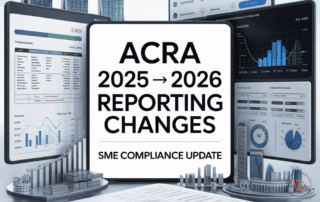
ACRA’s 2025 reporting updates mark a major shift in Singapore’s financial compliance standards, particularly for SMEs preparing their year-end accounts. This article explains the updated requirements and outlines how businesses can prepare for stricter enforcement in 2026.

2025-12-01T16:15:44+08:00

Why Is Singapore’s Record 2025 Private Sector Growth a Strategic Moment for Foreign Entrepreneurs?

Singapore’s labour market continues to expand, but wage growth is projected to slow sharply in 2026, creating a rare window for founders to build teams at more sustainable cost levels. For new and foreign-owned companies, this shift offers a strategic opportunity to establish operations before manpower pressures rise again.

2025-11-24T17:06:45+08:00

Why Foreigners Trust Professional Accounting Firms for Nominee Directors in Singapore (2025 Guide)

Foreign entrepreneurs in Singapore often rely on trusted accounting firms to provide nominee directors who safeguard their business reputation and ensure full compliance with ACRA and banking regulations. By partnering with a licensed Corporate Service Provider like Paul Hype Page & Co., foreigners can avoid legal risks, maintain transparency, and build a credible foundation for long-term business success.

2025-11-24T17:06:49+08:00

Singapore AML/CFT 2025: How Businesses Can Stay Compliant with MAS and ACRA Regulations

The Monetary Authority of Singapore (MAS) has introduced comprehensive updates to its AML/CFT framework, tightening compliance standards across financial institutions and Corporate Service Providers (CSPs). These reforms aim to strengthen transparency, accountability, and risk management — reinforcing Singapore’s position as a trusted global financial hub.

2025-11-24T17:06:50+08:00
Go to Top