Outline
- What does Singapore typically look for beyond English language ability in PR and citizenship cases?
- How are Singapore PR requirements commonly interpreted for professionals in 2026–2028?
- How does Singapore citizenship eligibility differ from PR in practical terms?
- Why is economic contribution such a central factor for PR and citizenship outcomes?
- How does an Employment Pass strategy shape an Employment Pass to PR Singapore pathway?
- How do “Accounting compliance Singapore” and tax filings affect PR and citizenship credibility?
- How can foreign entrepreneurs align “Foreign entrepreneurs Singapore PR” goals with real operating substance?
- What should you consider when planning “Singapore business setup foreigners” for long-term residency goals?
- How does community integration show up in PR and citizenship cases without becoming performative?
- What documents and records should you keep to support a stronger narrative over time?
- What are common PR/citizenship planning mistakes to avoid in 2026?
- Conclusion
- Want a clearer PR/citizenship narrative by 2026–2028?
- FAQs
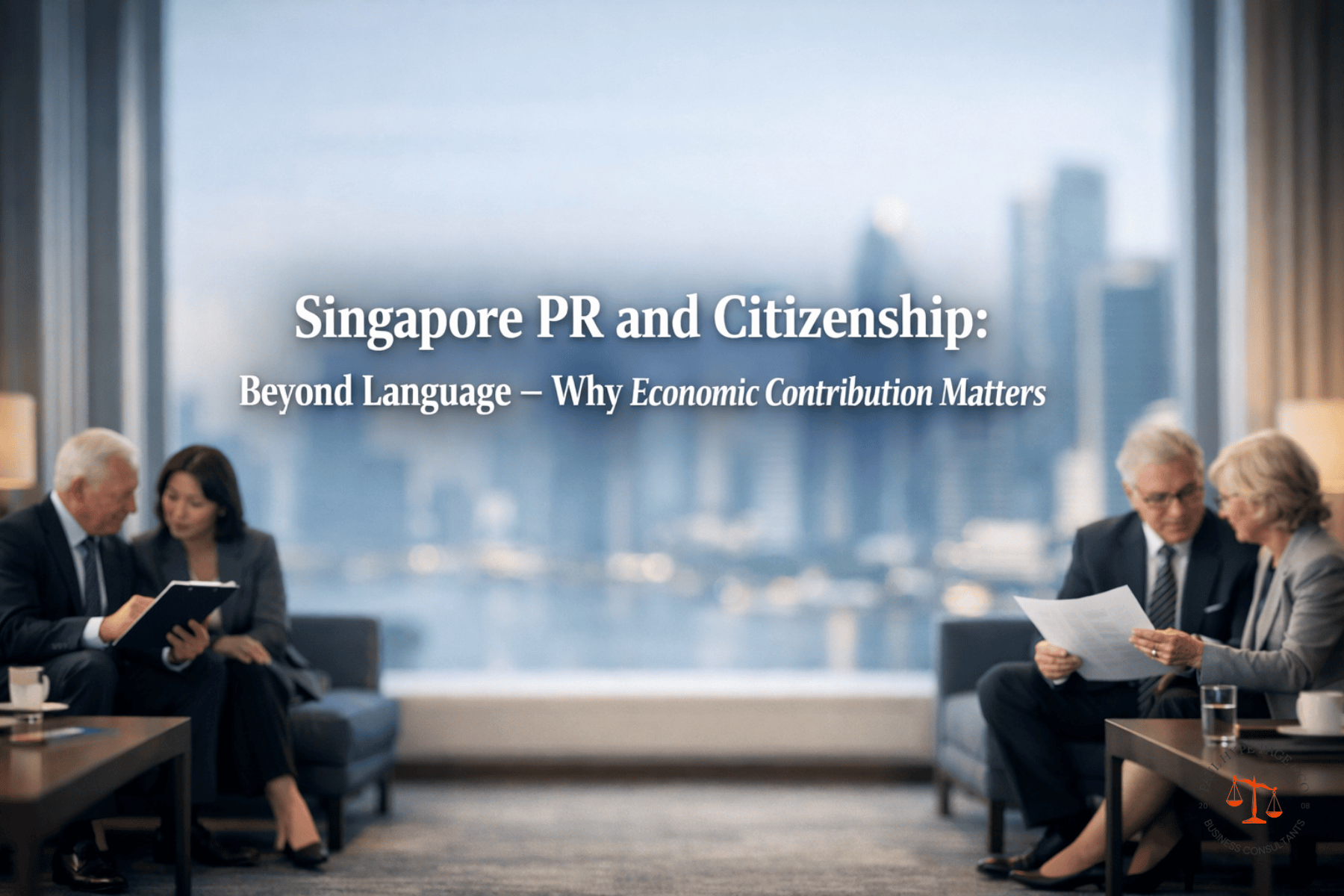
Singapore’s residency pathways are often discussed in terms of language ability, academic qualifications, or “profile strength.” In practice, however, Singapore PR requirements and Singapore citizenship eligibility are typically assessed through a broader, evidence-based view of how an applicant contributes over time—economically, professionally, and socially. With tighter global mobility, evolving hiring practices, and continued emphasis on sustainable growth, 2026–2028 planning increasingly comes down to demonstrating stable employment, credible income, compliant tax reporting, and real integration into Singapore life. For professionals and founders, this is where an Employment Pass strategy, consistent accounting compliance in Singapore, and well-structured operations matter: the paper trail you build through legitimate work, accurate filings, and ongoing local activity often becomes the narrative of your long-term commitment.
What does Singapore typically look for beyond English language ability in PR and citizenship cases?
When people search “English language Singapore PR,” they often assume language is a primary pass/fail factor. In reality, language is usually one indicator among many.
In practice, Singapore tends to assess whether an applicant is likely to:
- Contribute economically in a sustainable way
- Integrate into society (family ties, schooling, community participation)
- Maintain stable employment or credible business activity
- Comply with laws and public obligations, including taxes and corporate filings where relevant
Why “economic contribution” often outweighs language
Language can help with integration and employability, but economic contribution is easier to evidence and track. Immigration authorities can typically verify:
- Employment history and industry relevance
- Income consistency and progression
- CPF history (where applicable)
- Personal income tax filings
- Business activity (for founders) through corporate filings and tax positions
A practical way to think about the assessment
Instead of asking “Do I meet one criterion?”, it is more useful to ask:
- Do my documents tell a consistent story of long-term Singapore-based work or business?
- Does my profile show stability, progression, and low risk?
- Are there gaps, inconsistencies, or compliance issues that raise questions?
For many applicants, the limiting factor is not English. It is a weak or inconsistent economic narrative (job hopping without clear progression, unclear income, or a business with thin local substance).
How are Singapore PR requirements commonly interpreted for professionals in 2026–2028?
There is no single public checklist that guarantees PR approval, and requirements can be applied differently based on nationality, sector, and overall profile. Still, applicants generally benefit from aligning with the most consistently observable themes.
Core themes that tend to matter
- Stable Singapore-based employment (role continuity and relevance)
- Income level and trajectory (not just a one-off high salary)
- Skill scarcity or strategic sector alignment
- Family context (spouse/children, schooling in Singapore)
- Integration indicators (community involvement, long-term plans)
What “stable employment” looks like on paper
Stability is usually evidenced through:
- Clear appointment letters and job scope
- Consistent monthly salary records
- Employer credibility (business activity, filings, headcount consistency)
- Logical career progression across roles
Common professional mistakes that weaken an application
- Treating PR as a “time served” outcome (e.g., “I have been here two years, so it should be fine”)
- Switching jobs frequently without a coherent progression story
- Salary structure that looks artificial (e.g., unusually high allowances without clear rationale)
- Inconsistent personal tax filings or late submissions
For candidates mapping Employment Pass to PR Singapore, the strongest profiles are often those where the EP role is clearly legitimate, well-scoped, and supported by clean payroll and tax reporting—rather than a role created mainly to obtain residency.
How does Singapore citizenship eligibility differ from PR in practical terms?
Singapore citizenship eligibility is often discussed as a “next step” after PR. In practice, citizenship is typically assessed as a deeper commitment decision.
Practical differences in how cases are viewed
While PR focuses on whether the applicant is a good long-term resident, citizenship decisions often emphasise:
- Rootedness: family life, children’s schooling, long-term housing plans
- Sustained contribution: longer track record of work, taxes, and social integration
- National interest considerations that can vary by period
What applicants often underestimate
- Citizenship is not automatic after PR, even after several years
- Authorities may scrutinise consistency across years (work history, income, and integration)
- A “paper-only” Singapore presence (frequent time abroad, limited community ties) can dilute the narrative
2026–2028 planning note
If citizenship is a longer-term goal, aim to build a multi-year record that is consistent and easy to verify:
- Stable employment or business operations
- Clean, on-time tax and compliance filings
- Documented integration (where relevant and genuine)
This is also where good recordkeeping matters. If your employment documentation, payroll records, or tax filings are messy, you may end up spending months reconstructing evidence later.
Why is economic contribution such a central factor for PR and citizenship outcomes?
Economic contribution is central because it is measurable and forward-looking. It helps authorities evaluate whether an applicant is likely to remain employable, contribute taxes, and participate productively in the economy.
The types of contribution that are easier to evidence
For employees:
- Stable salary and job scope
- Industry relevance and skills
- Personal income tax compliance
For founders:
- Operating revenue and business substance
- Hiring and local team development (where feasible)
- Corporate income tax filings and statutory compliance
- Clear separation of personal vs corporate finances
Example: two applicants with similar education
Applicant A:
- Stable role for 3+ years, consistent salary progression
- Clear tax filings and payroll records
- Employer is compliant and active
Applicant B:
- Multiple short stints, inconsistent pay structure
- Gaps in tax filings or unclear income sources
- Employer has weak compliance history
Even if both applicants speak fluent English and have strong degrees, Applicant A usually has a cleaner, lower-risk economic narrative.
What to avoid
- Over-optimising a profile with “cosmetic” signals (titles, inflated compensation) without underlying substance
- Underestimating the impact of non-compliance (late filings, inaccurate statements)
For many cases, the strength is less about one big achievement and more about consistent, verifiable contribution over time.

How does an Employment Pass strategy shape an Employment Pass to PR Singapore pathway?
An Employment Pass is not a PR guarantee, but it can be a strong foundation when the role is credible and properly supported.
What makes an EP role “credible” in a PR context
- The job scope is specialised and aligned to the candidate’s background
- Compensation is consistent with market norms and the company’s ability to pay
- The employer has real operations (clients, revenue, staff, compliance track record)
- The candidate’s responsibilities are evidenced (projects, reporting lines, organisational charts)
EP vs S Pass: why the distinction matters (without oversimplifying)
MOM work pass criteria evolve over time, and pass type is not the only factor. Still:
- EP roles are typically assessed as higher-skilled professional positions
- S Pass roles may suit certain technical or mid-skilled profiles
From a narrative standpoint, PR applications often benefit when the applicant’s work pass history is coherent with their role seniority and progression.
Common mistakes employers and candidates make
- Job titles that do not match actual duties
- Under-documenting job scope (no clear KPIs, reporting line, or project evidence)
- Payroll practices that look inconsistent (e.g., irregular variable payments without policy)
Practical 2026 prep
If you are building toward PR:
- Keep job scope documentation updated (especially after internal role changes)
- Maintain consistent payroll practices and retain payslips
- Ensure personal income tax filings match employment income
- If switching companies, prepare a clear “why” story tied to progression
Firms like Paul Hype Page & Co. (PHP) often support employers and professionals with work pass strategy (EP vs S Pass), helping align role design, documentation, and compliance so the position stands up to scrutiny over time.
How do “Accounting compliance Singapore” and tax filings affect PR and citizenship credibility?
Applicants often think accounting and tax are “company matters” and unrelated to immigration outcomes. In practice, documentation and compliance form part of the credibility layer—especially for founders and senior hires.
For employees: why personal tax compliance matters
Your Notice of Assessment and tax filings help confirm:
- Income consistency over time
- Whether employment income is properly declared
- Whether there are unexplained income gaps
Late filing or discrepancies do not automatically mean rejection, but they can create avoidable questions.
For founders and directors: why corporate compliance becomes part of the story
For founder applicants and key appointment holders, authorities may look at whether the business:
- Files annual returns and maintains statutory registers
- Prepares proper financial statements
- Submits corporate income tax filings on time
- Runs payroll properly (where applicable)
This is where accounting compliance Singapore becomes a practical residency factor: clean books and timely filings help demonstrate that the business is real, ongoing, and responsibly operated.
Common compliance mistakes that create problems later
- Mixing personal and business expenses, making financials hard to defend
- Treating bookkeeping as “year-end only,” leading to weak audit trails
- Late ACRA filings or unresolved compliance notices
- Paying salary without a consistent payroll process
2026–2028 planning: build an evidence-ready finance trail
- Move to monthly bookkeeping (not quarterly scrambling)
- Keep invoices, contracts, and bank narratives clear
- Ensure remuneration policies are documented for directors and key staff
- Prepare for questions about business substance (customers, headcount, office arrangements)
PHP’s accounting, tax, payroll, and audit-readiness support is typically most valuable when implemented early—before you need to rely on the records to support a residency narrative.
How can foreign entrepreneurs align “Foreign entrepreneurs Singapore PR” goals with real operating substance?
Foreign entrepreneurs often face a balancing act: running lean while also demonstrating meaningful Singapore-based activity.
What “substance” can look like for a small but real business
Substance is not only about headcount or large revenues. Depending on the model, credible substance may include:
- Active client contracts and recurring invoices
- Clear delivery evidence (project plans, reports, milestones)
- Local banking activity that matches the business model
- A realistic founder salary policy (if drawing remuneration)
- Singapore-based partners, vendors, or professional services support
Concrete example: consultancy vs trading company
A consultancy may have:
- Fewer employees
- Higher margin, project-based revenue
- Strong documentation through statements of work and deliverables
A trading company may need:
- Inventory or logistics trails
- Purchase orders, shipping documents
- Clear gross margin explanations
Both can be credible, but the evidence differs. Weak evidence (e.g., only a company bank account with limited transactions) often undermines the “economic contribution” argument.
Common founder errors that weaken PR credibility
- Incorporating a company but operating mainly overseas
- Minimal invoicing in Singapore while claiming Singapore as business base
- Paying oneself irregular amounts without payroll records
- Under-investing in corporate secretarial compliance
How PHP support fits naturally
Many founders need coordination across incorporation, corporate secretarial, accounting, and tax. A structured approach helps ensure your business setup supports real operations—and that your filings reflect those operations accurately.
What should you consider when planning “Singapore business setup foreigners” for long-term residency goals?
Singapore business setup for foreigners is often framed as speed and convenience. For PR/citizenship planning, the more important lens is: will the structure and operations look coherent and sustainable over multiple years?
Structuring points that often matter in practice
- Who owns the shares, and why that split is commercially logical
- Who is appointed as director(s), and whether duties are real and documented
- Whether the company’s principal activities match its revenue reality
- Whether cross-border flows (management fees, royalties, intercompany charges) are defensible
Don’t treat incorporation as the end of the work
After incorporation, what strengthens credibility is operational follow-through:
- Proper contracts with customers/suppliers
- A clear invoicing and collections process
- A consistent payroll approach
- Timely ACRA and IRAS filings
Common incorporation mistakes seen with foreign founders
- Using template activities that do not match what the company actually does
- Ignoring ongoing compliance until a bank, investor, or pass application forces cleanup
- Setting up cross-border payments without transfer pricing or documentation discipline
2026–2028 prep guidance
If you are incorporating in 2026 with a view to PR later:
- Decide early where the real management and control sits
- Build a clean transaction trail from day one
- Keep board decisions and contracts organised
- Align the founder’s remuneration with actual business cash flow and policy
PHP’s company incorporation & structuring work (including multi-country setups) is often used to ensure the Singapore entity fits into the broader regional plan without creating compliance weak points later.
How does community integration show up in PR and citizenship cases without becoming performative?
Integration is real, but it is also easy to misunderstand. Authorities may consider whether your life is genuinely anchored in Singapore.
Integration signals that are typically “quiet but credible”
- Family life in Singapore (spouse employment, children in school)
- Stable housing arrangements and time spent in Singapore
- Participation in professional associations or community initiatives aligned to your real interests
What to avoid
- Token activities done purely to “check a box”
- Over-claiming involvement without documentation or consistency
Practical tip
Keep simple records where appropriate:
- Membership confirmations
- Volunteer letters (if genuine)
- School letters for children
Integration evidence is usually supporting material. The core of many successful cases remains stable economic contribution backed by consistent documentation.
What documents and records should you keep to support a stronger narrative over time?
Many rejections and delays are not due to a lack of merit but due to weak documentation, inconsistencies, or missing records.
For employees (PR/citizenship planning file)
- Employment contracts and updated job descriptions
- Payslips and CPF-related records (if applicable)
- Personal income tax assessments
- Performance reviews or project evidence (selectively)
- Education certificates and professional licences
For founders/directors
- ACRA filings (annual returns, updates)
- Financial statements and management accounts
- Corporate income tax filings and key tax computations
- Payroll records for employees and directors
- Key contracts, invoices, and bank statements
- Board resolutions for major decisions
A common problem: inconsistent numbers
If your declared income, payslips, and tax assessments don’t align, it creates an avoidable credibility gap.
This is one reason finance teams and founders often invest in tighter bookkeeping and payroll processes well before a PR or citizenship attempt. PHP teams commonly help by putting the recordkeeping on a monthly cadence, aligning payroll, and preparing the company for questions that may arise in future applications.
What are common PR/citizenship planning mistakes to avoid in 2026?
The most costly mistakes are the ones that take years to undo.
Mistake 1: Treating PR as a one-time application project
PR readiness is often a multi-year record. Rushing to apply without fixing underlying gaps can lead to rework.
Mistake 2: Undervaluing compliance hygiene
Late ACRA filings, messy accounts, or unclear tax positions can become distractions when you need a clean narrative.
Mistake 3: Artificial compensation structures
Overly complex pay packages (large allowances, inconsistent variable pay) can create questions. Keep remuneration logical and document policies.
Mistake 4: Thin business substance for founders
A company that exists on paper but operates elsewhere is a common weak point for foreign entrepreneurs Singapore PR goals.
Mistake 5: Poorly managed role changes
Promotions, lateral moves, and internal transfers should be documented. Keep job scopes and organisational charts updated.
A practical “2026 readiness checklist”
- Confirm your work pass role, salary, and scope are coherent and documented
- Align payroll records with tax filings
- Ensure the company’s accounting compliance Singapore obligations are met on time
- Maintain consistent records of residence and integration activities
- Avoid abrupt, unexplained changes (job, salary, business model) right before applying
Conclusion
Singapore PR and citizenship outcomes are rarely determined by one factor such as English ability alone. In 2026–2028 planning, applicants generally benefit most from building a clear, consistent record of economic contribution: stable employment or credible business operations, backed by clean documentation, timely tax reporting, and ongoing compliance. For professionals, a well-structured Employment Pass role and coherent career progression can strengthen the “Employment Pass to PR Singapore” narrative. For founders, real operating substance, disciplined bookkeeping, and proper corporate secretarial maintenance help demonstrate that the business is genuine and sustainable. If you are mapping out your long-term presence in Singapore, it is usually worth treating work pass strategy, accounting, and business setup as interconnected building blocks rather than separate tasks—so your profile remains consistent, defensible, and ready when you choose to apply.
FAQs
Keep a “ready file” that includes employment contracts/job descriptions, payslips, tax assessments, and (for founders) ACRA filings, financial statements, corporate tax filings, key contracts/invoices, and board resolutions—so your story is consistent and easy to verify.
Yes – especially for founders, directors, and senior hires. Clean personal tax filings, timely ACRA/IRAS submissions, consistent payroll records, and defensible financial statements reduce “credibility gaps” that can trigger questions.
A credible EP role can strengthen your long-term narrative when the job scope matches your background, pay is market-aligned, and the employer’s operations and compliance are solid. An EP role that looks artificial or poorly documented can weaken credibility.
It generally means sustained, measurable participation in Singapore’s economy over time—e.g., credible employment, consistent income progression, tax contributions, and (for founders) real business activity supported by filings and records.
Usually not on its own. Language can support integration, but authorities typically weigh verifiable factors more heavily—like stable work history, income consistency, and compliance.
Share This Story, Choose Your Platform!
Related Business Articles